Atom transport by AOD tweezers (zoned architecture) cx_aod
Crossed acousto-optic deflectors move tweezers to shuttle atoms between storage, entangling and readout zones at ~99.95% per move.
Atom transport by AOD tweezers (zoned architecture)
Coherence-preserving moves of 100s µm in 0.4–1.6 ms at ~99.95%; storage/entangling/readout zones.
Brief →Key references
Design space — attributes
- (a) carrier affinity
- natural
- (b) time · entangling
- 1.0 ms
- (c) readout
- —
- (d) mobility
- physical transport
- (e) control
- —
- (f) error structure
- loss (erasure)
- (g) manufacturing
- optical / mechanical assembly
Evaluation space — dated attributes
Harvard's continuously reloaded 3,000-atom system moves atoms ~0.5 m on optical-lattice conveyor belts, using AOD tweezers only for local rearrangement. TU/e's 3D acousto-optic lensing (arXiv:2510.09398) is a design study [S] with no atoms.
Standard records
Actors & goals — annotations
Edges
Used by 23 machines (22 primary · 1 alternate)
- neutral atoms 23
- Magne Atom Computing + Microsoft, for QuNorth press press ▨ 🔎
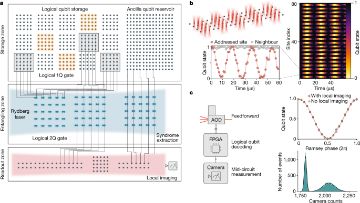
- Phoenix (Gen-1) and Gen-2 Atom Computing press press ▣ Fig. 1b (movable tweezers between zones) ✅
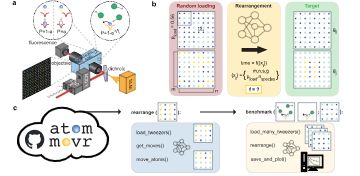
- 6,100-qubit tweezer array Caltech (Endres group) paper paper press ▣ Fig. 1c (two-SLM tweezer generation, NA 0.65 objective, 1.5 mm FOV); Fig. 5a-b (AOD transport up to ~610 um, cylindrical lensing) ✅
- Hanyuan-1 Zhongke Kuyuan (Wuhan, CAS) press press ▨ 🔎
- Hanyuan-2 Zhongke Kuyuan (Wuhan, CAS) press press ▨ 🔎
- 448-atom fault-tolerant processor Harvard / MIT / QuEra paper press ▣ Fig. 1 (storage, entangling, readout, reservoir zones) ✅
- Infleqtion Illinois neutral-atom quantum computer (IQMP, Chicago) Infleqtion press ◌ 🔎
- Sqale Infleqtion press ▣ Fig. 1a–b (6 qubits in hexagonal lattice, 6 µm); Methods: Qubit array generation ✅
- 72-qubit neutral-atom (Rb) quantum computer prototype (50 qubits in Dec 2024) Lomonosov Moscow State University with the Russian Quantum Center ◌ 🔎
- Pasqal Centaurus Pasqal product page press ◌ 🔎
- Fresnel / Fresnel 2 Pasqal ▣ Fig. 3a (SLM microtraps + 2D AOD moving tweezers); Fig. 5a-b (moving an atom between sites <1 ms; rearrangement into a defect-free sub-register); Fig. 4 (2D/3D tweezer arrays); §2.1.1 Register loading ✅
- Pasqal Lyra Pasqal press ◌ 🔎
- Orion Alpha / Beta ("Ruby") / Gamma Pasqal product page press press ▤ § The Neutral Atom Architecture 🔎
- Vela Pasqal blog ▦ §Next-Gen of Pasqal's Quantum Computers (all-to-all connectivity with no cryogenics) ✅
- DiNAQC planqc, for the DLR Quantum Computing Initiative product page press link ▦ 🔎
- metastable Yb-171 erasure array Princeton (Thompson group) paper paper paper ▣ Fig. 1a,e (AOD coherent transport, polarization); §II Results ✅
- Qinghe-1 (Qinghe No. 1, 清河一号) Zhongqi Wuliang (Shanghai, CAS SIOM spin-off) press press ▨ 🔎
- Aquila QuEra paper press ▣ Fig. 1.4 (arbitrarily positioned atom arrangements via reconfigurable tweezers); Fig. 1.5 (deterministic loading of an 11x11 lattice); Fig. 1.6 (atom geometry constraints: sites in rows); §Key ingredient: FPQA with arbitrary geometry and optical tweezers ✅
- Gemini-class QuEra paper product page ▣ Extended Data Fig. 2; Fig. 1c (right); Extended Data Fig. 1c ✅
- Libra QuEra press ▨ ✅
- Quantum X Labs neutral-atom platform (50+ qubits, claimed) Quantum X Labs Inc. (Nasdaq: QXL) press link ▨ 🔎
- neutral-ytterbium QPU Yaqumo (+ Fujitsu) press press ▨ ✅
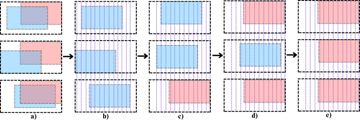
- continuously reloaded 3,000-atom machine Harvard / MIT paper paper ▣ Fig. 2a (zone architecture: lattice reservoir, 1,440-site preparation zone, 3,240-site storage zone); Extended Data Fig. 6 (Preparation zone atom rearrangement and iterative assembly); Methods: Atom Rearrangement ✅ (alternate)
Pictures
Every picture carries the story of what it shows and its credit line.
Atom transport by AOD tweezers (zoned architecture)
Crossed acousto-optic deflectors move tweezers to shuttle atoms between storage, entangling and readout zones at ~99.95% per move.
Verdict. Real: 610 µm in 1.6 ms at 99.95% survival; 448 atoms under fault-tolerant control. Unverified: AOD channel bandwidth past 10⁴ atoms. Demote if no >10³-atom zoned system runs long-memory QEC by 2028.
Λ = error-suppression factor per code-distance step; QBI = DARPA Quantum Benchmarking Initiative (Stage A concept → B R&D plan → C government V&V); G1–G7 = the report's goal classes (see Actors & economics).
Identity & lineage
An rf tone in a crystal makes an acoustic grating whose first-order diffraction angle tracks the tone, so sweeping the rf sweeps a tweezer and the atom in it; crossed x/y deflectors turn a comb of tones into a grid of movable traps. The zoned architecture partitions the plane into storage, entangling and readout regions, taking connectivity from moving atoms rather than fixed couplings — introduced by Bluvstein et al.'s 2022 coherent-transport processor (Harvard/MIT).
Attributes. Mobility: transport — atoms relocate hundreds of µm between zones, the platform's only long-range coupling. Time ~10⁻³ s per move, classical repositioning, neither deterministic nor heralded entanglement; the error is loss, not phase.
Physics & limits
Two clocks bound a move: acoustic transit across the beam aperture sets how fast a tone can change (µs for millimetre apertures), and trap radial frequency sets how fast the atom can accelerate without heating out. The second dominates — transport error is release-and-recapture loss driven by trajectory jerk, so minimum-jerk profiles and deeper transit traps, not faster electronics, buy fidelity. Measured: 610 µm in 1.6 ms at 99.95%, 270 µm in 400 µs at 99.8% D[138].
Coherence is not binding here: hyperfine T2 is 12.6 s in the same 6,100-atom array D[138] and 1.09(3) s under dynamical decoupling in a continuously reloaded 3,000-atom system D[144]. So the signature is loss — detectable by imaging, hence erasure-convertible, and over 80% of all leakage; used as a supercheck with ML decoding it gave 2.14(13)× suppression at d=3→5 D[4]fact. What moves the floor: minimum-jerk trajectories, deeper transit traps, and an acousto-optic lens adding the axial axis — so far a design study with no atoms S[503].
Engineering state of the art
Best demonstrated: 610 µm in 1.6 ms at 99.95% D[138]. Typical at scale is the 448-atom zoned processor, where transport is interleaved with gates, not benchmarked alone D[4].
table
| Year | Figure | Who | Tag+key |
|---|---|---|---|
| 2024-03 | 6,100-atom Cs array, hyperfine T2 12.6 s; moves 610 µm/1.6 ms at 99.95% | Caltech | D[138] |
| 2025-09 | 3,217 atoms at 99.3% filling held >2 h, 30,000 initialised qubits/s | Harvard | D[144] |
| 2025-11 | 448 atoms under fault-tolerant control, up to 96 logical qubits active | Harvard/MIT/QuEra | D[4] |
Dominant error term: atom loss at release and recapture — the channel that makes the platform erasure-friendly.
Manufacturing, materials & supply chain
No fab here — free-space optics bolted to a vacuum cell, so "yield" is array filling fraction: 99.3% after rearrangement D[144], 60.5% before it in a metasurface array D[145]. Named hardware in the 448-atom system: crossed AODs (DTSX-400, AA Opto-Electronic), Hamamatsu modulator and camera, Spectrum Instrumentation AWGs (arbitrary waveform generators), Rohde & Schwarz microwave sources D[4]; Gooch & Housego supplies deflectors in the 3,000- and 6,100-qubit papers P[504]. That is the concentration risk: two acousto-optics houses serve the published field — Gooch & Housego, quoted on the London Stock Exchange's AIM market, and the privately held AA Opto-Electronic. Cost per channel is not quotable. Export exposure is nil — the BIS rule of 2024-09-06 names no tweezer optics or deflectors fact; it controls only the resulting machines (4A906), and those only when qubit count and C-NOT error fall in the same band, from 34–99 qubits at ≤ 10⁻⁴ to any error from 2,000 qubits fact.
Control, readout & I/O burden
The burden is one rf tone per trap per axis, synthesised by AWG; count scales with atoms, not zones, and intermodulation between tones — not laser power — caps simultaneous traps. The cycle is the real cost: transport 0.4–1.6 ms plus imaging 0.5–1 ms gives QEC rounds of 1–4.5 ms, ~10³× a superconducting cycle, with the decoder obliged to keep up. At 10³ atoms a few AWG channels suffice; at 10⁴ the wall is beam steering — a deflector resolves as many spots as its rf bandwidth times the acoustic transit across the beam, a transit that also bounds how fast it re-points — a trade no source consulted here quantifies against atom number; at 10⁶ the only design point puts RSA-2048 at 19 M atoms and 5.6 days at 1 ms cycles S[31].
Role in the stack
It requires laser plus AOD/SLM optical control and provides for bivariate bicycle qLDPC codes, high-rate concatenated codes with transversal gates, and algorithmic fault tolerance — none reachable with fixed nearest-neighbour coupling, so it is a prerequisite, not a convenience. Architectures served: the alkali (Rb/Cs) and alkaline-earth(-like) (Yb/Sr) Rydberg tweezer arrays and the neutral-atom analogue simulator. Nothing replaces or conflicts with it in the graph; pressure comes from other transport physics — the 3,000-qubit continuous system moves atoms 0.5 m on optical-lattice conveyor belts, using tweezers only for local rearrangement D[144]. Contribution to the derived clock: dominant, at ~2.0×10⁻⁴ s per move it is 0.80 ms of the 1.31 ms sum of the syndrome round: gate layers + transport + readout + reset on both gate-model architectures, since CZ runs at 270 ns.
Evidence — how the numbers were measured
Move fidelity is post-recapture survival by fluorescence imaging: a loss metric, not a state fidelity, so 99.95% certifies the atom arrived, not that its phase did. No source isolates transport-only error at the logical level; the 448-atom results fold transport, gates and readout together D[4]. The sharpest negative evidence is Atom Computing's toric-code run, where suppression over four cycles vanished once continuous reloading was included (0.63% versus 0.64% per cycle over 90 rounds) D[148] — reloading and transport are the operations this node owns. Harvard and Caltech report 99.8–99.95% survival on different deflector hardware, consistent but not a replication.
The axial range, speed and survival in [503] come from an optical design study with no trapped atoms, not from an experiment. Not published: the channel count, or the deflector's trade between spot count and re-pointing speed, against atom number; a dated patent family (assignee and year) for AOD-based zoned atom transport; and the capacity and scale-up plans of AA Opto-Electronic and Gooch & Housego.
Actors & economics
Who.
| Organisation | Role | Country | What exactly they do with this technology | Evidence |
|---|---|---|---|---|
| Harvard | research | US | Originated zoned transport; 448-atom and 3,000-qubit systems | D[4] |
| QuEra | developer | US | Commercialises the zoned architecture; QBI Stage B | C[153] |
| Caltech | research | US | 6,100-atom array, move-fidelity records | D[138] |
| Atom Computing | developer | US | Alkaline-earth(-like) zoned system; reloading-with-QEC data | D[148] |
| Pasqal | developer | FR | AOD/SLM systems; photonic-chip trap alternative | C[330] |
| Infleqtion | developer | US | NYSE-listed neutral-atom vendor | G[332] |
| AA Opto-Electronic | supplier | FR | Crossed AODs (DTSX-400) in the 448-atom system | D[4] |
| Gooch & Housego | supplier | UK | Deflectors in the 3,000- and 6,100-qubit papers | P[504] |
Money.
- 2025-07-17 · QuNorth · order for Magne (Atom Computing/Microsoft, 50 logical) · €80 M · EIFO + Novo Nordisk Foundation · delivery turn of 2026/27 G[11]
- 2025-09-09 · QuEra · financing round · $230 M+ · Google, SoftBank Vision Fund 2, NVentures · closed C[153]
- 2026-06-16 · Atom Computing · Series C plus CHIPS LOI · >$300 M total · Third Point · closed + LOI C[154]fact
- 2026-08-12 · Infleqtion · Q2 revenue, FY guidance · $12.6 M, ~$43 M FY2026 · — · reported G[332]
- 2026-08-28 · Pasqal · SPAC merger completed (Nasdaq PSQL) · ~$360 M cash · — · closed P[156]
Market & supply chain. The equipment is generic photonics with one exception: crossed AODs, where AA Opto-Electronic and Gooch & Housego are the only vendors named in sourced material D[4]P[504]. Deflector-channel demand grows linearly with atom count, so a small supplier could gate a platform. Unit economics are not quotable. G3 and G4 pay directly; G1 partly; G2, G5, G6, G7 indirectly.
IP & standards. No dated patent family with assignee and year was found for AOD-based zoned transport, and no standards body governs tweezer hardware. The one vendor specification with numbers is QuEra's Gemini page: 260 physical qubits, 99.2% global two-qubit fidelity, one shot per second Cfact.
Roadmaps & track record. QuEra (promised Jan 2024 · 100 logical qubits in 2026 · status 2026-09-03: replaced by Libra 2028, >256 logical — a two-year slip) R[162]. Atom Computing/Microsoft (2025-07 · Magne, 50 logical, turn of 2026/27 · installing) G[11]. Pasqal (2024 · 10,000 physical in 2026 · slipped to 2028) C[156]. Google entered March 2026 with no hardware result C[9]. Experimental groups deliver what they publish; vendor logical-qubit dates have slipped about two years each.
Strategic reading. If zoned transport scales, Harvard's lineage companies and the two deflector houses win, and fixed-connectivity Rydberg machines lose the code families that matter. The substitution threat is other optics, not another node: metasurface arrays (11,022 atoms, no gates) D[145] and photonic-chip trap delivery (4 atoms, 27.5 s, claimed 50× footprint cut) C[330] would displace bulk AOD/SLM stacks if they reach gate quality.
Outlook & open questions
Confirm by end-2027 a zoned system holding >1,000 atoms under fault-tolerant control; demote if by end-2028 no group shows long-memory suppression (Λ > 2) with continuous reloading — the case where suppression has already vanished once D[148]. Best case by 2029: transport loss cut several-fold and the axial axis in use, unlocking 10⁴-atom zones. Worst case: channel count and deflector bandwidth cap zones near 10³–10⁴ atoms. Open questions: does move fidelity hold at QEC duty cycles under reloading; can channel count scale past the deflector's bandwidth–transit limit; who else supplies deflectors at volume?
References
- [4] D. Bluvstein et al., “A fault-tolerant neutral-atom architecture for universal quantum computation,” Nature, vol. 649, no. 8095, pp. 39–46, Nov. 2025, doi: 10.1038/s41586-025-09848-5. arXiv:2506.20661. D
- [9] H. Neven, “Building superconducting and neutral atom quantum computers,” Google, Mar. 24, 2026. [Online]. Available: https://blog.google/
innovation-and-ai/ Ctechnology/ research/ neutral-atom-quantum-computers/ - [11] Novo Nordisk Foundation, “New quantum computer with great potential to boost Nordic research and innovation,” Novo Nordisk Fonden, Jul. 17, 2025. [Online]. Available: https://novonordiskfonden.dk/
en/ Gnews/ new-quantum-computer-with-great-potential-to-boost-nordic-research-and-innovation/ - [31] H. Zhou et al., “Resource Analysis of Low-Overhead Transversal Architectures for Reconfigurable Atom Arrays,” Proc. 52nd Annu. Int. Symp. Comput. Archit. (ISCA), 2025, doi: 10.1145/3695053.3731039. arXiv:2505.15907. S
- [138] H. J. Manetsch, G. Nomura, E. Bataille, K. H. Leung, X. Lv, and M. Endres, “A tweezer array with 6100 highly coherent atomic qubits,” Nature, vol. 647, pp. 60–67, 2025, doi: 10.1038/s41586-025-09641-4. arXiv:2403.12021. D
- [144] N.-C. Chiu et al., “Continuous operation of a coherent 3,000-qubit system,” Nature, vol. 646, no. 8087, pp. 1075–1080, Sep. 2025, doi: 10.1038/s41586-025-09596-6. D
- [145] Y. Wang et al., “Trapping 11,000 Atoms in a Tweezer Array Generated by a Single Metasurface,” arXiv:2606.02715, Jun. 2026. D
- [148] Atom Computing and Collaborators, “Quantum error correction with the toric code,” arXiv:2606.04079, Jun. 2026. D
- [153] QuEra Computing, “QuEra Expands $230 Million Financing Round Advancing Quantum-Accelerated Supercomputing,” Sep. 9, 2025. [Online]. Available: https://www.quera.com/
press-releases/ Cquera-expands-230-million-financing-round-advancing-quantum-accelerated-supercomputing - [154] Atom Computing, “Atom Computing Raises More Than $300 Million to Accelerate Deployment of Fault-Tolerant, Neutral-Atom Quantum Computers,” PR Newswire, Jun. 16, 2026. [Online]. Available: https://www.prnewswire.com/
news-releases/ Catom-computing-raises-more-than-300-million-to-accelerate-deployment-of-fault-tolerant-neutral-atom-quantum-computers-302800832.html - [156] M. Swayne, “Pasqal Completes SPAC Merger With $360 Million in Cash,” The Quantum Insider, Aug. 28, 2026. [Online]. Available: https://thequantuminsider.com/
2026/ P08/ 28/ pasqal-completes-spac-merger-with-360-million-in-cash/ - [162] QuEra Computing, “QuEra Announces 2028 Fault-Tolerant Quantum Computer and Expanded Multi-Year Strategic Collaboration with AWS,” Jun. 15, 2026. [Online]. Available: https://www.quera.com/
press-releases/ Rquera-announces-2028-fault-tolerant-quantum-computer-and-expanded-multi-year-strategic-collaboration-with-aws - [330] Pasqal, “Pasqal brings qubit control on-chip, advancing the path to fault-tolerant quantum computing at scale,” Aug. 10, 2026. [Online]. Available: https://www.pasqal.com/
news/ Cpasqal-brings-qubit-control-on-chip-advancing-the-path-to-fault-tolerant-quantum-computing-at-scale/ - [332] Infleqtion, “Infleqtion Reports Record Q2 Revenue, Raises 2026 Outlook as Quantum Commercialization Accelerates,” Aug. 12, 2026. [Online]. Available: https://ir.infleqtion.com/
news-events/ Gpress-releases/ detail/ 201/ infleqtion-reports-record-q2-revenue-raises-2026-outlook-as-quantum-commercialization-accelerates - [503] Z. Guo, R. A. van Herk, E. J. Vredenbregt, and S. J. Kokkelmans, “Acousto-optic lens for 3D shuttling of atoms in a neutral atom quantum computer,” arXiv:2510.09398, Oct. 2025. S
- [504] Gooch & Housego (G&H), “G&H Acousto-Optic Deflectors Referenced in Nature Papers Demonstrating 3,000 & 6,100 Qubit Quantum Systems,” G&H, Mar. 2026. [Online]. Available: https://gandh.com/
news-and-resources/ Pg-and-h-acousto-optic-deflectors-in-nature-papers