Alkali atom (Rb/Cs) in optical tweezers alkali
Hyperfine ground-state qubit in a single rubidium or caesium atom held by a far-detuned optical tweezer, moved on demand.
Alkali atom (Rb/Cs) in optical tweezers
Hyperfine qubit; Rydberg interaction (MHz–GHz) allows sub-µs gates; T2 ~1–13 s; dominant error is atom loss.
Brief →Key references
Design space — attributes
- (a) carrier affinity
- natural
- (b) time · entangling
- 251 ns · deterministic
- (c) readout
- fluorescence imaging (camera) · 501 µs · non-destructive · mid-circuit
- (d) mobility
- physical transport
- (e) control
- optical @ room temperature
- (f) error structure
- loss (erasure), leakage, coherent / calibration
- (g) manufacturing
- optical / mechanical assembly
Evaluation space — dated attributes
Standard records
Actors & goals — annotations
Edges
Used by 18 machines (18 primary · 0 alternate)
- neutral atoms 18
- 6,100-qubit tweezer array Caltech (Endres group) paper paper press ▣ Fig. 1a-b (single-shot / averaged images of single caesium atoms across an 11,998-site tweezer array) ✅
- Hanyuan-1 Zhongke Kuyuan (Wuhan, CAS) press press ▨ 🔎
- Hanyuan-2 Zhongke Kuyuan (Wuhan, CAS) press press ▨ 🔎
- 448-atom fault-tolerant processor Harvard / MIT / QuEra paper press ▣ Fig. 1 (zoned reconfigurable tweezer-array architecture); Methods: System overview ✅
- continuously reloaded 3,000-atom machine Harvard / MIT paper paper ▣ Fig. 2b (single-shot fluorescence image of 3,217 atoms in the 3,240-site storage array, 99.3% filling); Fig. 1 (Atom-array architecture for continuous operation) ✅
- Infleqtion Illinois neutral-atom quantum computer (IQMP, Chicago) Infleqtion press ▨ Highlights; Second Quarter and Recent Business Highlights 🔎
- Sqale Infleqtion press ▣ Fig. 1b (image of Cs atoms, hexagonal lattice); Methods: Qubit array generation ✅
- 72-qubit neutral-atom (Rb) quantum computer prototype (50 qubits in Dec 2024) Lomonosov Moscow State University with the Russian Quantum Center ▨ 🔎
- Pasqal Centaurus Pasqal product page press ▦ 🔎
- Fresnel / Fresnel 2 Pasqal ▣ Fig. 3a-b (main hardware components; photograph of the heart of the neutral-atom co-processor); §2 Neutral atoms arrays ✅
- Pasqal Lyra Pasqal press ▦ 🔎
- Orion Alpha / Beta ("Ruby") / Gamma Pasqal product page press press ▤ § The Neutral Atom Architecture 🔎
- Vela Pasqal blog ▦ §Next-Gen of Pasqal's Quantum Computers (Vela launches 2026 with over 256 high-quality qubits) ✅
- Qinghe-1 (Qinghe No. 1, 清河一号) Zhongqi Wuliang (Shanghai, CAS SIOM spin-off) press press ▨ 🔎
- Aquila QuEra paper press ▣ Fig. 1.3 (Rb-87 valence electron states used as qubit and physical host); Fig. 1.1 (interior of Aquila: vacuum cell with dilute Rb gas); §Key ingredient: Rubidium atoms ✅
- Gemini-class QuEra paper product page ▣ Fig. 1c (atom images, 85 qubits); Extended Data Fig. 1a ✅
- Libra QuEra press ▨ 🔎
- Quantum X Labs neutral-atom platform (50+ qubits, claimed) Quantum X Labs Inc. (Nasdaq: QXL) press link ▨ 🔎
Pictures
Every picture carries the story of what it shows and its credit line.
Alkali atom (Rb/Cs) in optical tweezers
Hyperfine ground-state qubit in a single rubidium or caesium atom held by a far-detuned optical tweezer, moved on demand.
Verdict. Identical, free, transportable qubits with second-scale coherence; the binding constraints are trap-laser watts, millisecond imaging and atom loss — not fabrication.
Λ = error-suppression factor per code-distance step; QBI = DARPA Quantum Benchmarking Initiative (Stage A concept → B R&D plan → C government V&V); G1–G7 = the report's goal classes (see Actors & economics).
Identity & lineage
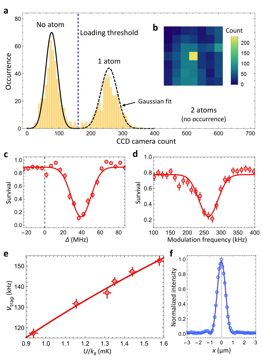
A single neutral ⁸⁷Rb or ¹³³Cs atom in a far-off-resonant dipole trap of ~1 µm waist, the qubit encoded in two hyperfine ground states split by 6.83 GHz (Rb) or 9.19 GHz (Cs). The trap, order 1 mK deep, confines but does not define the qubit, so every carrier is the same object to the precision of atomic physics. Single-atom trapping dates to 2001 (Institut d'Optique); the platform begins with the 2016 demonstrations of deterministic defect-free arrays assembled by moving tweezers (Harvard; Institut d'Optique).
Attributes. Carrier affinity: fully natural — nothing fabricated, nothing to bin. Characteristic time: ~0.25 µs entangling interaction, deterministic, not heralded. Readout: fluorescence imaging, ~0.5 ms, non-destructive, mid-circuit capable. Mobility: the atom is physically transported by moving tweezers, so connectivity is reconfigured mid-circuit. Control: optical, room-temperature, outside the vacuum. Error structure as the code sees it: atom loss and leakage first, coherent error second — loss is detectable at imaging, hence erasure-convertible. Manufacturing: optical assembly, not lithography.
Physics & limits
The trap sets the scaling law. Holding a laser-cooled atom costs roughly 0.5–1 mW of 850–1064 nm light: Tsinghua's 18,225-site array took 33 W incident and 12.2 W effective trapping power, ~0.67 mW per site D[145]. Trap light grows strictly linearly with qubit count: a 10⁶-atom array is a kilowatt-class optical plant, not a larger version of today's machine.
Coherence is not the constraint. Hyperfine clock states are first-order magnetically insensitive: T2 = 12.6(1) s in a 6,100-atom Cs array D[138]; T2 = 1.09(3) s in Rb while a magneto-optical trap ran 0.5 m away, against a shielded 1.34(4) s D[144]. Against a millisecond cycle both are enormous.
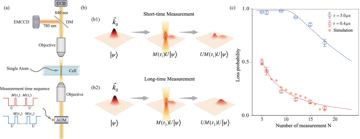
The floor is atom loss. Background-gas collisions and photon-scattering heating give a tweezer-limited lifetime near 60 s in a room-temperature cell D[144]; loss runs ~0.09% per two-qubit gate D[134], and over 80% of leakage in a logical circuit is loss D[4]. That is the defining asymmetry: the dominant error announces itself. Moving the floor takes cryogenic vacuum, reloading during computation (300,000 atoms/s into tweezers, >30,000 initialised qubits/s D[144]) or a species change — alkalis buy the simplest laser system and the best-characterised Rydberg structure but lack the manifolds that make erasure conversion and loss-free imaging native in Sr/Yb.
Engineering state of the art
Records timeline.
| Year | Figure | Who | Tag+key |
|---|---|---|---|
| 2024-03 → 2025-07 | 6,100 Cs atoms in ~12,000 sites; T2 12.6(1) s; imaging survival 99.98952(1)% | Caltech | D[138] |
| 2025-09-15 | 3,217 Rb atoms in one shot, >3,000 held >2 h; 300,000 atoms/s loaded; ~60 s lifetime | Harvard/MIT | D[144] |
| 2025-11-10 | 448 atoms under fault-tolerant control; 2.14(13)× below threshold, four rounds | Harvard/MIT/QuEra | Dfact |
| 2026-06-01 | 11,022 Rb atoms in 18,225 metasurface tweezers, 60.5% filling, no gates | Tsinghua/Qosmos | D[145] |
Typical at scale trails the records: QuEra's shipping Gemini is 260 physical qubits at 1 shot/s, SPAM 99.7% Cfact. The gap between 11,022 trapped and 448 under logical control is the field's honest position as of 3 September 2026, and atom loss dominates the budget in every regime. The carrier-quality bound set by the best entangling gate — 0.087(5)% atom loss per CZ Dfact — is a loss figure, not a coherence figure.
Manufacturing, materials & supply chain
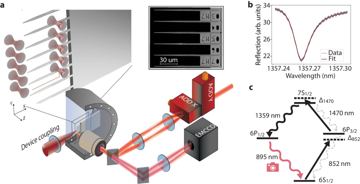
There is no wafer. The process is an optical assembly: a UHV glass cell, an alkali dispenser, a high-NA objective — or, at Tsinghua, a 19.8 mm silicon-nitride metasurface 2.5 mm outside the cell replacing the objective entirely D[145] — an SLM for the static array, crossed acousto-optic deflectors for movable tweezers, a scientific camera. Uniformity is a runtime property, not a yield: stochastic loading fills 50–60% of sites and rearrangement repairs the array every shot. Substituting sorting for yield is this carrier's structural advantage over every fabricated one.
The supply chain is optics, concentrated in Europe and Japan P[329]. Lasers: TOPTICA (Munich), Exail (in Pasqal's racks), M Squared, and Menlo Systems and NKT — both Hamamatsu subsidiaries. SLMs: Meadowlark, Hamamatsu LCOS, Holoeye. Acousto-optics: AA Opto-Electronic, Gooch & Housego, Isomet. Cameras: Hamamatsu ORCA-Quest qCMOS, chosen for mid-circuit imaging in the Harvard/QuEra machine. Vacuum: Pfeiffer, Edwards, Kurt J. Lesker, VACOM. Over 90% of system size and cost is lasers and photonics P[329]. There is no Bluefors-equivalent chokepoint, but Hamamatsu appears simultaneously in lasers, SLMs and cameras — the one name hard to route around. No vendor discloses a per-system price. Export exposure runs through tunable lasers and vacuum equipment under Wassenaar Categories 6 and 2 and the 2024 US BIS quantum rule; exact ECCNs are unverified below.
Control, readout & I/O burden
The I/O burden does not scale with N: one SLM hologram makes the static array, one deflector pair addresses whichever subset is operated on. Wiring count — the wall for every solid-state carrier — is replaced by optical power and bandwidth. The cost lands in time: imaging 0.5–1 ms, transport 0.1–1 ms, correction cycle 1–4.5 ms, three orders slower than superconducting circuits, with the compensating benefit that a real-time decoder has an easy latency target (NVQLink 3.84 µs C[324]).
At 10³ the platform is done. At 10⁴ the constraints are aggregate trap power (12 W at the atoms today), deflector bandwidth, rearrangement time and camera field of view. At 10⁶ nothing demonstrated applies: kilowatt trap light, no multi-core interconnect, no sorting scheme finishing inside a cycle. Photonic delivery is the proposed answer, and Pasqal's four chip-trapped Rb atoms, ~27.5 s lifetime (2026-08-10) C[330], are three and a half orders from mattering.
Role in the stack
Two architectures, primary in both: "Rydberg tweezer array — alkali (Rb/Cs)" and "Neutral-atom analogue simulator (Rydberg arrays, lattice gases)". It requires optical/mechanical assembly and provides the carrier for Rydberg-blockade CZ, for fluorescence imaging of atom arrays, and for the atom–photon cavity interface a network layer would need. It replaces the slot of alkaline-earth and alkaline-earth-like atoms (Sr, Yb): switching costs a laser rebuild (narrow-line cooling and clock lasers at 689/698 nm) plus a decade of alkali Rydberg calibration, and buys native erasure conversion and non-destructive nuclear-spin readout. The field splits on that line — QuEra, Pasqal, Infleqtion (Cs), Harvard, Tsinghua on alkalis; Atom Computing (Yb), planqc (Sr), Caltech's gate work (Sr) on alkaline-earth(-like) atoms. Derived clock on the alkali tweezer array = sum of the syndrome round (gates 1 µs, transport 0.80 ms, 1Q 10 µs, readout 0.50 ms) ≈ 1.3 × 10⁻³ s, set by transport then readout, never the gate. Neighbouring empty slots: no cavity interconnect at array scale, no cryogenic-vacuum array above 10³.
Evidence — how the numbers were measured
The headline coherence is a dynamically decoupled, array-averaged T2: it absorbs site-to-site trap-depth inhomogeneity into the pulse sequence rather than reporting it. Imaging survival of 99.98952(1)% is per image at a stated exposure and bounds nothing about loss during transport or Rydberg excitation. The 60.5% filling fraction is pre-rearrangement — "11,022 atoms" and "11,022 usable qubits" are different claims. No protocol here separates loss from depolarising error, so error-per-Clifford figures are not comparable to solid-state ones without the post-selection.
Conflicts. The Caltech abstract says "over 6,100 atoms in around 12,000 sites"; versions differ (v1 2024-03, v4 2025-07) and the 12.6 s figure belongs to v4, the later revision, which takes precedence D[138]. The review arguing a 99.9% blockade ceiling also tabulates a 2025 USTC CZ of 99.84% that no primary source corroborates P[140].
Not published: the computing atom species of Infleqtion and of planqc (if strontium, planqc belongs to the alkaline-earth atoms technology), a vacuum-limited trap lifetime for the Tsinghua metasurface array, and a per-qubit or per-system capital cost for any tweezer machine.
Actors & economics
Who.
| Organisation | Role | Country | What exactly they do | Evidence |
|---|---|---|---|---|
| QuEra | developer | US | Rb arrays; Gemini 260 q shipping; Libra promised 2028 | C[137], [162] |
| Harvard/MIT | research | US | 448-atom architecture; 3,000-qubit continuous run; CZ record | D[4], [144] |
| Caltech | research | US | 6,100-atom Cs array; T2 12.6 s; record imaging survival | D[138] |
| Pasqal | developer | FR | Rb machines; on-chip trapping; Nasdaq PSQL | C[330], [331] |
| Infleqtion | developer | US | Sqale line; NYSE INFQ; Illinois system 2027 | G[155], [332] |
| Tsinghua | research | CN | 11,022-atom metasurface array, largest trapped ensemble | D[145] |
| Google Quantum AI | research | US | neutral-atom track opened 2026-03 under Adam Kaufman | C[9] |
| Atom Computing | developer | US | Yb competitor; Magne with Microsoft; QBI Stage B | G[11] |
| planqc | developer | DE | Sr competitor; DLR and LRZ builds; 1,000 qubits at LRZ circa 2027 | C[246] |
| TOPTICA | supplier | DE | dominant supplier of Rb/Cs cooling and trapping lasers | P[329] |
| Hamamatsu | supplier | JP | LCOS-SLMs and qCMOS cameras; owns Menlo and NKT | P[329] |
Money.
- 2022-05-04 / 2024-07-08 · planqc · DLR contract EUR 29 M; Series A EUR 50 M · DLR Quantum Computing Initiative; lead undisclosed · closed C[246]
- 2025-07-17 · QuNorth · "Magne" order from Atom Computing/Microsoft · EUR 80 M · EIFO + Novo Nordisk Foundation · ordered fact
- 2025-09-09 · QuEra · financing round · > USD 230 M · Google, SoftBank Vision Fund 2, NVentures · closed Cfact
- 2025-11-06 · QuEra · DARPA QBI Stage B · up to USD 15 M · DARPA · selected fact
- 2026-02-17 · Infleqtion · NYSE listing (INFQ) · > USD 550 M gross · SPAC · closed fact
- 2026-05-21 · Infleqtion · CHIPS letter of intent · USD 100 M · US Dept of Commerce · LOI (non-binding) fact
- 2026-06-15 · QuEra · Libra 2028 roadmap, expanded AWS Braket collaboration · undisclosed · AWS · roadmap Rfact
- 2026-08-12 · Infleqtion · Q2 2026 results · revenue USD 12.6 M (+116% y/y), H1 USD 22.094 M, FY26 guidance ~USD 43 M, Q2 net loss USD 25.5 M, cash USD 582 M · reported G[332]
- 2026-08-27 · Pasqal · SPAC completion, Nasdaq PSQL · ~USD 360 M cash; 2025 revenue EUR 16.5 M · Bleichroeder Acquisition Corp. II · closed fact
Market & supply chain. The enabling equipment is sold by photonics firms that were profitable before quantum existed; concentration is real but diffuse, with over 90% of system cost in lasers and photonics P[329]. Unit economics are undisclosed; the only quotable figure is 0.67 mW of trap light per tweezer D[145]. G1 (analogue simulation) is what alkali arrays are actually paid for today; G5 (optimisation) is what is marketed; G3 (early fault tolerance) is where every 2028 promise sits; G4 is the thesis behind the valuations. G6 is blocked on the cavity-interface slot.
IP & standards. The foundational tweezer-array and coherent-transport families come from Harvard/MIT, licensed into QuEra; the CNRS/Institut d'Optique lineage feeds Pasqal. Vertical integration is the visible move: Pasqal acquired Aeponyx for silicon-nitride photonics under 18 months before its August 2026 result C[330]. Open-source stacks: Bloqade (QuEra), Pulser (Pasqal), both with analogue-Hamiltonian front ends no other modality needs. No litigation found; no dated patent count from a named database.
Roadmaps & track record. QuEra (promised 2024-01 · for 2026 · 100 logical qubits undelivered as of 2026-09-03, replaced by Libra >256 logical in 2028 — a two-year slip). Pasqal (promised 2024-03 · for 2026 · 10,000 physical slipped to 2028; 100 logical now 2029). Infleqtion (reaffirmed 2026-08-12 · for 2026 · 30 logical qubits, unverified; >50 logical at Illinois 2027). planqc (promised 2024-11 · for ~2027 · 1,000 qubits at LRZ; no device metrics published since). Credibility: Harvard/MIT outrun every roadmap because they publish rather than promise; QuEra and Pasqal have each slipped a flagship number by two years and read as 2029 companies; Infleqtion alone reports audited revenue against its claims; planqc has contracts but no published metrics.
Strategic reading. If alkali arrays win, value accrues asymmetrically to component vendors — TOPTICA, Hamamatsu, Meadowlark — paid identically whichever developer prevails and facing no substitution risk from the alkaline-earth(-like) branch beyond a change of wavelength catalogue. The real threat to this node is internal: Sr/Yb carriers convert the dominant error into an erasure for free. Bargaining power sits with buyers — Infleqtion holds USD 582 M, Pasqal ~USD 360 M, against far smaller European vendors — and the response is acquisition rather than negotiation.
Outlook & open questions
Confirm if a defect-free array above 2,000 atoms runs gates by end-2027; if Infleqtion demonstrates 30 logical qubits by 2026-12-31; if a chip-delivered tweezer array exceeds 100 traps by end-2027. Demote if no group shows Λ > 2 over more than 50 rounds with continuous reloading by end-2027 — Atom Computing's toric-code run lost its suppression precisely when reloading was included D[148], and that, not gate fidelity, is the load-bearing question.
Best case by 2029: Libra-class systems above 256 logical qubits on cloud, chip or metasurface optics collapsing the footprint, loss handled as erasure end to end. Worst case: 10³-qubit analogue simulators with a few dozen logical qubits, the millisecond cycle fatal outside simulation, alkalis losing fault tolerance to Sr/Yb.
Open questions. (1) Does continuous reloading survive contact with error correction, or does stray light impose a coherence tax growing with duty cycle? (2) Can rearrangement of >10⁴ sites finish inside a correction cycle, or does sorting become the clock? (3) Are metasurface and chip-based trap delivery compatible with the trap depths and beam quality high-fidelity gates require?
Watch: Infleqtion's Q4 2026 report against the 30-logical claim; a QuEra Libra milestone in 2027; Pasqal's chip channel count; Google's first neutral-atom paper; any vacuum-limited lifetime above 300 s at array scale.
References
- [4] D. Bluvstein et al., “A fault-tolerant neutral-atom architecture for universal quantum computation,” Nature, vol. 649, no. 8095, pp. 39–46, Nov. 2025, doi: 10.1038/s41586-025-09848-5. arXiv:2506.20661. D
- [9] H. Neven, “Building superconducting and neutral atom quantum computers,” Google, Mar. 24, 2026. [Online]. Available: https://blog.google/
innovation-and-ai/ Ctechnology/ research/ neutral-atom-quantum-computers/ - [11] Novo Nordisk Foundation, “New quantum computer with great potential to boost Nordic research and innovation,” Novo Nordisk Fonden, Jul. 17, 2025. [Online]. Available: https://novonordiskfonden.dk/
en/ Gnews/ new-quantum-computer-with-great-potential-to-boost-nordic-research-and-innovation/ - [134] S. J. Evered et al., “High-fidelity entangling gates and nonlocal circuits with neutral atoms,” arXiv:2604.25987, Apr. 2026. D
- [137] QuEra Computing Inc., “Gemini-Class Gate-Model Quantum Computer.” [Online]. Available: https://www.quera.com/
gemini C - [138] H. J. Manetsch, G. Nomura, E. Bataille, K. H. Leung, X. Lv, and M. Endres, “A tweezer array with 6100 highly coherent atomic qubits,” Nature, vol. 647, pp. 60–67, 2025, doi: 10.1038/s41586-025-09641-4. arXiv:2403.12021. D
- [140] J. Wang, Z. Wang, L. Li, F. Wang, S. Liang, and K. Yan, “Neutral Atom Quantum Computing: Principles, Routes, Progress, and Challenges,” arXiv:2608.05010, Aug. 2026. P
- [144] N.-C. Chiu et al., “Continuous operation of a coherent 3,000-qubit system,” Nature, vol. 646, no. 8087, pp. 1075–1080, Sep. 2025, doi: 10.1038/s41586-025-09596-6. D
- [145] Y. Wang et al., “Trapping 11,000 Atoms in a Tweezer Array Generated by a Single Metasurface,” arXiv:2606.02715, Jun. 2026. D
- [148] Atom Computing and Collaborators, “Quantum error correction with the toric code,” arXiv:2606.04079, Jun. 2026. D
- [155] L. Roady, “Infleqtion Becomes First Neutral-Atom Quantum Company to Go Public,” Infleqtion, Feb. 17, 2026. [Online]. Available: https://infleqtion.com/
infleqtion-becomes-first-neutral-atom-quantum-company-to-go-public/ G - [162] QuEra Computing, “QuEra Announces 2028 Fault-Tolerant Quantum Computer and Expanded Multi-Year Strategic Collaboration with AWS,” Jun. 15, 2026. [Online]. Available: https://www.quera.com/
press-releases/ Cquera-announces-2028-fault-tolerant-quantum-computer-and-expanded-multi-year-strategic-collaboration-with-aws - [246] planqc, “News.” [Online]. Available: https://planqc.eu/
news C - [324] S. Caldwell et al., “NVIDIA NVQLink Architecture Integrates Accelerated Computing with Quantum Processors,” NVIDIA Technical Blog, Nov. 17, 2025. [Online]. Available: https://developer.nvidia.com/
blog/ Cnvidia-nvqlink-architecture-integrates-accelerated-computing-with-quantum-processors/ - [329] M. Ivezic, “The Tweezer Array's Hidden Supply Chain: Who Really Wins If Neutral-Atom Quantum Computing Wins,” PostQuantum.com, Nov. 17, 2025. [Online]. Available: https://postquantum.com/
quantum-ecosystem/ Pneutral-atom-quantum-ecosystem/ - [330] Pasqal, “Pasqal brings qubit control on-chip, advancing the path to fault-tolerant quantum computing at scale,” Aug. 10, 2026. [Online]. Available: https://www.pasqal.com/
news/ Cpasqal-brings-qubit-control-on-chip-advancing-the-path-to-fault-tolerant-quantum-computing-at-scale/ - [331] Pasqal, “Newsroom.” [Online]. Available: https://www.pasqal.com/
newsroom/ C - [332] Infleqtion, “Infleqtion Reports Record Q2 Revenue, Raises 2026 Outlook as Quantum Commercialization Accelerates,” Aug. 12, 2026. [Online]. Available: https://ir.infleqtion.com/
news-events/ Gpress-releases/ detail/ 201/ infleqtion-reports-record-q2-revenue-raises-2026-outlook-as-quantum-commercialization-accelerates