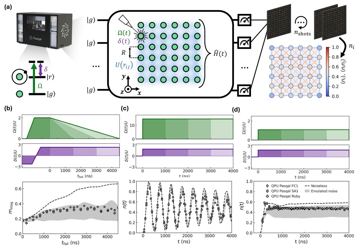
Orion Alpha / Beta ("Ruby") / Gamma
Orion Alpha / Beta ("Ruby") / Gamma
Register profile — the machine's variant of its architecture
qubit type: hyperfine qubit (digital); ground-Rydberg (analog)
gate mechanism: Rydberg-blockade CZ (digital); analog Rydberg evolution
connectivity: reconfigurable tweezer register; Orion is 3 kW, 2,500 kg, cryogenics-free, room temperature
control: SLM/AOD laser control
control placement: optics (room temperature)
readout: fluorescence imaging
gate evidence: no published figure
flags: no code named, no published error rates
Technologies by layer — the machine's cell per layer
| 1 Qubit carrier | Alkali atom (Rb/Cs) in optical tweezers · primary ▤ § The Neutral Atom Architecture 🔎 87Rb hyperfine qubit (digital) / ground-Rydberg (analog); Orion Beta 100+ qubits (2024–25), Gamma >140 (late 2025) |
| 2 Encoding | Ground–Rydberg analogue qubit · alternate ▦ §Bases 🔎 Pulser (Pasqal SDK) ground-rydberg basis |g⟩,|r⟩ addressed by a Rydberg channel; digital basis |g⟩,|h⟩ by a Raman channel; Orion not named |
| 3 Gate mechanism | Rydberg-blockade CZ · primary ▨ 🔎 Rydberg-blockade CZ (digital); no per-system 1Q/2Q fidelity published Analogue Rydberg Hamiltonian evolution · alternate ▦ §AnalogDevice 🔎 Pulser AnalogDevice 'only supports the |r⟩ and |g⟩ states ... one channel of type Rydberg (rydberg_global) ... implements the Ising Hamiltonian'; Orion not named |
| 4 Connectivity / transport | Atom transport by AOD tweezers (zoned architecture) · primary ▤ § The Neutral Atom Architecture 🔎 reconfigurable tweezer register; Orion Gamma >140 qubits (late 2025) |
| 5 Control | Laser + AOD/SLM optical control (atoms) · primary ▤ § The Neutral Atom Architecture 🔎 SLM/AOD laser control; room-temperature optics, cryogenics-free |
| 6 Readout | |
| 7 Code | — none — nothing in this layer ▦ ✅ no QEC demonstrated; no code named publicly (roadmap: 200+ logical by 2029) |
| 8 Decoder | |
| 9 Interconnect | |
| 10 Manufacturing | Optical / mechanical assembly (lasers, vacuum, objectives) · primary ▤ § Engineering the Quantum Transition / Neutral Atom Architecture 🔎 room-temperature optical assembly; Orion 3 kW, 2,500 kg, cryogenics-free |
evidence: ✅ 1 / 12
Pictures
Every picture carries the story of what it shows and its credit line.