Atom–photon cavity interface ic_atomcavity
An optical cavity around tweezer-trapped neutral atoms Purcell-enhances atom–photon coupling so an atom's state can be written onto a flying photon.
Atom–photon cavity interface
Tweezer atoms coupled to cavities: ~90% generation-to-detection atom–photon efficiency (MPQ); no inter-module rates yet.
Brief →Key references
Design space — attributes
- (a) carrier affinity
- natural
- (b) time · entangling
- —
- (c) readout
- —
- (d) mobility
- flying qubits (photons)
- (e) control
- optical @ room temperature
- (f) error structure
- loss (erasure)
- (g) manufacturing
- optical / mechanical assembly
Evaluation space — dated attributes
Atom Computing–Nu Quantum/Cisco (MoUs, no numbers). A 'cavity-carved Bell fidelity 91%' sometimes quoted is not in the source abstract. Nu Quantum's $60 M Series A closed 2025-12-10, led by National Grid Partners.
Actors & goals — annotations
Edges
Used by no registered machine
Pictures
Every picture carries the story of what it shows and its credit line.

Atom–photon cavity interface
An optical cavity around tweezer-trapped neutral atoms Purcell-enhances atom–photon coupling so an atom's state can be written onto a flying photon.
Verdict. Single-pair efficiency is high (~90% generation-to-detection) but far from the 99.9% a fault-tolerant link wants; remote entanglement has joined single-atom nodes, never two multi-atom tweezer processors, so the interconnect claim is unproven — falsifiable the day one reports a rate.
Λ = error-suppression factor per code-distance step; QBI = DARPA Quantum Benchmarking Initiative (Stage A concept → B R&D plan → C government V&V); G1–G7 = the report's goal classes (see Actors & economics).
Identity & lineage
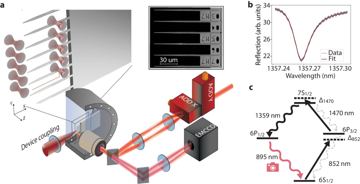
An optical resonator around tweezer-trapped neutral atoms, enhancing coupling to a single photonic mode so emission into that mode is near-deterministic rather than a few percent of 4π. Cavity QED with single atoms is decades old; what dates from 2024 is a tweezer-assembled, individually addressable register inside one cavity, with multiplexed atom–photon entanglement at a generation-to-detection efficiency approaching 90% D[777]. Attributes: d = mobility "flying", moving information from a stationary atom onto a photon that leaves the module; f = dominant error is loss, not Pauli, so a failure is a heralded absence and the trial is retried.
Physics & limits
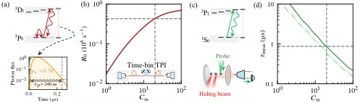
The controlling parameter is single-atom cooperativity C = g²/κγ, coherent coupling against cavity decay and free-space scattering. Emission into the cavity mode goes as C/(1+C), so pushing efficiency from 90% (C ≈ 9) toward the 99.9% a fault-tolerant link wants (C ≈ 999) costs two orders of magnitude in C — smaller mode volume or higher finesse, both tightening mirror-loss and atom-positioning tolerances. End-to-end efficiency is a product of cavity emission, outcoupling, fibre transmission and detection; 90% D[777] is close to what bulk optics allows. Loss is heralded, which is why this interface pairs naturally with erasure-native alkaline-earth(-like) qubits. What moves the floor: fibre-tip and nanophotonic microcavities with higher C; direct telecom emission that removes lossy frequency conversion D[778]; and channel counts that track array size.
Engineering state of the art
table
| Year | Figure | Who | Tag+key |
|---|---|---|---|
| 2024-07 | Tweezer register in a cavity, multiplexed atom–photon entanglement at ~90% generation-to-detection | MPQ (Rempe group) | D[777] |
| 2025-09-12 | Parallelised telecom (1389 nm) atom–photon entanglement from a ¹⁷¹Yb array; rate scales with channel count | Illinois (Covey group) | D[778] |
| 2026-08-31 | 10-channel chip-scale 780 nm waveguide array at 25 µm pitch, visibility 0.87; 75–94% per-channel efficiency in trade press | Osaka University | DfactP[779] |
No group has published an entanglement rate between two multi-atom neutral-atom processors; the remote links on record join single-atom nodes — MPQ's cavity nodes (2012), a gate between modules 60 m apart (2021) and LMU's atoms over 33 km of fibre (2022) Dfact. Efficiency and fidelity are respectable; throughput, the only figure an architect can use, is unmeasured.
Manufacturing, materials & supply chain
Bench optics, not lithography — high-finesse mirror coatings, fibre-tip or nanophotonic microcavities, vacuum, and tweezer optics shared with the processor, all tuned per system. There is no cavity yield statistic, and the nearest nanocavity-plus-emitter study publishes none: QuTech's tin-vacancy work P[362] characterised 327 cavities at room temperature, found coupled centres in 7 of the 9 it cooled and measured two above cooperativity one Dfact. The interesting direction is chip-scale integration: Osaka's glass waveguide array (with NICT and Hamamatsu) couples ten tweezer sites into ten channels at 25 µm pitch P[779]; Chicago's 2024 platform had already combined up to 64 tweezers with a chip of more than 100 nanophotonic cavities D[579]. Named suppliers are thin: Hamamatsu for detectors, Nu Quantum for photonic switching P[780]. No COTS product exists, so no unit economics are quotable; no export-control classification specific to this hardware was found.
Control, readout & I/O burden
Trapping and addressing lasers are shared with the array; this interface adds cavity locking, a photon path and detector channels. The burden is per-link, not per-qubit: one cavity mode serves one module today, and multiplexing is the open problem — Osaka's 10 channels at 25 µm pitch, targeting ~100, are a step toward making channel count track array size P[779]. At 10³ atoms per module nobody needs it yet. At 10⁴–10⁶ distributed operation is the stated architecture of every neutral-atom vendor, and nothing published says how many simultaneous links a module needs. Heralding latency is unpublished; the retry loop is set by detector dead time and classical feedback.
Role in the stack
Serves both Rydberg tweezer arrays — alkali (Rb/Cs) and alkaline-earth(-like) (Yb/Sr) — and requires a tweezer-trapped atom plus the optical-assembly layer that builds the cavity. Within neutral atoms its only competitor is free-space collection, simpler and much less efficient; across modalities it races ion–photon and spin–photon links, and the defect-spin route is visibly harder — a fibre microcavity buys about 10× in NV photon collection, ~0.05% to ~0.5% D[359]. It contributes nothing to the derived clock today because no multi-module architecture exists: for one module, sum of the syndrome round: gate layers + transport + readout + reset is 1.31 ms per QEC round, set by transport with imaging behind it, against a 270 ns CZ D[4]. Any slower link becomes the clock the moment it is used. Empty slot: a two-module link with a rate.
Evidence — how the numbers were measured
The three results are not on a common scale. MPQ's ~90% is generation-to-detection efficiency for one atom–photon pair in a bulk cavity D[777]; Osaka's 0.87 visibility, a correlation between atomic state and photon polarisation, comes from a chip-integrated array with no cavity enhancement, published in Optica on 2026-08-31, while its 75–94% per-channel efficiency appears only in trade press DfactP[779]; Covey's telecom result is a fibre-array scheme claiming proportionality with channel count, not an absolute rate D[778]. None measures what a link needs: heralded events per second between two processors, with fidelity after heralding overhead.
The "cavity-carved Bell-state fidelity of 91%" sometimes attributed to arXiv:2407.09109 is not in its abstract, which states only the ~90% generation-to-detection efficiency. Not published: a measured entanglement rate or fidelity for Nu Quantum's two roadmap prototypes fact, and an export-control classification specific to cavity optics or atom–photon interfaces.
Actors & economics
Who.
| Organisation | Role | Country | What exactly they do with this technology | Evidence |
|---|---|---|---|---|
| MPQ | research | Germany | Tweezer register in a cavity, ~90% generation-to-detection | D[777] |
| University of Illinois | research | USA | Parallelised telecom atom–photon entanglement from a Yb array | D[778] |
| Osaka University | research | Japan | 10-channel chip-scale collection array, with NICT and Hamamatsu | P[779] |
| Atom Computing | developer | USA | Yb systems; networking deals with Nu Quantum and Cisco | P[780] |
| Nu Quantum | supplier | UK | Qubit–photon interface and photonic networking units | C[781] |
| Cisco | supplier | USA | Quantum-networking hardware and distributed-computing software | P[782] |
Money.
2025-07-17 · QuNorth · order, "Magne" from Atom Computing/Microsoft · EUR 80 M · 50 logical qubits · ordered G[11]
2025-11-06 · DARPA · QBI Stage B, Atom Computing and QuEra among eleven · up to USD 15 M each · official G[65]
2025-12-10 · Nu Quantum · Series A · USD 60 M · National Grid Partners lead, with Amadeus, IQ Capital, NSSIF, Sumitomo/Presidio · closed C[781]
2026-05-21 · US Dept of Commerce · CHIPS letter of intent, Atom Computing · USD 100 M · non-binding LOI G[300]
2026-06-16 · Atom Computing · Series C (Third Point) · USD 100 M · > USD 300 M cumulative · closed G[154]
Market & supply chain. There is no market: nobody sells an atom–photon cavity interface, and the money here is processor money (Atom Computing) or adjacent networking money (Nu Quantum, Cisco). Nu Quantum is the only company targeting this function directly; it has raised a USD 60 M Series A and published no measured rate or fidelity C[781]. Detector and photonic-integration supply is the plausible chokepoint. Pays for G6 today and, if it works, G4 and G7; pays for none of G1–G3.
IP & standards. No named patent family or dated patent-database count specific to atom–cavity interfaces was found — no dated fact found. No consortium or standard governs the interface; the MPQ, Illinois and Osaka results are academic devices, not products.
Roadmaps & track record. Nu Quantum's roadmap had two items and both arrived on time as prototypes — the Qubit–Photon Interface on 2024-10-14, the Quantum Networking Unit on 2025-06-12 — neither with a measured rate or fidelity: the unit's "up to 99.7%" is the ceiling its optical path allows C[781]fact. Atom Computing–Nu Quantum (2026-06-17) and Atom Computing–Cisco (2026-03-25) carry no dated targets P[780]P[782]; Osaka's ~100-channel target carries no date P[779]. As of 4 Sep 2026 no actor here has a promise specific enough to score — itself the finding.
Strategic reading. If chip-scale collection matures faster than bulk cavity QED, this interface inherits a photonic-foundry supply chain instead of bespoke lab hardware, and the advantage goes to whoever partnered with a photonic-integration group early — among vendors, Atom Computing. If not, distributed neutral-atom computing stays a slide and every roadmap past ~10⁴ atoms loses its scaling story. The substitution threat is across modalities: ion–photon and spin–photon links chase the same milestone, and the first to publish a usable rate sets the narrative.
Outlook & open questions
Confirm by end-2027 if any group publishes a heralded entanglement rate between two multi-atom neutral-atom modules; demote the interconnect claim if new results are still single-pair efficiencies. Best case by 2029: multiplexed collection reaches ~100 channels and a two-module logical operation is shown. Worst case: efficiency plateaus near 90%, channel counts stay in the tens, and the networking agreements never convert into a dated target. Open questions: what rate does a distributed neutral-atom architecture require; can chip-scale collection reach bulk-cavity cooperativity; does direct telecom emission beat cavity enhancement plus conversion.
References
- [4] D. Bluvstein et al., “A fault-tolerant neutral-atom architecture for universal quantum computation,” Nature, vol. 649, no. 8095, pp. 39–46, Nov. 2025, doi: 10.1038/s41586-025-09848-5. arXiv:2506.20661. D
- [11] Novo Nordisk Foundation, “New quantum computer with great potential to boost Nordic research and innovation,” Novo Nordisk Fonden, Jul. 17, 2025. [Online]. Available: https://novonordiskfonden.dk/
en/ Gnews/ new-quantum-computer-with-great-potential-to-boost-nordic-research-and-innovation/ - [65] DARPA, “Stage B selection,” Nov. 6, 2025. [Online]. Available: https://www.darpa.mil/
research/ Gprograms/ quantum-benchmarking-initiative/ stage-b-selection - [154] Atom Computing, “Atom Computing Raises More Than $300 Million to Accelerate Deployment of Fault-Tolerant, Neutral-Atom Quantum Computers,” PR Newswire, Jun. 16, 2026. [Online]. Available: https://www.prnewswire.com/
news-releases/ Gatom-computing-raises-more-than-300-million-to-accelerate-deployment-of-fault-tolerant-neutral-atom-quantum-computers-302800832.html - [300] National Institute of Standards and Technology, “Department of Commerce Announces Letters of Intent With 9 Companies for $2 Billion to Accelerate U.S. Leadership in Quantum Computing,” NIST News, May 21, 2026. [Online]. Available: https://www.nist.gov/
news-events/ Gnews/ 2026/ 05/ department-commerce-announces-letters-intent-9-companies-2-billion - [359] J. Fischer et al., “Spin-photon correlations from a Purcell-enhanced diamond nitrogen-vacancy center coupled to an open microcavity,” Nat. Commun., vol. 16, no. 1, Art. no. 11680, Nov. 2025, doi: 10.1038/s41467-025-66722-8. D
- [362] QuTech, “Coherent coupling of diamond colour centre to a nanocavity,” Jun. 25, 2026. [Online]. Available: https://qutech.nl/
2026/ P06/ 25/ a-step-toward-faster-quantum-networks/ - [579] S. G. Menon, N. Glachman, M. Pompili, A. Dibos, and H. Bernien, “An integrated atom array–nanophotonic chip platform with background-free imaging,” Nat. Commun., vol. 15, no. 1, Art. no. 6156, Jul. 2024, doi: 10.1038/s41467-024-50355-4. D
- [777] L. Hartung, M. Seubert, S. Welte, E. Distante, and G. Rempe, “A quantum-network register assembled with optical tweezers in an optical cavity,” Science, vol. 385, no. 6705, pp. 179–183, Jul. 2024, doi: 10.1126/science.ado6471. arXiv:2407.09109. D
- [778] L. Li et al., “Parallelized telecom quantum networking with an ytterbium-171 atom array,” Nat. Phys., vol. 21, no. 11, pp. 1826–1833, Nov. 2025, doi: 10.1038/s41567-025-03022-4. D
- [779] C. Pittmann, “Neutral-Atom Quantum Processors Get Chip-Scale Photonic Link: Osaka Hits 10 Channels,” Tech Times, Sep. 1, 2026. [Online]. Available: https://www.techtimes.com/
articles/ P326188/ 20260901/ neutral-atom-quantum-processors-get-chip-scale-photonic-link-osaka-hits-10-channels.htm - [780] M. Swayne, “Atom Computing and Nu Quantum Partner to Scale Neutral Atom Quantum Computers,” The Quantum Insider, Jun. 17, 2026. [Online]. Available: https://thequantuminsider.com/
2026/ P06/ 17/ atom-computing-and-nu-quantum-partner-to-scale-neutral-atom-quantum-computers/ - [781] Nu Quantum, “Nu Quantum Raises $60M Series A in Largest Financing Round for Quantum Computer Networking,” Dec. 10, 2025. [Online]. Available: https://www.nu-quantum.com/
news/ Cnu-quantum-raises-60m-series-a-in-largest-financing-round-for-quantum-computer-networking - [782] M. U. Rehman, “Cisco and Atom Computing Partner on Quantum Networking for Scalable Computing,” The Quantum Insider, Mar. 25, 2026. [Online]. Available: https://thequantuminsider.com/
2026/ P03/ 25/ atom-computing-cisco-distributed-quantum-collaboration/