Cryogenic signal fan-out for spin arrays (router die, 3D stacked wiring) ic_fanout
A millikelvin router die, an on-die multiplexer or 3D stacked wiring that turns a few cold input lines into the tens to thousands of gate voltages a spin-qubit array needs.
Cryogenic signal fan-out for spin arrays (router die, 3D stacked wiring)
A millikelvin router (Intel's Pando Tree fanning out to 64 channels), 3D stacked cryogenic wiring or on-die routing that takes a spin array from tens to thousands of gate lines — the interconnect layer the spin architectures had no slot for.
Brief →Key references
Design space — attributes
- (a) carrier affinity
- fabricated
- (b) time · entangling
- —
- (c) readout
- —
- (d) mobility
- static nearest-neighbour wiring
- (e) control
- low-frequency electrical @ 4 K stage / millikelvin stage
- (f) error structure
- coherent / calibration
- (g) manufacturing
- CMOS foundry 300 mm
Evaluation space — dated attributes
no dated attribute
Channel count per die and heat load per line are the figures of merit; no inter-module link yet.
Actors & goals — annotations
Edges
Used by 4 machines (4 primary · 0 alternate)
- semiconductor spins 4
- RacQ (Bell-1) Equal1 product page blog blog ◌ 🔎
- Hitachi x Intel 18A spin programme Hitachi + Intel K.K. + AIST (G-QuAT) press press ◌ 🔎
- Tunnel Falls Intel paper press press ▦ blog post (Pando Tree integration with Tunnel Falls) ✅
- QM-One Quantum Motion ◌ 🔎
Pictures
Every picture carries the story of what it shows and its credit line.
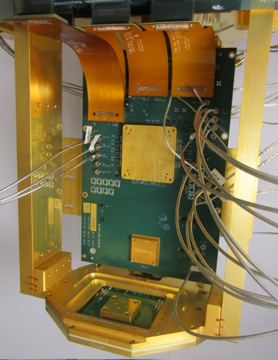
Cryogenic signal fan-out for spin arrays (router die, 3D stacked wiring)
A millikelvin router die, an on-die multiplexer or 3D stacked wiring that turns a few cold input lines into the tens to thousands of gate voltages a spin-qubit array needs.
Verdict. The parts exist — Intel's 64-terminal Pando Tree, Quantum Motion's 1,024-dot multiplexed chip, Delft's 648-device demultiplexer — but no gate fidelity measured through a millikelvin router has been published as of 2026-09-26, and at Delft's ~1.25 µW per generated voltage a milliwatt of millikelvin cooling holds ~800 voltages: 10³ qubits only with shared control.
MXC = mixing chamber, the coldest refrigerator stage; SET = single-electron transistor; DRAM = dynamic random-access memory; FinFET = fin field-effect transistor; 22FDX = GlobalFoundries' 22 nm fully depleted silicon-on-insulator process; PDK = process design kit; Rent's rule T = t·g^p (T terminals, g components, t terminals per component, p the Rent exponent); G1–G7 = the report's goal classes (see Actors & economics).
Identity & lineage
Every gate of a spin qubit is a line. Fan-out routes the few lines a refrigerator carries to those gates: a router die at the MXC (Intel), multiplexers on the qubit die (Quantum Motion, Equal1), or qubit chip and control electronics stacked vertically (Hitachi). Vandersypen et al. (2017) judged wiring ~10⁸ sub-100 mK qubits to room temperature "impractical" and put electronics beside the qubits D[761]. Li et al. shared the lines — "the control lines define the qubit grid" D[762]; Schaal et al. and Paquelet Wuetz et al. put CMOS switches at millikelvin D[763]D[764]. Intel described Pando Tree on 2024-06-20 C[272]; the register's first dated fan-out record is from 2025.
Attributes: static interconnect; low-frequency signals at mK and 4 K; coherent error; CMOS fabrication.
Physics & limits
Lines. In 2019 every platform wired each qubit directly, p = 1, against 0.36 for Intel's x86 processors; in Franke et al.'s example an added spin qubit costs two gates, t = 2 D[765] — 2×10⁶ lines at g = 10⁶. A crossbar gives T = 6√g − 1, 23 terminals for 16 dots D[520], ~6×10³ at 10⁶ S. At a 90 nm gate pitch D[197] routing must happen on or beside the die.
Heat. Large dilution refrigerators give "beyond 1 mW at 100 mK" D[761]. Delft generated and demultiplexed 96 voltages onto 648 devices at 66 mK for under 120 µW D[552]: ~1.25 µW per voltage, so a milliwatt holds ~800 — ~400 directly wired qubits or ~1.8×10⁴ crossbar dots S. Switching costs ∝ C·V²·f: strobing commercial multiplexers at 8 kHz lifted a 50 mK stage to 130 mK D[764]. A demultiplexer visits terminals in turn, each holding charge meanwhile — Schaal's cell stores it on the dot gate like a one-transistor–one-capacitor DRAM cell D[763] — so refresh rate trades droop against heat S.
Engineering state of the art
table
| Year | Figure | Who | Tag+key |
|---|---|---|---|
| 2020-05-19 | Commercial CMOS multiplexers at 50 mK: 16 channels × 6 lines | QuTech / Intel | D[764] |
| 2023-08-28 | 16-dot germanium crossbar, 23 terminals | QuTech | D[520] |
| 2024-05-01 | 300 mm cryoprober: 232 twelve-dot arrays, electron temperature 1.6 ± 0.2 K | Intel | D[766] |
| 2024-06-20 | Pando Tree: bias and pulses to 64 terminals, 10–20 mK | Intel | C[272] |
| 2025-01-03 | 1,024 dots on one on-chip multiplexer, 22FDX, <1 K, mapped in <10 min | Quantum Motion | D[767] |
| 2025-03-16 | Bell-1, renamed RacQ in 2026: six qubits and control in one rack, 0.3 K, 1,600 W | Equal1 | C[768] fact |
| 2025-07 | 648 devices from 96 voltages, 66 mK, <120 µW, 22 nm FinFET | TU Delft / Intel | D[552] |
No row is a gate benchmark through a router: Pando Tree shares a circuit board with a Tunnel Falls chip C[272], with no fidelity measured through it found, as of 2026-09-26. Nearest: a 32-cell millikelvin pulse chip costing ~0.07% single-qubit fidelity D[551] — generation, not routing. Dominant term: heat per addressed voltage.
Manufacturing, materials & supply chain
Router dies are foundry CMOS run cold: 22 nm FinFET from Intel for Delft D[552], 22FDX for Quantum Motion D[767] and Equal1 C[273], Intel 18A for Hitachi's quantum PDK, "the first such interface for a 1.8nm-class process" P[769]. Tunnel Falls comes off a 300 mm line with extreme-ultraviolet lithography D[199]. Three routes compete: a separate router die (Intel), monolithic multiplexers (Quantum Motion, Equal1), and "stacking qubit chips and control electronics vertically" (Hitachi) P[769]. Cold wafer test gates all three — Intel's cryoprober is the published instance D[766] — and imec's SPINS pilot line adds 300 mm spin-qubit runs, PDKs and cryo-CMOS C[770]. Router and bond yields are unpublished as of 2026-09-26.
Control, readout & I/O burden
Pando Tree delivers "both constant voltage bias and high-speed voltage pulsing for up to 64 qubit terminals" from nine digital signals and one line from the 4 K Horse Ridge II controller C[272]: ten lines for 32 qubits at two terminals each (t = 2), ~0.3 lines per qubit S. The register's 0.0156 lines per qubit counts only the analogue line and reads terminals as qubits S. Intel's "approximately 20 cables" for a million qubits C[272] carries no heat or bandwidth budget, as of 2026-09-26. Readout fans in too: Diraq reads eight qubits through two SETs D[197]. At 1.25 µW per voltage and two terminals per qubit S, 10³ qubits need ~2.5 mW wired directly, ~0.2 mW on a crossbar; 10⁶ need ~2.5 W, or ~7.5 mW shared — only the combination nears one refrigerator's budget.
Role in the stack
Slot 9, the only layer-9 entry, of "Silicon / germanium quantum-dot spins". It requires fab_cmos (foundry CMOS) — "a CMOS router die at cryogenic temperature" — and ct_cryocmos (cryogenic CMOS control), which generates what this technology routes; cx_crossbar (layer 4) shares lines inside the array. No provides edge is recorded. ic_mcm (coupled multi-chip modules) replaces it; neither spin architecture has an inter-module link, as of 2026-09-26. Four register machines carry it (4 as primary): Tunnel Falls, Hitachi × Intel 18A, RacQ (Bell-1) and QM-One — those whose makers name an artefact. Tunnel Falls' cell is ✅, on the Pando Tree demultiplexer; the others are inferred and 🔎. Gap G-spinl9, answered in part: slot 9 of the quantum-dot architecture now holds this technology, the proposed ic_router; slot 9 of the donor-spin architecture is still empty.
Evidence — how the numbers were measured
The figures of merit — channels per die, heat per line at the MXC, hold droop, refresh rate, switching crosstalk — sit in no register cell. The record is component-level: Delft's held voltages drift 60 µV/s to 18 mV/s D[552], slow coherent error that randomised benchmarking averages away S; the cryoprober and the 1,024-dot chip measure devices, not gates D[766]D[767]. Equal1's page lists 99.3% average two-qubit fidelity C[273], which the register holds beside a press survey's 98.4%; neither names the fan-out behind it. Missing, as of 2026-09-26: a benchmark through a millikelvin router, and Pando Tree's dissipation.
Not published: the process node of Intel's Pando Tree and any qubit fidelity measured through it, and the fan-out plans of SQC, Quobly and Groove Quantum.
Actors & economics
Who.
| Organisation | Role | Country | What exactly they do with this technology | Evidence |
|---|---|---|---|---|
| Intel | developer | US | Pando Tree router; 300 mm cryoprober | C[272]D[766] |
| Hitachi | developer | JP | Qubit chips and control stacked vertically; 18A PDK | P[769] |
| Quantum Motion | developer | UK | 1:1,024 on-chip multiplexer; tiles with on-chip control and readout | D[767]C[200] |
| Equal1 | developer | IE | Qubits and control electronics in 22FDX at 0.3 K | C[273] |
| TU Delft / QuTech | research | NL | Millikelvin demultiplexing; germanium crossbar | D[552]D[520] |
Money.
- 2026-01-15 · Equal1 · round led by the Ireland Strategic Investment Fund, system "onto a single chip" · USD 60 M · announced C[771]
- 2026-03-18 · Rhonexum · pre-seed led by QDNL Participations · USD 1 M · announced P[560]
- 2026-04-03 · imec-led consortium · SPINS pilot line, EU Chips Joint Undertaking co-funding · EUR 50 M · launched C[770]
- 2026-05-07 · Quantum Motion · Series C, fan-out not named · USD 160 M · announced C[355]
Market & supply chain. Fan-out is bought with the qubit die; the one merchant entrant found, Lausanne's Rhonexum, is at pre-seed P[560]. Scarce inputs — cold device models, cold wafer test, foundry slots — are shared with ct_cryocmos. It serves G4 and G7 on the quantum-dot architecture.
IP & standards. No fan-out patent count from a named database and no interface standard, as of 2026-09-26; the nearest artefacts are PDKs — SPINS' C[770] and Hitachi's intended 18A kit P[769].
Roadmaps & track record. Intel: ~20 cables per million qubits, undated C[272]; no qubit data through Pando Tree since 2024-06-20, as of 2026-09-26. Hitachi: cloud access in fiscal 2027, 100 qubits in fiscal 2028, 1,000 in fiscal 2030 P[769]. Diraq: 150,000 physical qubits by 2029, over 2 million by 2031, fan-out unstated R[211]. No fan-out milestone has come due; nothing to score yet.
Strategic reading. Intel's separate router and the monolithic dies of Equal1 and Quantum Motion are rival bets on the millikelvin milliwatt. If routers fall well below a microwatt per voltage, value moves to foundries with cold device models and to cold wafer test; if not, qubits run hotter — Equal1 at 0.3 K C[768] — or split into modules, and ic_mcm takes the slot S.
Outlook & open questions
Confirm if, by 2027-12-31, a peer-reviewed spin-qubit gate benchmark runs through a millikelvin router or on-die multiplexer and reports heat per channel; demote if Hitachi's fiscal-2028 prototype or Diraq's 2029 system ships with per-gate lines from 4 K or room temperature. Open questions. (1) What does Pando Tree dissipate per switched terminal? (2) What hold droop do exchange gates tolerate between refreshes? (3) Does time-multiplexed pulsing cap gate parallelism below what a surface-code round needs? (4) Can crossbar sharing and millikelvin routing share one die? (5) Will spin modules (ic_mcm) take the slot before routers reach 10⁴ channels?
References
- [197] A. Nickl et al., “Eight-qubit operation of a 300 mm SiMOS foundry-fabricated device,” Nat. Commun., vol. 17, no. 1, Art. no. 5878, Jul. 2026, doi: 10.1038/s41467-026-74597-6. D
- [199] H. C. George et al., “12-spin-qubit arrays fabricated on a 300 mm semiconductor manufacturing line,” Nano Lett., vol. 25, no. 2, pp. 793–799, Dec. 2024, doi: 10.1021/acs.nanolett.4c05205. arXiv:2410.16583. D
- [200] Quantum Motion, “Quantum Motion Delivers the Industry's First Full-Stack Silicon CMOS Quantum Computer,” Sep. 15, 2025. [Online]. Available: https://quantummotion.com/
quantum-motion-delivers-the-industrys-first-full-stack-silicon-cmos-quantum-computer/ C - [211] F. Elliott, “Diraq charts course to utility-scale quantum computing with millions of spin qubits on a single silicon chip,” Diraq, Aug. 27, 2026. [Online]. Available: https://www.diraq.com/
newsdesk/ Rdiraq-sets-roadmap-for-utility-scale-quantum-computing-with-millions-of-qubits-on-a-single-silicon-chip - [272] S. Subramanian and S. Pellerano, “Intel's Millikelvin Quantum Research Control Chip Provides Denser Integration with Qubits,” Intel Community, Jun. 20, 2024. [Online]. Available: https://community.intel.com/
t5/ CBlogs/ Tech-Innovation/ Data-Center/ Intel-s-Millikelvin-Quantum-Research-Control-Chip-Provides/ post/ 1608558 - [273] Equal1, “UnityQ.” [Online]. Available: https://www.equal1.com/
technology C - [355] Quantum Motion, “Quantum Motion Raises $160 Million Series C to Deliver Quantum Computing's "Transistor Moment,” May 7, 2026. [Online]. Available: https://quantummotion.com/
quantum-motion-raises-160-million-series-c-to-deliver-quantum-computings-transistor-moment/ C - [520] F. Borsoi et al., “Shared control of a 16 semiconductor quantum dot crossbar array,” Nat. Nanotechnol., vol. 19, no. 1, pp. 21–27, Jan. 2024, doi: 10.1038/s41565-023-01491-3. D
- [551] S. K. Bartee et al., “Spin-qubit control with a milli-kelvin CMOS chip,” Nature, vol. 643, no. 8071, pp. 382–387, Jul. 2025, doi: 10.1038/s41586-025-09157-x. D
- [552] J. van Staveren et al., “Cryo-CMOS Bias-Voltage Generation and Demultiplexing at mK Temperatures for Large-Scale Arrays of Quantum Devices,” IEEE Trans. Quantum Eng., vol. 6, pp. 1–18, 2025, doi: 10.1109/TQE.2025.3580377. D
- [560] M. Abdel-Kareem, “Rhonexum Raises $1M Pre-Seed to Solve the Quantum Cabling Bottleneck via Cryo-CMOS,” Quantum Computing Report, Mar. 18, 2026. [Online]. Available: https://quantumcomputingreport.com/
rhonexum-raises-1m-pre-seed-to-solve-the-quantum-cabling-bottleneck-via-cryo-cmos/ P - [761] L. M. K. Vandersypen et al., “Interfacing spin qubits in quantum dots and donors—hot, dense, and coherent,” npj Quantum Inf., vol. 3, Art. no. 34, Sep. 2017, doi: 10.1038/s41534-017-0038-y. D
- [762] R. Li et al., “A Crossbar Network for Silicon Quantum Dot Qubits,” Sci. Adv., vol. 4, Art. no. eaar3960, 2018, doi: 10.1126/sciadv.aar3960. arXiv:1711.03807. D
- [763] S. Schaal et al., “A CMOS dynamic random access architecture for radio-frequency readout of quantum devices,” Nat. Electron., vol. 2, no. 6, pp. 236–242, Jun. 2019, doi: 10.1038/s41928-019-0259-5. arXiv:1809.03894. D
- [764] B. P. Wuetz et al., “Multiplexed quantum transport using commercial off-the-shelf CMOS at sub-kelvin temperatures,” npj Quantum Inf., vol. 6, Art. no. 43, May 2020, doi: 10.1038/s41534-020-0274-4. D
- [765] D. P. Franke, J. S. Clarke, L. M. K. Vandersypen, and M. Veldhorst, “Rent's rule and extensibility in quantum computing,” Microprocess. Microsyst., vol. 67, pp. 1–7, 2019, doi: 10.1016/j.micpro.2019.02.006. D
- [766] S. F. Neyens et al., “Probing single electrons across 300-mm spin qubit wafers,” Nature, vol. 629, no. 8010, pp. 80–85, May 2024, doi: 10.1038/s41586-024-07275-6. D
- [767] E. J. Thomas et al., “Rapid cryogenic characterization of 1,024 integrated silicon quantum dot devices,” Nat. Electron., vol. 8, no. 1, pp. 75–83, Jan. 2025, doi: 10.1038/s41928-024-01304-y. D
- [768] Equal1, “Equal1 Launches Bell-1: The First Quantum System Purpose-Built for the HPC Era,” Mar. 16, 2025. [Online]. Available: https://www.equal1.com/
post/ Cequal1-launches-bell-1-the-first-quantum-system-purpose-built-for-the-hpc-era - [769] M. Rutherford, “Silicon Spin Qubits Get Foundry Path: Hitachi Banks on Intel 18A Process,” Tech Times, Jul. 28, 2026. [Online]. Available: https://www.techtimes.com/
articles/ P321867/ 20260728/ hitachi-intel-18a-spin-qubit.htm - [770] imec, “Quantum pilot line 'SPINS' launched with EU support,” Apr. 3, 2026. [Online]. Available: https://www.imec-int.com/
en/ Cpress/ semiconductor-based-quantum-pilot-line-spins-launched-eu-support - [771] University College Dublin, “Equal1 Announces $60 million in Funding to Accelerate Quantum Computing using Existing Semiconductor Manufacturing,” UCD Innovation, Jan. 15, 2026. [Online]. Available: https://www.ucd.ie/
innovation/ Cnews-and-events/ 2026/ equal1-announces-funding-round/