Multi-chip modules / l-couplers (same cryostat) ic_mcm
Splitting a superconducting processor across several dies inside one cryostat, joined by bump-bonded chiplet links or metre-scale superconducting l-couplers.
Multi-chip modules / l-couplers (same cryostat)
Chiplet tiling (Rigetti 12×9 q, 99.1%) and metre-scale l-couplers between modules (IBM Cockatoo 2027 [R]).
Key references
Design space — attributes
- (a) carrier affinity
- fabricated
- (b) time · entangling
- —
- (c) readout
- —
- (d) mobility
- long-range static couplers
- (e) control
- microwave @ millikelvin stage
- (f) error structure
- coherent / calibration
- (g) manufacturing
- superconducting lithography
Evaluation space — dated attributes
Actors & goals — annotations
Edges
Used by 13 machines (12 primary · 1 alternate)
- superconducting circuits 12
- D-Wave gate-model dual-rail system D-Wave Quantum press ◌ 🔎
- Fujitsu >10,000 physical / ~250 logical (STAR) Fujitsu + AIST + RIKEN press ▨ 🔎
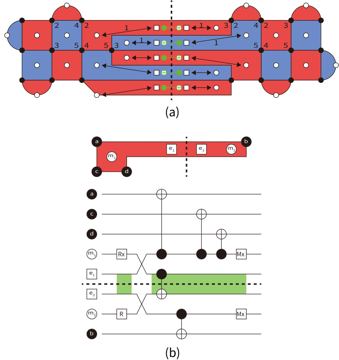
- IBM Quantum Blue Jay IBM blog ▣ Fig. 2 (module connectivity: linear / triangular arrangements); §2.4 Inter-module measurements ✅
- IBM Quantum Cockatoo IBM press ▣ Fig. 2 (module connectivity; code-code adapter between modules) ✅
- IBM Quantum Flamingo (l-coupler proof of concept) IBM blog ▥ coupler taxonomy ('L-couplers, which connect chips with cables'); Flamingo sentence ✅
- IBM Quantum Kookaburra IBM docs ▣ Fig. 2 (module components: code, LPU, factory, code-code adapter) ✅
- IBM Quantum Starling IBM blog ▣ Fig. 2 (module connectivity: linear/triangular); §2.4 Inter-module measurements ✅
- Aqumen Seeker Quantum Circuits Inc. (acquired by D-Wave, Jan 2026) press ▤ 🔎
- QuantWare Bass-A10K (VIO-40K) QuantWare press ▦ §VIO-40K announcement (consists entirely of chiplet modules connected via chip-to-chip connections) ✅
- Rigetti Cepheus-1-108Q Rigetti Computing blog ▣ Fig. 1a-c (Bump-Paddle, Bump-Bump, Four-Bump multi-chip coupler designs on a common carrier chip); Fig. 3 (assembled device); Fig. 5 (coherence with indium bumps); §II.B ✅
- Rigetti Cepheus-1-36Q Rigetti Computing blog press ▣ Fig. 1a-c (Bump-Paddle, Bump-Bump, Four-Bump multi-chip coupler designs on a common carrier chip); Fig. 3 (assembled device); Fig. 5 (coherence with indium bumps); §II.B ✅
- IBM Quantum Nighthawk r2 IBM blog ▥ 🔎 (alternate)
- quantum annealers 1
- Advantage3 D-Wave Quantum press link ▨ 'packaging and superconducting interconnect technologies to scale the annealing architectures to multi-chip fabrics' ✅
Pictures
Every picture carries the story of what it shows and its credit line.
Multi-chip modules / l-couplers (same cryostat)
Splitting a superconducting processor across several dies inside one cryostat, joined by bump-bonded chiplet links or metre-scale superconducting l-couplers.
Verdict. Chiplet tiling ships and costs fidelity — 99.5% at four chiplets, 99.1% at twelve; l-couplers have no published fidelity. Demote if no two-module entangling figure by end-2027.
Λ = error-suppression factor per code-distance step; QBI = DARPA Quantum Benchmarking Initiative (Stage A concept → B R&D plan → C government V&V); G1–G7 = the report's goal classes (see Actors & economics).
Identity & lineage
A multi-chip module partitions one processor across several superconducting dies sharing a single dilution refrigerator, with quantum-coherent links between them. Two different links wear the label. The short one is a chiplet join: dies flip-chip mounted on a common carrier at sub-millimetre pitch, coupled through indium bumps or vacuum-gap capacitors, so an inter-die coupler is electrically a slightly longer on-chip coupler. The long one is IBM's "l-coupler", a superconducting cable of centimetre-to-metre length carrying a microwave mode between separately packaged modules under one mixing chamber. Both differ from inter-fridge links, which cross a room-temperature gap, and from on-chip long-range couplers, which never leave the die.
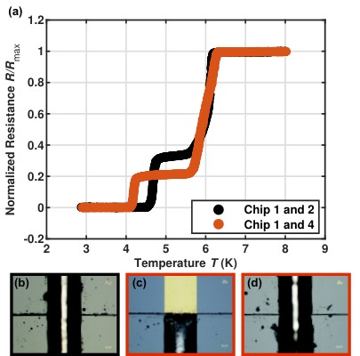
Lineage: Rigetti entangled qubits across four separate silicon dies in 2021-09, iSWAP 99.1 ± 0.5% and CZ 98.3 ± 0.3%, with a Bell violation between dies D[747]; SUSTech linked five modules with aluminium coaxial interconnects in 2023-02 D[748]; IBM says l-couplers were "first demonstrated in 2024" on Flamingo C[481], and in 2024-09 published low-loss indium joins for the superconducting cables of such links, tested on 1 m of aluminium coax with no qubit measured through it D[750]. The graph record dates the node to 2025, when tiling became a shipped product rather than a demonstration.
Attributes. Affinity: fully fabricated, a packaging structure with no natural counterpart. Characteristic time and determinism: not applicable — the node carries no entangling primitive, it inherits the gate it transports. Readout: none. Mobility: long-range, the property it exists to supply. Control: microwave at millikelvin. Error structure as the code sees it: coherent. Manufacturing: superconducting lithography plus packaging steps.
Physics & limits
The short-link floor is frequency crowding, not loss. Each chiplet is a separate fabrication instance with its own junction-resistance distribution, so tiling k dies convolves k frequency distributions that were never co-targeted; collisions between qubit, coupler and inter-die modes are fixed at packaging time and cannot be tuned away. Hence the coherent error structure: a mis-set detuning is a deterministic phase, not a stochastic click. The bonds themselves are benign — Rigetti's multi-chip tunable couplers, built from vacuum-gap capacitors or indium bumps, reached a CZ of 99.13 ± 0.15% in 56 ns through a coupler bridging four chips, "at the same level" as a single-chip tunable coupler, with no coherence penalty from one or more bonds D[749].
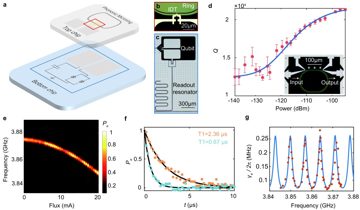
The long-link floor is cable loss and mode density. A metre-scale cable is a multimode resonator whose free spectral range is of order 100 MHz, so tens of modes fall in the 3–5.5 GHz band the qubits use D[750]. Loss sets transfer error: at an internal quality factor of 1.24 × 10⁶ on an indium press-mold cable-to-chip join, photon lifetime is Q/ω ≈ 49 µs, so a 100 ns inter-module SWAP costs about 2 × 10⁻³ S[750]. Joins dominate in practice — contact resistances of 6 × 10⁻⁴ Ω at an inner-conductor splice and 8.5 × 10⁻⁴ Ω cable-to-chip are the measured levers D[750].
Underneath both is a yield argument: monolithic yield falls as y^N in qubit count, and tiling k chiplets of n qubits replaces one exponential with k smaller ones plus an assembly step. The price shows in the only shipped data, 99.5% at four chiplets against 99.1% at twelve C[36], [751]. Moving the floor needs co-targeted junction trimming across a chiplet set Dfact and joins whose loss and mode comb stay out of the way.
Engineering state of the art
Best demonstrated as of 2026-09-03: inter-module SWAP at the 99% level in under 100 ns between two modules in one cryostat, remote-entanglement error near 1% D[752]. Typical at scale: Rigetti's Cepheus-1-108Q, 108 qubits from twelve 9-qubit chiplets, median two-qubit 99.1%, single-qubit 99.9%, ~60 ns gates C[36]. No l-coupled processor exists; IBM's 2026 milestone is two coupled cryogenic cells with no qubits in them C[50].
Records timeline
| Year | Figure | Who | Tag+key |
|---|---|---|---|
| 2021-09 | iSWAP 99.1 ± 0.5%, CZ 98.3 ± 0.3% across four dies; Bell violation | Rigetti | D[747] |
| 2023-02 | five modules on Al coax, Q 8.1 × 10⁵, transfer and Bell 99%, 12-qubit GHZ 55.8 ± 1.8% | SUSTech | D[748] |
| 2023-08 | CZ 99.13 ± 0.15% in 56 ns through a coupler bridging four chips | Rigetti | D[749] |
| 2024-09 | indium cable-to-chip join, Q 1.24 × 10⁶, contact resistance 8.5 × 10⁻⁴ Ω | IBM | D[750] |
| 2025-06 | inter-module SWAP 99% in < 100 ns, remote entanglement error ≈ 1% | Illinois | D[752] |
| 2025-07-16 | 36 qubits, four chiplets, median 2Q 99.5%, 2× error cut vs Ankaa-3 | Rigetti | C[751] |
| 2026-04-07 | 108 qubits, twelve chiplets, median 2Q 99.1% | Rigetti | C[36] |
| 2026-08-19 | two cryogenic cells coupled; 0.53 m² wiring, 2.75 m³ vacuum per cell | IBM | C[50] |
The dominant term is not the interconnect. Rigetti's own comparison isolates it: same chiplet, same join, three times as many, 40 basis points of two-qubit fidelity lost C[36], [751]. Nothing published attributes that loss, which makes frequency targeting across a tiled set the leading suspect and the leading unknown.
Manufacturing, materials & supply chain
Superconducting lithography plus a packaging line: flip-chip bonding, indium bumps or press-mold joins, through-silicon vias, a carrier. IBM builds on 300 mm at Albany NanoTech Cfact; QuantWare sells 3D vertical integration as a product — a stack of chiplet modules with chip-to-chip connections targeting 10,000 qubits, first delivery 2028, with a Kilofab in Delft opening 2026 to raise capacity 20× P[495]fact. Rigetti fabricates 9-qubit chiplets on its own line C[751].
The single points of failure sit outside the fab. The cryostat is one: IBM's cell architecture is a bespoke refrigerator programme, and the merchant alternative is Bluefors' KIDE, quoted at more than 4,000 RF lines and "over 1000 qubits" on nine pulse tubes Cfact. Bump-bond and TSV capacity for superconducting stacks sits with a handful of lines — Albany, Kilofab, GlobalFoundries under its CHIPS letter of intent fact, SkyWater now inside IonQ fact. Export exposure is uneven. The BIS rule of 2024-09-06 puts dilution refrigerators rated ≥ 600 µW at ≤ 0.1 K under ECCN 3A904, but a quantum computer under 4A906 only when its qubit count and its C-NOT (controlled-NOT gate) error fall in the same band — 34–99 qubits at ≤ 10⁻⁴, 100–199 at ≤ 10⁻³, the ceiling rising to 6 × 10⁻³ below 2,000 qubits, any error from 2,000 on fact. Rigetti's 108 qubits at a median two-qubit error near 9 × 10⁻³ C[36] fall outside 4A906, so a refrigerator of that class can be controlled while the tiled processor it cools is not.
Control, readout & I/O burden
Packaging does not reduce lines per qubit; it relocates them and buys wiring area. At 10³ qubits one merchant cryostat suffices — KIDE's 4,000-plus RF lines cover it Cfact. At 10⁴ the choice is 40,000 lines through vertical I/O, QuantWare's 2028 promise Pfact, or cold multiplexing. At 10⁶ neither works: many cells plus on-chip control generation, whose published pointer is millikelvin SFQ control at 1Q > 99% fact.
Latency is not the l-coupler's problem — the demonstrated inter-module SWAP is under 100 ns D[752] against a 280 ns readout at 99.94% fidelity D[38]. The decoder is: cross-module syndrome extraction must close inside a ~1 µs cycle while a parity check spans two packages, and no such demonstration exists as of 2026-09-03. NVQLink's 3.84 µs round trip Pfact is a host-QPU budget, far too slow for an intra-cryostat check.
Role in the stack
Three architectures use it: superconducting transmons, superconducting bosonic cat/GKP, superconducting dual-rail erasure. It requires superconducting-qubit lithography with multilayer routing and flip-chip packaging. It replaces inter-fridge cryogenic links, and the price is thermal: everything shares one cooling budget and one vacuum, so scaling stops at the fridge rather than at the network. Its contribution is manufacturability, not gate physics.
A fabricated carrier acquires far-range connectivity through packaging, where atoms and ions acquire it through motion. Derived clock = sum of the syndrome round: gate layers + transport + readout + reset for the architecture: 0.65 µs, readout at ≈ 280 ns its largest term, and the < 100 ns inter-module SWAP D[752] is at most about 15% of the round (100 of 650 ns), so transport does not bind. Neighbouring empty slots: cross-module error correction, and a qLDPC code whose checks span modules — compilation for such machines exists only in simulation S[753].
Evidence — how the numbers were measured
Rigetti's 99.1% and 99.5% are company medians without error bars or a stated protocol C[36], [751]; the 2021 die-to-die numbers carry explicit uncertainties D[747]. SUSTech's 99% is a state-transfer and Bell-state fidelity, not a gate fidelity, and its 12-qubit GHZ at 55.8 ± 1.8% shows what five linked modules do at depth D[748]. The Illinois figure is a SWAP efficiency with a separately stated ~1% error called threshold-level; the two should not be conflated D[752]. IBM's coupled-cell result contains no qubits and no fidelity claim C[50]. No value conflicts were found; the gap is that nothing explains the 99.5% → 99.1% step.
Neither arXiv:2308.09240 (Rigetti; cross-chip CZ 99.13 ± 0.15% in 56 ns) nor arXiv:2409.04634 (IBM Quantum, T. J. Watson Research Center; cable joins, no qubit measured) has a journal version as of 2026-09-30. The 40,000 I/O lines of QuantWare's Bass-A10K (VIO-40K) rest only on QuantWare's own release of 2025-12-08 fact, which the trade-press page of 2025-12-10 P[495] omits, and no delivered device confirms them. Not published: a gate fidelity or latency through IBM's l-coupler, "first demonstrated in 2024" on Flamingo C[50], [481], whose cable joins were tested on 1 m of aluminium coax at internal Q ≈ 10⁶ D[750], as of 2026-09-30; and a dated assignee record for Rigetti's chiplet-packaging and QuantWare's vertical-I/O patent families.
Actors & economics
Who.
| Organisation | Role | Country | What exactly they do with this technology | Evidence |
|---|---|---|---|---|
| IBM | developer | US | l-couplers between modules and their cable joins; modular cryogenic cells; Cockatoo 2027, Starling 2029 | C[50], [481] D[750] fact |
| Rigetti | developer | US | only shipped multi-chip system with published figures: 4- and 12-chiplet processors | C[36], [751] fact |
| QuantWare | supplier | Netherlands | merchant 3D-integrated chiplet stacks; VIO-40K, Kilofab Delft | P[495] fact |
| SUSTech | research | CN | five-module aluminium-coax interconnect network | D[748] |
| Univ. of Illinois Urbana-Champaign | research | US | interchangeable modules, 99% inter-module SWAP < 100 ns | D[752] |
| Bluefors | supplier | FI | KIDE platform, > 4,000 RF lines, the merchant multi-module fridge | Cfact |
| GlobalFoundries | supplier | US | multi-modality foundry under CHIPS letter of intent, $375 M | fact |
| DARPA | funder | US | QBI Stage B funds IBM's modular path; Rigetti not on the list | fact |
Money.
- 2025-11-06 · IBM · DARPA QBI Stage B selection · up to $15 M each · DARPA · announced fact
- 2026-05-05 · QuantWare · Series B · $178 M (€152 M) · Intel Capital, In-Q-Tel, ETF Partners, no single lead · cumulative > $210 M · closed Pfact
- 2026-05-21 · Rigetti · CHIPS letter of intent · up to $100 M · Dept of Commerce, within a $2.013 B package (GlobalFoundries $375 M, IBM/Anderon $1 B) · LOI, non-binding fact
- 2026-07-31 · IonQ · acquisition of SkyWater Technology · ~$1.8 B at announcement · closed fact
- 2026-08 · Rigetti · Q2-2026 results · revenue $5.1 M, GAAP loss $52.6 M, cash $541.3 M · reported fact
Market & supply chain. No one sells an l-coupler; it is a captive design block. The merchant layer is one company deep — QuantWare is the only vendor selling 3D-integrated multi-chip QPUs to third parties P[495] — plus Bluefors for the enclosure and a short list of lines that can do superconducting flip-chip at volume. Who pays: G3 and G4 above all, since Starling depends on modules rather than a bigger die; G7 for deployable multi-cell systems; G2 through wider processors.
IP & standards. IBM holds US 12,517,856, "Modular quantum system with discrete levels of connectivity" (filed 2022-09-28, granted 2026-01-06), and US 12,587,192 on chains of resonators with tunable inductive couplers (granted 2026-03-24) fact — the l-coupler's cable joins are published D[750], a gate fidelity through one is not. For Rigetti's chiplet packaging and QuantWare's vertical I/O, no dated patent fact was found within budget. There is no inter-module interface standard and no open-source packaging stack.
Roadmaps & track record.
- IBM: promised 2025-06-10 · l-couplers demonstrated on Flamingo in 2024 · claimed delivered, no link fidelity published as of 2026-09-30 C[481].
- IBM: promised 2025-06-10 · Cockatoo 2027, entanglement between modules via the universal adapter; Nighthawk on nine l-coupled modules for 1,080 qubits by 2028 · pending R[481] fact.
- IBM: promised 2022-05-10 · Kookaburra, a 1,386-qubit multi-chip processor, for 2025 C[313]; re-promised 2025-06-10 for 2026 as the first module with a qLDPC memory R[481] · not delivered as of 2026-09-30 fact.
- Rigetti: promised 2025-07-16 · 100+ qubit chiplet system at median 99.5% before end-2025 · delivered 2026-04-07 at 99.1%, target moved to "later in 2026" C[36], [751].
- QuantWare: promised 2025-12-08 · VIO-40K (VIO is QuantWare's vertical-wiring architecture), 10,000 qubits, first delivery 2028 · pending Pfact.
Credibility: IBM meets its single-chip processor dates but not its multi-chip one — Kookaburra, promised for 2025, is undelivered — and publishes packaging as architecture rather than measurement, so its modular claims stay unfalsifiable until Cockatoo; Rigetti ships what it describes, a fidelity step behind its own target; QuantWare has money and a fab but no delivered multi-chip QPU at scale to judge.
Strategic reading. If multi-chip modules work, the decisive asset moves from lithography to packaging and cryogenics, and the winner is whoever controls bump-bond, TSV and fridge capacity — IBM by vertical integration, QuantWare by merchant supply, IonQ through SkyWater. The loser is any roadmap assuming a single ever-larger die. Substitution threats: on-chip long-range couplers, which buy connectivity without packaging risk, and inter-fridge links, which buy unlimited scale at the price of a room-temperature crossing. Supplier bargaining power is high: there are more credible qubit vendors than lines that can bond them.
Outlook & open questions
Confirm within 12–24 months if: IBM's Cockatoo demonstrates entanglement between two l-coupled modules with a published fidelity by end-2027 R[481]; Rigetti's 108-qubit system reaches median 99.5% C[36]; anyone runs a stabiliser round whose checks cross a module boundary. Demote if no l-coupler fidelity is published by end-2027. Best case by 2029: a few thousand qubits in coupled cells with cross-module error correction at Λ comparable to monolithic. Worst case: tiling saturates near 10² qubits because frequency targeting across dies does not scale.
Open questions: what causes the 40-basis-point tiling tax, per-join or per-calibration? Can a metre-scale cable's mode comb be pushed out of band without shortening it? What is an l-coupler's fidelity, two years after the claim? Does a qLDPC check spanning modules survive the extra transport error? Watch Rigetti's roadmap update, IBM's first Cockatoo measurement, QuantWare's Kilofab yield, and any paper benchmarking a chiplet boundary as such.
References
- [36] Rigetti Computing, Inc., “Rigetti Announces General Availability of 108-Qubit System,” Apr. 7, 2026. [Online]. Available: https://investors.rigetti.com/
news-releases/ Cnews-release-details/ rigetti-announces-general-availability-108-qubit-system - [38] F. Marxer et al., “Above 99.9% Fidelity Single-Qubit Gates, Two-Qubit Gates, and Readout in a Single Superconducting Quantum Device,” PRX Quantum, vol. 7, Art. no. 020333, 2026, doi: 10.1103/n86s-2b88. arXiv:2508.16437. D
- [50] C. Dundon, S. Hall, M. Hollister, and A. Lindler, “IBM's new modular architecture for cryogenic systems,” IBM Quantum Computing Blog, Aug. 19, 2026. [Online]. Available: https://www.ibm.com/
quantum/ Cblog/ modular-cryogenics - [313] J. Gambetta, “Expanding the IBM Quantum roadmap to anticipate the future of quantum-centric supercomputing,” IBM Quantum Blog, May 10, 2022. [Online]. Available: https://www.ibm.com/
quantum/ Cblog/ ibm-quantum-roadmap-2025 - [481] R. Mandelbaum et al., “How IBM will build the world's first large-scale, fault-tolerant quantum computer,” IBM Quantum Computing Blog, Jun. 10, 2025. [Online]. Available: https://www.ibm.com/
quantum/ Cblog/ large-scale-ftqc - [495] M. Abdel-Kareem, “QuantWare Debuts VIO-40K™ Architecture to Enable 10,000-Qubit Superconducting Processors,” Quantum Computing Report, Dec. 10, 2025. [Online]. Available: https://quantumcomputingreport.com/
quantware-debuts-vio-40k-architecture-to-enable-10000-qubit-superconducting-processors/ P - [747] A. Gold et al., “Entanglement across separate silicon dies in a modular superconducting qubit device,” npj Quantum Inf., vol. 7, no. 1, Art. no. 142, Sep. 2021, doi: 10.1038/s41534-021-00484-1. arXiv:2102.13293. Also https://arxiv.org/
abs/ . D2102.13293 - [748] J. Niu et al., “Low-loss interconnects for modular superconducting quantum processors,” Nat. Electron., vol. 6, no. 3, pp. 235–241, Feb. 2023, doi: 10.1038/s41928-023-00925-z. arXiv:2302.02751. D
- [749] M. Field et al., “Modular Superconducting Qubit Architecture with a Multi-chip Tunable Coupler,” arXiv:2308.09240, Aug. 2023. D
- [750] Y. Martin et al., “Mechanically-intermixed indium superconducting connections for microwave quantum interconnects,” arXiv:2409.04634, Sep. 2024. D
- [751] Rigetti Computing, “Rigetti Demonstrates Industry's Largest Multi-Chip Quantum Computer; Halves Two-Qubit Gate Error Rate,” Rigetti Investor Relations, Jul. 16, 2025. [Online]. Available: https://investors.rigetti.com/
news-releases/ Cnews-release-details/ rigetti-demonstrates-industrys-largest-multi-chip-quantum - [752] M. Mollenhauer, A. Irfan, X. Cao, S. Mandal, and W. Pfaff, “A high-efficiency elementary network of interchangeable superconducting qubit devices,” Nat. Electron., vol. 8, no. 7, pp. 610–619, Jul. 2025, doi: 10.1038/s41928-025-01404-3. D
- [753] Z. Du et al., “Hardware-aware Compilation for Chip-to-Chip Coupler-Connected Modular Quantum Systems,” arXiv:2505.09036, May 2025. S