Cryogenic microwave link between refrigerators ic_cryolink
Superconducting waveguide held below 50 mK along its whole length, carrying itinerant 5–7 GHz photons or squeezed states between two independently cooled dilution refrigerators.
Cryogenic microwave link between refrigerators
30 m superconducting waveguide at < 50 mK; Bell fidelity 80.4% at 12.5 kHz; 0.55–0.65 dB total loss.
Key references
Design space — attributes
- (a) carrier affinity
- fabricated
- (b) time · entangling
- —
- (c) readout
- —
- (d) mobility
- long-range static couplers
- (e) control
- microwave @ millikelvin stage
- (f) error structure
- loss (erasure), coherent / calibration
- (g) manufacturing
- superconducting lithography
Evaluation space — dated attributes
ETH Zürich. A '75–79% transfer efficiency' sometimes quoted is not implied by 0.55–0.65 dB, which is 86–88% transmission; the ETH paper attributes the loss to the 26 demountable module joints, and any residue would be node emission/absorption efficiency.
Actors & goals — annotations
Edges
Used by no registered machine
Pictures
Every picture carries the story of what it shows and its credit line.
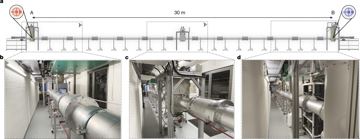
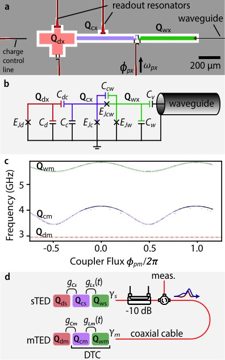
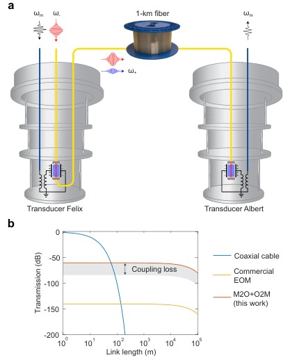
Cryogenic microwave link between refrigerators
Superconducting waveguide held below 50 mK along its whole length, carrying itinerant 5–7 GHz photons or squeezed states between two independently cooled dilution refrigerators.
Verdict. Two groups hold the headlines: ETH Zürich for photon transfer and Bell tests — 30 m, Bell fidelity 80.4% at 12.5 kHz, loophole-free — and TU Munich with VTT for squeezed states over 6.6 m. Loss sits in the demountable joints, not the waveguide, and no architecture puts this on a fault-tolerance critical path.
Λ = error-suppression factor per code-distance step; QBI = DARPA Quantum Benchmarking Initiative (Stage A concept → B R&D plan → C government V&V); G1–G7 = the report's goal classes (see Actors & economics).
Identity & lineage
A superconducting waveguide cooled far below aluminium's superconducting transition (≈1.2 K) along its whole length, carrying itinerant ~5–7 GHz photons between two separately cooled dilution refrigerators — not between chips in one cryostat. Wallraff's group at ETH Zürich introduced it in 2020: 5 m, state transfer 85.8%, remote Bell pairs 79.5% D[772]. The 30 m successor carried the first loophole-free superconducting Bell test in 2023 D[305]; the 2026 paper documents it as a reproducible modular assembly D[773]. TU Munich with VTT runs the only independent second line, sending squeezed Gaussian states over 6.6 m D[774]. Attributes: d = long-range inter-cryostat connectivity, the only layer entry spanning separate refrigerators; e/f/g = millikelvin microwave drive at both fridges, loss and coherent phase rather than Pauli errors, superconducting lithography with demountable interfaces (graph record).
Physics & limits
The waveguide is not the limit: attenuation is α < 1 dB/km, under 0.03 dB across the full 30 m — the same figure in the 2023 and 2026 papers D[305], [773]. End-to-end photon transfer loss is nonetheless 0.55–0.65 dB (12–14%), which the 2026 paper attributes to the interfaces between modules, not the line D[773]: every one of the 26 demountable joints costs transmission.
Second, thermal occupation. At 5.6 GHz a photon is worth 0.27 K, so a 50 mK channel holds 4.6×10⁻³ residual photons, while the 1 K channel centre at which Munich/VTT still resolved entanglement holds ≈3.3 D[774]. Fock transfer degrades roughly linearly in that occupation; Gaussian squeezed states tolerate it, so squeezing is the cheaper carrier to lengthen. Third, phase: two mechanically independent cryostats need a common reference, and no source quantifies the residual phase noise — the term that would bound a repeatered link. What moves the floor: welded or bump-bonded joints replacing demountable flanges.
Engineering state of the art
table
| Year | Figure | Who | Tag+key |
|---|---|---|---|
| 2023-05 | 30 m link, Bell fidelity 80.4% at 12.5 kHz, CHSH S = 2.0747 ± 0.0033 | ETH Zürich | D[305] |
| 2025-05 | 6.6 m squeezed link, 2.10 ± 0.02 dB squeezing, negativity 0.501 ± 0.011 | TU Munich | D[774]fact |
| 2026-04 | 30 m modular assembly, 26 modules, 6.5 d cooldown, 0.55–0.65 dB transfer loss | ETH Zürich | D[773] |
Interface loss dominates, ~20× the waveguide's own contribution D[773]; no chained (≥3-fridge) link, no link run during gate execution, and no independent 30 m replication as of 2026-09-04.
Manufacturing, materials & supply chain
Every link is bespoke. The ETH 30 m assembly is 26 modules plus two nodes and a central cooling unit, holding the 4 K stage under 6 K across the span; the 6.5-day cooldown, not fidelity, is what makes iteration slow, and simulation puts one cooling unit per ~15 m out to 120 m D[773]S[773]. Base cryostats come from a concentrated market: Bluefors closed its Cryomech acquisition (pulse-tube and Gifford-McMahon cryocoolers) on 2023-03-28, giving ~600 staff and revenue above EUR 160 M C[524]; ULVAC is a Japanese third source built with IBM input C[525]fact. Export exposure is inherited: ECCN 3A904 (BIS, 2024-09-06) covers refrigerators sustaining ≥600 µW at 0.1 K for 48 h; no ECCN names a link G[301]fact.
Control, readout & I/O burden
Each attempt needs a flux-tunable coupler at both ends and microwave sources phase-locked across two cryostats. The 2023 Bell test carries this report's hardest real-time constraint: 32.824 m of separation leaves a 109 ns window in which basis choice, gate, readout and record must all complete D[305]. The 12.5 kHz repetition rate — 80 µs per attempt — is set by reset and pulse shaping, not time of flight. Nothing is published at 10³–10⁶ qubits; the binding quantities are cryoplant count and independent phase references.
Role in the stack
The only architecture is superconducting transmon (Google, IBM, Rigetti, IQM, OQC, USTC/Zhejiang, Fujitsu); it requires superconducting-qubit lithography. It competes with same-fridge modularity — IBM coupled two cryogenic cells in 2026-08, l-couplers at "one meter scale", with no qubits and no fidelity reported C[50]fact — and with microwave-optical transduction, best total efficiency 47% and nothing at η > ½ with sub-unity added noise P[775]fact. Derived clock: 80 µs per entanglement attempt (2 s.f.) against a 1.1 µs surface-code cycle — ~73× slower, under two orders of magnitude. Adjacent empty slot: a cryogenic microwave switch, absent which N fridges need N(N−1)/2 waveguides.
Evidence — how the numbers were measured
A loophole-free violation of the CHSH (Clauser–Horne–Shimony–Holt) Bell inequality with space-like separated measurements is device-independent, not tomographic — unusually strong verification for this layer D[305]. Munich rests on homodyne tomography D[774]; the two are not comparable, neither replicated, and both ran with local processors idle. Conflict: the graph record's 75–79% transfer efficiency is not what 0.55–0.65 dB implies alone (86–88%).
Not published: the residual phase noise between the two cryostats.
Actors & economics
Who.
| Organisation | Role | Country | What exactly they do with this technology | Evidence |
|---|---|---|---|---|
| ETH Zürich | Research | Switzerland | Built the 5 m, 30 m and modular links; holds the photon-transfer and Bell-test headlines | D[305], [772], [773] |
| TU Munich | Research | Germany | 6.6 m squeezed-state link with VTT — the independent second line, with its own headline | D[774] |
| Bluefors | Supplier | Finland | Refrigerator and cryocooler vendor; KIDE is the rival path | C[303]fact |
| ULVAC Cryogenics | Supplier | Japan | ~10 mK refrigerator with IBM input, tested at Poughkeepsie | C[525]fact |
| IBM | Developer | USA | Runs the competing intra-fridge modular-cryogenics line | C[50]fact |
Money. 2023-03-28 · Bluefors · M&A (Cryomech) · undisclosed · combined revenue > EUR 160 M · closed C[524]. 2024-09-06 · US BIS · ECCN 3A904 rule · n/a · in force G[301]. 2025-03-20 · ULVAC · ~10 mK refrigerator programme with IBM · undisclosed · "early 2026" target passed, no shipment confirmed as of 2026-09-30 C[525]. No round, grant or acquisition specific to an inter-fridge link exists as of 2026-09-04.
Market & supply chain. There is no link market, only a refrigerator market in which a link consumes two units instead of one; Oxford Instruments is the second merchant source C[525]. Bluefors plus Cryomech supplies the dilution stage and the pulse tubes beneath it with no alternative at that volume C[524]. G6 (networking) pays directly; G4 pays only once a cryostat's line budget runs out, which KIDE's >4,000 RF lines are designed to postpone C[303]fact.
IP & standards. No patent family specific to cross-cryostat microwave links in any named database and no standards body addressing cryogenic microwave interfaces — no dated fact found; module geometry is published openly D[773].
Roadmaps & track record. ETH Zürich: (2023-05 · 30 m Bell test · delivered); (2026-04 · 120 m via cooling units per ~15 m · simulated only) S[773]. ULVAC/IBM: (2025-03 · refrigerator "early 2026" · target passed, unconfirmed as of 2026-09-30) C[525]. IBM: (2026-08 · two coupled cells · delivered, no qubits in them) C[50]. ETH has met every milestone it announced; both vendor timelines are unverified.
Strategic reading. If this works the cryostat suppliers capture the value, not the QPU vendor. If it fails nothing breaks — every published superconducting roadmap scales inside one cryostat first. Substitution runs both ways: l-couplers remove the need below ~1,000 qubits per cell C[50], transduction removes the distance limit above it. No independent link vendor exists to bargain with.
Outlook & open questions
Falsifiable (12–24 months): confirm if any group publishes a three-cryostat chained link, or a 30 m link run while both processors execute gates, by end-2027; demote if interface loss is not below 0.3 dB by then. Best case 2029: per-hop efficiency above 90% and an architecture that needs two fridges. Worst case: intra-cryostat modularity absorbs all growth through 2030 and this stays a Bell-test instrument. Open questions: residual inter-cryostat phase noise; whether joints can be non-demountable and still serviceable; whether anyone builds a cryogenic microwave switch. Watch: ETH follow-ons, IBM's first coupled cells with qubits in them.
References
- [50] C. Dundon, S. Hall, M. Hollister, and A. Lindler, “IBM's new modular architecture for cryogenic systems,” IBM Quantum Computing Blog, Aug. 19, 2026. [Online]. Available: https://www.ibm.com/
quantum/ Cblog/ modular-cryogenics - [301] US Department of Commerce, Bureau of Industry and Security, “Commerce Control List Additions and Revisions; Implementation of Controls on Advanced Technologies Consistent With Controls Implemented by International Partners,” Federal Register, vol. 89, p. 72926, Sep. 6, 2024. [Online]. Available: https://www.federalregister.gov/
documents/ G2024/ 09/ 06/ 2024-19633/ commerce-control-list-additions-and-revisions-implementation-of-controls-on-advanced-technologies - [303] Bluefors, “KIDE Cryogenic Platform — For Large-Scale Quantum Computing,” Jun. 16, 2026. [Online]. Available: https://bluefors.com/
products/ Ckide-cryogenic-platform/ - [305] S. Storz et al., “Loophole-free Bell inequality violation with superconducting circuits,” Nature, vol. 617, no. 7960, pp. 265–270, May 2023, doi: 10.1038/s41586-023-05885-0. D
- [524] Bluefors, “Bluefors closes the acquisition of Cryomech,” Mar. 28, 2023. [Online]. Available: https://bluefors.com/
press-releases/ Cbluefors-closes-the-acquisition-of-cryomech/ - [525] ULVAC, “ULVAC Developing Next-Generation Dilution Refrigerator for Quantum Computing by 2026,” Nasdaq (JCN Newswire), Mar. 20, 2025. [Online]. Available: https://www.nasdaq.com/
press-release/ Culvac-developing-next-generation-dilution-refrigerator-quantum-computing-2026-2025-03 - [772] P. Magnard et al., “Microwave Quantum Link between Superconducting Circuits Housed in Spatially Separated Cryogenic Systems,” Phys. Rev. Lett., vol. 125, no. 26, Art. no. 260502, Dec. 2020, doi: 10.1103/PhysRevLett.125.260502. arXiv:2008.01642. D
- [773] J. D. Schär et al., “A Modular Cryogenic Link for Microwave Quantum Communication Over Distances of Tens of Meters,” arXiv:2604.15971, Apr. 2026. D
- [774] W. K. Yam et al., “Cryogenic microwave link for quantum local area networks,” npj Quantum Inf., vol. 11, no. 1, Art. no. 87, May 2025, doi: 10.1038/s41534-025-01046-5. D
- [775] T. A. Aditto, J. S. Ifty, and K. Zahin, “Toward Scalable Heterogeneous Quantum Networks: Microwave-Optical Transduction Across Platforms,” arXiv:2605.26976, May 2026. P