Ion–photon link ic_ionphoton
Heralded ion–photon entanglement over fibre links separate ion traps into one machine; best published rate 250 s⁻¹ against a ~10⁴ s⁻¹ need.
Ion–photon link
Remote Bell pairs at 9.7–250 s⁻¹ with 94–97% fidelity; teleported CZ 86%; needs ≥ 10⁴ s⁻¹.
Brief →Key references
Design space — attributes
- (a) carrier affinity
- natural
- (b) time · entangling
- —
- (c) readout
- —
- (d) mobility
- flying qubits (photons)
- (e) control
- optical @ room temperature
- (f) error structure
- loss (erasure)
- (g) manufacturing
- optical / mechanical assembly
Evaluation space — dated attributes
The 2007 first remote ion–ion entanglement is Monroe's group (Michigan, later Maryland/Duke) — the lineage holding today's rate record — not the Wineland/NIST line. IonQ's 2026-04 interconnect milestone discloses no rate, fidelity or distance and asserts no measured Bell state.
Actors & goals — annotations
Edges
Used by 3 machines (3 primary · 0 alternate)
- trapped ions 3
- Superion 256 IonQ press press ▨ ✅
- Apollo Quantinuum blog ▥ 🔎
- Maryland / Duke Quantum Center (EURIQA lineage) University of Maryland / Duke University paper paper ▤ 🔎
Pictures
Every picture carries the story of what it shows and its credit line.
Ion–photon link
Heralded ion–photon entanglement over fibre links separate ion traps into one machine; best published rate 250 s⁻¹ against a ~10⁴ s⁻¹ need.
Verdict. Real: remote Bell pairs at 9.7–250 s⁻¹, 94–97% fidelity, teleported CZ 86%. Unverified: IonQ's networked-systems claim carries no rate or fidelity. Demote if nothing exceeds 10³ s⁻¹ by end-2028.
Λ = error-suppression factor per code-distance step; QBI = DARPA Quantum Benchmarking Initiative (Stage A concept → B R&D plan → C government V&V); G1–G7 = the report's goal classes (see Actors & economics).
Identity & lineage
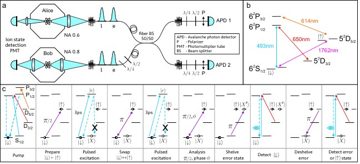
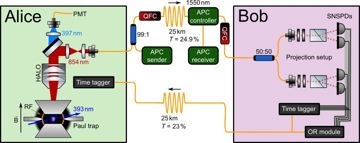
An ion decaying from an excited state emits a photon entangled with its qubit state; interfere two such photons from two traps on a beamsplitter and a coincident detection projects the distant ions into a Bell pair — heralded and probabilistic, unlike an in-trap gate, and the only mechanism coupling ions in separate vacuum systems. First shown in 2007 by Monroe's group (Michigan, later Maryland/Duke) — the lineage that holds today's rate record, not the Wineland/NIST line.
Attributes. Mobility: flying — the photon, not the ion, carries entanglement. Control modality @ placement: optical, room temperature — collection, interference and detection sit outside the trap's vacuum envelope.
Physics & limits
The rate is the whole problem. Success probability per attempt goes as η², where η is collection solid angle × branching ratio × fibre coupling × detector efficiency, since both photons must survive; two in η is four in rate. With free-space objectives η sits in the low per cent, so published rates are 9.7 s⁻¹ over a 2-m link D[115] and 250 s⁻¹ at the record D[116] against the ~10⁴ s⁻¹ a QEC cycle would consume — 40× at best, closing quadratically through collection, not electronics.
Fidelity is the healthier budget: two-photon interference visibility, detector dark counts and jitter, and residual ion motion cap heralded fidelity at 94–97% D[115], [116]. Because failures are heralded, the error the code sees is loss, so low η costs throughput, not infidelity — an erasure channel at the interconnect layer. What moves the floor: cavity (Purcell) enhancement, waveguide-integrated collection in photonic-chip traps, telecom frequency conversion, emitter multiplexing per module, and quantum memories that let attempts accumulate rather than retry in lockstep.
Engineering state of the art
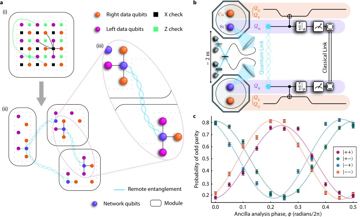
Best demonstrated is a distributed computation, not just a Bell pair: Oxford ran a teleported CZ at 86.2(9)% and a distributed Grover search across a 2-m link D[115].
table
| Year | Figure | Who | Tag+key |
|---|---|---|---|
| 2024 | Remote entanglement rate record, 250 s⁻¹ at fidelity >94% | Duke/Maryland | D[116] |
| 2025-02 | 2-m link: remote Bell 96.89(8)% at 9.7 s⁻¹, teleported CZ 86.2(9)% | Oxford | D[115] |
| 2025-06 | Lightsynq (photonic interconnect + quantum memory, >20 patents and applications) acquired | IonQ | C[776] |
| 2026-04 | Two commercial ion systems linked; no rate, fidelity or distance disclosed | IonQ | C[589] |
Dominant gap: throughput. Published rates sit 40× (the record) to ~10³× below the ~10⁴ s⁻¹ a networked QEC cycle needs; fidelity is not the blocker.
Manufacturing, materials & supply chain
No fab and no wafer statistic — the "yield" is optical collection efficiency, an alignment and numerical-aperture figure. A link is a high-NA objective or in-vacuum cavity, single-mode fibre and polarisation control, a Bell-state-measurement apparatus with two single-photon detectors, and coincidence logic. Traps come from elsewhere: Infineon is the merchant trap foundry for IonQ/Oxford Ionics, eleQtron and Universal Quantum, Honeywell fabricates Quantinuum's in house Cfact. The concentrated input is detectors: the merchant SNSPD base is five vendors — Single Quantum, ID Quantique (owned by IonQ), Photon Spot, Quantum Opus and Moscow's Scontel Pfact. Cost per link is not quotable. Export exposure is indirect: the BIS rule of 2024-09-06 names no interconnect optics G[301]; it reaches only the machine, under 4A906, and only when its qubit count and C-NOT error fall in the same band, from 34–99 qubits at ≤ 10⁻⁴ to any error from 2,000 qubits fact.
Control, readout & I/O burden
Per link: one collection channel per ion, two detectors, a phase-stable optical path, a coincidence gate. Heralding latency is sub-µs, so the electronics limit nothing — the attempt rate does. At ~10 modules a handful of point-to-point links works; at 10⁴ any-to-any needs a switch fabric plus enough pair generation to feed inter-module lattice surgery, and no published design states a link count. Quantinuum's in-trap alternative exchanges ions at 2.5 kHz and transports through junctions at 4 m/s D[113] — an order faster than the best photonic link, which is why QCCD vendors have not adopted the technology.
Role in the stack
It requires the trapped atomic ion and single-photon detection (SNSPD/TES) and provides for nothing downstream: a terminal capability, the exit from single-trap scaling. Architectures served: all three trapped-ion architectures, as primary — QCCD (Quantinuum), the linear Paul trap with laser addressing (AQT, Maryland/Duke, Quantum Art) and electronic-gate, chip-controlled ions (IonQ/Oxford Ionics, eleQtron). The graph lists no replacement or conflict, but in-trap transport is the functional rival and currently wins. Derived-clock contribution: dominant where used — at 250 s⁻¹ one inter-module pair costs 4.0×10⁻³ s, comparable to a full-width ion layer; at 9.7 s⁻¹ it is 1.0×10⁻¹ s.
Evidence — how the numbers were measured
Heralded fidelity is tomography or parity oscillation conditioned on a successful click, so 94–97% describes the links that happened, not the channel including loss; the honest figure of merit is rate × fidelity, which nobody reports. Published rates come from different species, distances and collection geometries and are not directly comparable. The weakest evidence is commercial: IonQ's release states it "validated the generation, transmission, and detection of photons used to enable quantum entanglement" — wording that stops short of reporting a measured Bell state, with no rate, fidelity or distance and no replication C[589]. Among peer-reviewed results there is no conflict.
The ">20 patents and patent applications" Lightsynq brought is IonQ's own count, with no family names, assignees or filing years. Not published: the Lightsynq deal terms, and a link count or switch-fabric topology for a 10⁴-module ion machine.
Actors & economics
Who.
| Organisation | Role | Country | What exactly they do with this technology | Evidence |
|---|---|---|---|---|
| University of Oxford | research | UK | 2-m link, teleported CZ and distributed Grover | D[115] |
| Duke University | research | US | Co-holder of the 250 s⁻¹ record | D[116] |
| IonQ | developer | US | Networked two systems; owns Lightsynq and ID Quantique | C[589] |
| Quantinuum | developer | US | Scales by in-trap transport; photonic link only as Apollo's stated direction | D[113] |
| ID Quantique | supplier | CH | SNSPD vendor, acquired by IonQ | Pfact |
| Single Quantum | supplier | NL | Merchant SNSPD supplier, independent | Pfact |
| AFRL | user | US | Partner on IonQ's April-2026 milestone | C[589] |
| DARPA | investor | US | QBI Stage B funds both ion vendors | G[65] |
Money.
- 2025-05-06 · IonQ · M&A, ID Quantique (single-photon detectors) · undisclosed · — · closed Pfact
- 2025-06-03 · IonQ · M&A, Lightsynq (interconnect, quantum memory, >20 patents) · undisclosed · Harvard/AWS founders · closed C[776]
- 2025-09-17 · IonQ · M&A, Oxford Ionics · $1.075 B · — · closed C[18]
- 2025-11-06 · DARPA · QBI Stage B · up to $15 M each · IonQ and Quantinuum among eleven G[65]
- 2026-06-03 · Quantinuum · IPO, Nasdaq QNT · $1.68 B gross · — · closed G[123]
- 2026-07-31 · IonQ · M&A, SkyWater Technology · ~$1.8 B · — · closed C[19]
Market & supply chain. There is no market yet — five merchant detector houses and a few optics suppliers — and the largest natural customer owns one of the five. IonQ has bought the vertical: Lightsynq for interconnect and memory, ID Quantique for detectors, Oxford Ionics for gates, SkyWater for fabrication. Unit economics are not quotable. G6 pays directly; G4 pays as the way past single-trap ceilings; the rest do not.
IP & standards. The only dated IP fact is IonQ's statement that Lightsynq brought "over 20 patents and patent applications" in photonic interconnect and quantum memory — a company count with no family, assignees or filing years C[776]. No named patent family was found for ion–photon link hardware; no standards body governs it.
Roadmaps & track record. IonQ (promised 2025-06 · 2 M physical, 40–80 k logical by 2030 · status 2026-09-03: needs an interconnect ~40× faster than the best published rate) R[132]; its 2020 roadmap missed 4,000 qubits by 2026 by ~40×. Quantinuum (promised 2024-09 · Sol 2027, Apollo 2029 · no dated photonic-interconnect commitment) R[118]; Helios launched on schedule, so its dates carry weight.
Strategic reading. If heralded links reach production rates the single-trap ceiling stops mattering and every ion vendor becomes modular; IonQ wins that world because it owns each layer, and merchant detector vendors lose their largest customer to a competitor. If rates stay put, Quantinuum wins by ignoring the technology — in-trap transport at 4 m/s is already faster. Supplier power is negligible today and would rise only if link counts grew with module counts.
Outlook & open questions
Confirm by end-2027 if any group publishes above 10³ s⁻¹, or IonQ discloses rate, fidelity and distance. Demote the networking-ready framing if by end-2028 nothing exceeds 10³ s⁻¹, four times the 250 s⁻¹ record. Best case by 2029: cavity or waveguide collection plus telecom conversion reaches 10³–10⁴ s⁻¹ and a three-node network appears. Worst case: rates stay at 10²–10³ s⁻¹ and modular ion machines use in-trap transport instead. Open questions: what did IonQ's link achieve; does cavity enhancement cost interference visibility; can frequency conversion survive the fidelity budget?
References
- [18] IonQ, “IonQ Completes Acquisition of Oxford Ionics, Rapidly Accelerating Its Quantum Computing Roadmap,” Sep. 17, 2025. [Online]. Available: https://www.ionq.com/
news/ Cionq-completes-acquisition-of-oxford-ionics-rapidly-accelerating-its-quantum - [19] IonQ, “IonQ Completes Acquisition of SkyWater Technology,” Jul. 31, 2026. [Online]. Available: https://www.ionq.com/
news/ Cionq-completes-acquisition-of-skywater-technology - [65] DARPA, “Stage B selection,” Nov. 6, 2025. [Online]. Available: https://www.darpa.mil/
research/ Gprograms/ quantum-benchmarking-initiative/ stage-b-selection - [113] R. D. Delaney et al., “Scalable Multispecies Ion Transport in a Grid-Based Surface-Electrode Trap,” Phys. Rev. X, vol. 14, Art. no. 041028, Nov. 2024, doi: 10.1103/PhysRevX.14.041028. arXiv:2403.00756. D
- [115] D. Main et al., “Distributed quantum computing across an optical network link,” Nature, vol. 638, no. 8050, pp. 383–388, Feb. 2025, doi: 10.1038/s41586-024-08404-x. D
- [116] J. O'Reilly et al., “Fast photon-mediated entanglement of continuously-cooled trapped ions for quantum networking,” Phys. Rev. Lett., vol. 133, Art. no. 090802, Aug. 2024, doi: 10.1103/PhysRevLett.133.090802. arXiv:2404.16167. D
- [118] Quantinuum, “Quantinuum Unveils Accelerated Roadmap to Achieve Universal, Fully Fault-Tolerant Quantum Computing by 2030,” Sep. 10, 2024. [Online]. Available: https://www.quantinuum.com/
press-releases/ Rquantinuum-unveils-accelerated-roadmap-to-achieve-universal-fault-tolerant-quantum-computing-by-2030 - [123] Quantinuum, “Quantinuum Announces Pricing of Upsized Initial Public Offering,” Jun. 3, 2026. [Online]. Available: https://www.quantinuum.com/
press-releases/ Gquantinuum-announces-pricing-of-upsized-initial-public-offering - [132] IonQ, “IonQ's Accelerated Roadmap: Turning Quantum Ambition into Reality,” Jun. 13, 2025. [Online]. Available: https://www.ionq.com/
blog/ Rionqs-accelerated-roadmap-turning-quantum-ambition-into-reality - [301] US Department of Commerce, Bureau of Industry and Security, “Commerce Control List Additions and Revisions; Implementation of Controls on Advanced Technologies Consistent With Controls Implemented by International Partners,” Federal Register, vol. 89, p. 72926, Sep. 6, 2024. [Online]. Available: https://www.federalregister.gov/
documents/ G2024/ 09/ 06/ 2024-19633/ commerce-control-list-additions-and-revisions-implementation-of-controls-on-advanced-technologies - [589] IonQ, “IonQ Achieves Key Photonic Interconnect Milestone, Demonstrating Networked Quantum Systems Using Entanglement,” Apr. 14, 2026. [Online]. Available: https://www.ionq.com/
news/ Cionq-achieves-key-photonic-interconnect-milestone-demonstrating-networked-quantum-systems-using-entanglement - [776] IonQ, “IonQ Completes Acquisition of Lightsynq, Accelerating Quantum Computing and Networking Roadmap,” Jun. 3, 2025. [Online]. Available: https://www.ionq.com/
news/ Cionq-completes-acquisition-of-lightsynq-accelerating-quantum-computing-and