Fast unconditional / dissipative qubit reset ro_reset
Returning a superconducting qubit to |0⟩ in ~100–500 ns by handing its excitation to a lossy mode, usually the readout resonator, instead of waiting for T1 or measuring and flipping.
Fast unconditional / dissipative qubit reset
Returning a qubit to |0⟩ in ~100–500 ns by coupling it to a lossy resonator or by a measurement-free dissipative drive — a per-cycle cost term of every surface-code budget that the readout node alone does not describe.
Brief →Key references
Design space — attributes
- (a) carrier affinity
- fabricated
- (b) time · entangling
- —
- (c) readout
- —
- (d) mobility
- —
- (e) control
- microwave @ room temperature
- (f) error structure
- leakage
- (g) manufacturing
- superconducting lithography
Evaluation space — dated attributes
no dated attribute
Reset time and residual excitation (~10⁻³) are the figures of merit; leakage removal is the companion problem.
Actors & goals — annotations
Edges
Used by 6 machines (3 primary · 3 alternate)
- superconducting circuits 6
- Sycamore-class 72-qubit processor Google Quantum AI paper paper ▣ Fig. 1b (MR step, 921-ns cycle budget); Fig. 4a (measure+reset error) ✅
- IBM Quantum Loon IBM blog ▥ §Building our fault-tolerant architecture (reset gadgets that quickly reset the qubit to the ground state) ✅
- IBM Quantum Nighthawk r2 IBM blog ▤ § Accelerating computations with independent, high-speed qubit reset ✅
- Willow Google Quantum AI paper paper product page ▤ Methods: reset and leakage removal 🔎 (alternate)
- IBM Quantum System Two at CSCS (Swiss Quantum Innovation Hub) IBM with ETH Zurich (CSCS) and Lockheed Martin press ▦ Nighthawk section, r2 revision (September 2026) ✅ (alternate)
- Zuchongzhi 3.2 USTC / Hefei National Laboratory ▤ ✅ (alternate)
Pictures
Every picture carries the story of what it shows and its credit line.

Fast unconditional / dissipative qubit reset
Returning a superconducting qubit to |0⟩ in ~100–500 ns by handing its excitation to a lossy mode, usually the readout resonator, instead of waiting for T1 or measuring and flipping.
Verdict. Demonstrated since 2018 and inside production error-correction rounds (Google's 160 ns step in a 921 ns round; USTC's all-microwave ancilla reset). IBM's dissipative gadget on Nighthawk r2 is company-reported only: no reset duration or absolute residual population published as of 2026-09-26.
T1 = energy-relaxation time; κ = energy-decay rate of the lossy mode; LRU = leakage reduction unit; DQLR = data-qubit leakage removal; MLR = multi-level reset; Λ = error-suppression factor per code-distance step; G1–G7 = the report's goal classes (see Actors & economics).
Identity & lineage
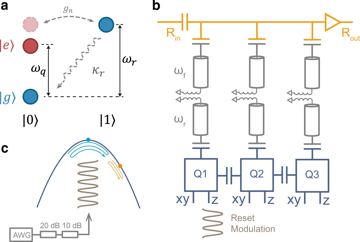
Reset returns a qubit to |0⟩ before a shot and, in error correction, every measure qubit once per syndrome round. Unconditional reset — this technology — hands the excitation to a lossy mode with no classical decision, unlike waiting for T1 or measuring and flipping. It began with the all-microwave "f0g1" scheme: a drive couples |f,0⟩ to |g,1⟩ of the transmon–resonator pair (g, f = ground and second excited states; 0, 1 = resonator photons) and the photon leaks out, leaving 0.2% residual excitation in under 500 ns without feedback D[596]. It sits in the readout layer because the lossy mode is usually the readout resonator and feedline D[597]D[598]. Attributes: on-chip, superconducting lithography, driven from room temperature, no transport; error class leakage.
Physics & limits
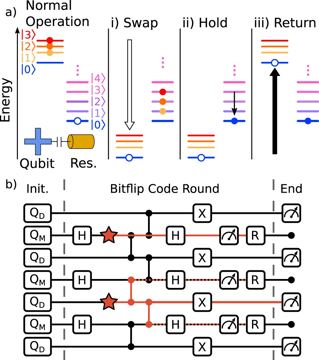
Passive relaxation is too slow: even with no thermal floor, 10⁻³ at T1 = 200 µs takes ln(10³)·T1 ≈ 1.4 ms S. The floor matters too: a 5 GHz transmon at 50 mK effective temperature holds ~0.8% excitation S, so reset must cool — with engineered rate Γ_r ≫ Γ_q the residual tends to (Γ_q·n_q + Γ_r·n_r)/(Γ_q + Γ_r), the colder bath's occupation S. Speed is set by the lossy mode: an excitation swapped into a mode of decay rate κ leaves no faster than the critically damped κ/2, so 10⁻³ takes ≈ 21/κ, 170–340 ns for κ/2π = 20–10 MHz S — the 100–500 ns band. A 34 ns flux swap thus becomes 284 ns once the resonator must be emptied D[599]; a broadband metamaterial bath escapes the single-mode bound D[600]. A switchable dissipator decouples reset rate from idle T1: IBM's moves effective T1 from ~200 µs to ~25 ns C[601], an on/off ratio of ~8×10³ S. Leakage is the companion problem: a conditional X acts only on |0⟩↔|1⟩, so |2⟩ stays leaked S; MLR empties |1⟩–|3⟩ at one setting D[597].
Engineering state of the art
table
| Year | Figure | Who | Tag+key |
|---|---|---|---|
| 2018-08-07 | f0g1: 0.2% residual in <500 ns | Magnard et al. | D[596] |
| 2021-03-19 | MLR of |1⟩–|3⟩ in ~250 ns, >99% (readout-limited) | D[597] | |
| 2021-10-11 | Flux swap: 0.08% ± 0.08% in 34 ns; 284 ns with depletion | Zhou et al. | D[599] |
| 2023-02-22 | 160 ns reset + 500 ns measurement in a 921 ns round | Google, Sycamore | D[602] |
| 2024-09-25 | Reset + leakage reduction in 83 ns, fixed-frequency, >99% | Chen et al. | D[598] |
| 2024-11-05 | Reset error <0.13% (|1⟩), 0.16% (|2⟩) in 88 ns; |2⟩-only LRU 44 ns | Kim et al. | D[600] |
| 2025-12-22 | Microwave LRUs + ancilla reset: leakage ÷72 to 6.4×10⁻⁴; d=7, Λ = 1.40 ± 0.06 | USTC, Zuchongzhi 3.2 | P[603] |
| 2026-08-31 | 120 reset elements; initialisation error ÷25 | IBM, Nighthawk r2 | C[601] |
Sycamore spent 660 of 921 ns (72%) measuring and resetting, and its authors name data-qubit idling during them a dominant error D[602]. Willow runs MLR on measure qubits and DQLR on data qubits every 1.1 µs cycle D[1], after DQLR cut data-qubit leakage tenfold, below 10⁻³ device-wide D[604]. USTC's row is the press reading of its PRL D[3]. IBM's gain is shot rate: 100,000 circuits per second, 25× Heron C[601]. Dominant term: residual population, which production vendors do not publish.
Manufacturing, materials & supply chain
Resonator-based reset adds no fabrication step D[596]. The cost follows qubit type: flux-tunable transmons reuse their flux lines D[597]; fixed-frequency ones use the microwave route, a tunable coupler D[598] or a dedicated element per qubit C[601]. A tunable element is in general one more control signal per qubit S; press coverage credits USTC's microwave-only route with avoiding Google's DC-pulse wiring P[605].
Control, readout & I/O burden
Unconditional reset is an open-loop pulse: no discrimination, decision or feed-forward. Conditional reset stacks readout, ring-down, a decision and a π pulse, floored by assignment error; IBM's earlier scheme flipped on |1⟩, then idled hundreds of microseconds between executions C[601], an idle exposed as rep_delay that trades execution time against state-preparation error C[606]. In a surface code the measurement happens anyway; what follows is a 160 ns step D[602] or a feed-forward loop paid every round S.
Role in the stack
Slot 6 of the Transmon lattice with tunable couplers architecture, beside dispersive readout. It requires the transmon (the qubit to be reset) and ro_disp (the readout resonator as loss channel); no provides, replaces or conflicts edge exists as of 2026-09-26. The ro_disp edge is the common case, not a necessity: Nighthawk r2 couples each qubit to a cold environment through its own tunable coupler C[601]. It answers gap G-reset with reset time and residual population as attributes; the Atlas's derived clock counts readout + reset as ≈ two-thirds of the superconducting round. The ledger's cat and dual-rail placements were not taken; atom re-initialisation or reloading has no lossy-mode step and is not this technology G. The sibling gap G-lru, data-qubit leakage removal, stays open. Register machines, primary: Sycamore-class 72-qubit processor, IBM Quantum Loon, IBM Quantum Nighthawk r2; alternate: Zuchongzhi 3.2, IBM Quantum System Two at CSCS (Swiss Quantum Innovation Hub).
Evidence — how the numbers were measured
Reset is checked by reading the qubit afterwards, so readout error bounds it: McEwen et al.'s ~10⁻³ was readout-limited D[597]. Reported quantities do not compare — residual excitation, reset error, effective T1, an error ratio. All four register cells are verified ✅, but only Sycamore's has a figure locator (Fig. 1b); IBM's rest on blogs, Loon's naming "reset gadgets" without figures C[486]; Zuchongzhi 3.2's has neither locator nor reset figure.
The Zuchongzhi 3.2 figures (72×, 6.4×10⁻⁴, d = 7, Λ) come from press analysis. The 1.4 ms, 0.8%, ≈21/κ and 8×10³ figures are derived from arXiv:2409.16748 and arXiv:2411.02950, not quoted by them. Not published, as of 2026-09-26: USTC's reset duration and residual; Nighthawk r2's reset duration, absolute residual and any paper — its blog gives an effective T1, a 25× ratio and ~1 µs idle; Loon's reset-gadget figures; Heron's conditional-reset duration and feed-forward latency; and Willow's measurement and reset durations, with the DQLR duration of Miao et al.
Actors & economics
Who.
| Organisation | Role | Country | What exactly they do with this technology | Evidence |
|---|---|---|---|---|
| Google Quantum AI | developer | US | 160 ns reset in Sycamore's round; MLR + DQLR every Willow cycle | D[602]D[1] |
| IBM | developer | US | Conditional reset on Heron; 120 dissipative elements on Nighthawk r2; gadgets on Loon | C[601]C[486] |
| USTC / Hefei National Laboratory | developer | CN | Microwave LRUs and in-cycle ancilla reset, Zuchongzhi 3.2 | P[603] |
Money. No dated financial item is specific to qubit reset as of 2026-09-26.
Market & supply chain. No separate market: reset is bought as chip design and calibration and pays out as round time and shot rate, into G2–G4.
IP & standards. No standard defines a reset figure of merit; no dated patent count from a named database as of 2026-09-26.
Roadmaps & track record. IBM named reset gadgets on 2025-11-12 C[486] and shipped them on Nighthawk r2 on 2026-08-31 C[601]: delivered, with ratios rather than absolute figures.
Strategic reading. Reset is where fixed-frequency and tunable architectures part. If switchable dissipators keep their off-state T1 at scale, readout resonators can be optimised for readout alone.
Outlook & open questions
Confirm if IBM or an independent group publishes Nighthawk r2's reset duration, absolute residual and mid-circuit use by 2027-06-30, and if a d ≥ 9 surface code brings readout + reset below half its round by 2027-12-31; demote the gadget to a throughput feature if figures cover only between-shot initialisation.
Open questions. (1) What absolute residual does Nighthawk r2 reach? (2) What does a dissipator's off-state cost in T1 across 10³ qubits? (3) Can reset overlap ring-down to shrink the 660 ns term? (4) Do microwave-only resets match flux-based speed without crosstalk? (5) Which data-qubit leakage scheme closes G-lru without adding a round step?
References
- [1] Google Quantum AI and Collaborators, “Quantum error correction below the surface code threshold,” Nature, vol. 638, no. 8052, pp. 920–926, Dec. 2024, doi: 10.1038/s41586-024-08449-y. D
- [3] T. He et al., “Experimental Quantum Error Correction below the Surface Code Threshold via All-Microwave Leakage Suppression,” Phys. Rev. Lett., vol. 135, no. 26, Art. no. 260601, Dec. 2025, doi: 10.1103/rqkg-dw31. D
- [486] R. Mandelbaum, “Scaling for quantum advantage and beyond,” IBM Quantum Computing Blog, Nov. 12, 2025. [Online]. Available: https://www.ibm.com/
quantum/ Cblog/ qdc-2025 - [596] P. Magnard et al., “Fast and Unconditional All-Microwave Reset of a Superconducting Qubit,” Phys. Rev. Lett., vol. 121, no. 6, Art. no. 060502, Aug. 2018, doi: 10.1103/physrevlett.121.060502. arXiv:1801.07689. D
- [597] M. McEwen et al., “Removing leakage-induced correlated errors in superconducting quantum error correction,” Nat. Commun., vol. 12, Art. no. 1761, Mar. 2021, doi: 10.1038/s41467-021-21982-y. arXiv:2102.06131. D
- [598] L. Chen et al., “Fast unconditional reset and leakage reduction in fixed-frequency transmon qubits,” arXiv:2409.16748, Sep. 2024. D
- [599] Y. Zhou et al., “Rapid and unconditional parametric reset protocol for tunable superconducting qubits,” Nat. Commun., vol. 12, Art. no. 5924, Oct. 2021, doi: 10.1038/s41467-021-26205-y. D
- [600] G. Kim et al., “Fast Unconditional Reset and Leakage Reduction of a Tunable Superconducting Qubit via an Engineered Dissipative Bath,” arXiv:2411.02950, Nov. 2024. D
- [601] H. Haas, D. McKay, and R. Davis, “IBM Quantum Nighthawk r2—more circuits, faster,” IBM Quantum Computing Blog, Aug. 31, 2026. [Online]. Available: https://www.ibm.com/
quantum/ Cblog/ nighthawk-r2 - [602] R. Acharya et al., “Suppressing quantum errors by scaling a surface code logical qubit,” Nature, vol. 614, pp. 676–681, Feb. 2023, doi: 10.1038/s41586-022-05434-1. D
- [603] M. Ivezic, “China's Zuchongzhi 3.2 Crosses the Error Correction Threshold - and Takes a Different Path Than Google to Get There,” PostQuantum.com, Dec. 30, 2025. [Online]. Available: https://postquantum.com/
quantum-research/ Pzuchongzhi-3-2-belowthreshold/ - [604] K. C. Miao et al., “Overcoming leakage in quantum error correction,” Nat. Phys., vol. 19, pp. 1780–1786, Oct. 2023, doi: 10.1038/s41567-023-02226-w. D
- [605] M. Swayne, “China Demonstrates Quantum Error Correction Using Microwaves, Narrowing Gap With Google,” The Quantum Insider, Dec. 26, 2025. [Online]. Available: https://thequantuminsider.com/
2025/ P12/ 26/ china-demonstrates-quantum-error-correction-using-microwaves-narrowing-gap-with-google/ - [606] IBM, “Qubit initialization.” [Online]. Available: https://quantum.cloud.ibm.com/
docs/ Cen/ guides/ repetition-rate-execution