Kunlun
Tsinghua University IIIS (D.-L. Deng) with Zhejiang University (H. Wang, C. Song groups)
Kunlun
Register profile — the machine's variant of its architecture
qubit type: transmon
gate mechanism: tunable coupler
connectivity: long-range couplers; weight-6 non-local stabilisers
control: room-temperature RF
control placement: room-temp
readout: dispersive
gate evidence: no published figure
decoder mode: offline — syndromes decoded after the run
codes: qcga, stab_18_6_3
Technologies by layer — the machine's cell per layer
| 1 Qubit carrier | |
| 2 Encoding | Bare physical qubit (no encoding) · primary ◌ 🔎 Bare two-level subspace — Computational subspace of an anharmonic oscillator; leakage to |2⟩ is the price. |
| 3 Gate mechanism | Tunable-coupler CZ / iSWAP · primary ▣ Fig. S5 (parallel CZ gates); SI: Multi-length couplers; SI: Single- and two-qubit gates ✅ tunable coupler |
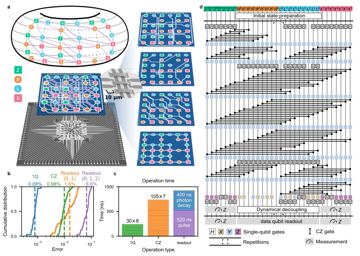
| 4 Connectivity / transport | Long-range on-chip couplers (c-couplers, mm-scale) · primary ▣ Fig. 1a (84 couplers in four length sets, long-range in purple); Fig. 2a; SI: Multi-length couplers ✅ long-range couplers on a 32-transmon lattice; weight-6 non-local stabilisers realised (May 2025) |
| 5 Control | |
| 6 Readout | Dispersive microwave readout (+TWPA, Purcell) · primary ▣ Fig. S6 (readout resonator frequencies, dispersive shift χ); SI: Measurement setup ✅ dispersive |
| 7 Code | Non-local qLDPC codes (bivariate bicycle, 'gross') · primary ▣ Fig. 1d, Fig. 3 ([[18,4,4]] BB code, logical error per cycle); Extended Data Figs. 1–3 ([[18,6,3]]) ✅ qcga/generalized_bicycle d=4 (4 logical) at 8.91(17)% logical error per cycle; qLDPC d=3 (6 logical) at 7.77(12)%; single distance each (May 2025) |
| 8 Decoder | — none — nothing in this layer ▤ Methods: Decoding; §Decoding and logical error rates ✅ no real-time decoder; decoding offline |
| 9 Interconnect | |
| 10 Manufacturing | Superconducting-qubit lithography (Al/AlOx/Al junctions, Nb wiring, 300 mm) · primary ▣ Fig. 1a right (magnified coupler crossing microstructure); SI: Multi-length couplers ✅ |
Standard records
idle / memory error per round → 0.0891 · the only on-hardware bivariate-bicycle measurement (logical error per cycle at d=4)
May 2025 · source
evidence: ✅ 7 / 10
Pictures
Every picture carries the story of what it shows and its credit line.