Long-range on-chip couplers (c-couplers, mm-scale) cx_lr
Waveguide- or resonator-extended tunable couplers that entangle fixed superconducting qubits millimetres apart, buying the degree-6 graphs that qLDPC codes need.
Long-range on-chip couplers (c-couplers, mm-scale)
Resonator/coupler links beyond NN; enables degree-6 qLDPC layouts; 2 mm CZ 99.81% (IQM); IBM Loon components without numbers.
Key references
Design space — attributes
- (a) carrier affinity
- fabricated
- (b) time · entangling
- —
- (c) readout
- —
- (d) mobility
- long-range static couplers
- (e) control
- —
- (f) error structure
- coherent / calibration
- (g) manufacturing
- superconducting lithography
Evaluation space — dated attributes
Standard records
Actors & goals — annotations
Edges
Used by 8 machines (8 primary · 0 alternate)
- superconducting circuits 6
- IBM Quantum Blue Jay IBM blog ▤ §1 Introduction (intra-module couplers tens of sites long; long-range inter-module couplers) ✅
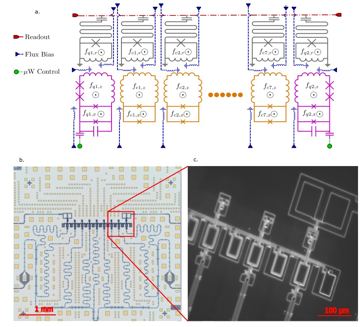
- IBM Quantum Cockatoo IBM press ▣ Fig. 1a (long-range-connected modular hardware) ✅
- IBM Quantum Kookaburra IBM docs ▣ Fig. 1a (bicycle architecture: long-range-connected modular hardware) ✅
- IBM Quantum Loon IBM blog ▥ §Building our fault-tolerant architecture (6-way qubit connections; physically longer couplers; more routing layers) ✅
- IBM Quantum Starling IBM blog ▣ Fig. 1a (long-range modular vs short-range monolithic); §1.2 ✅
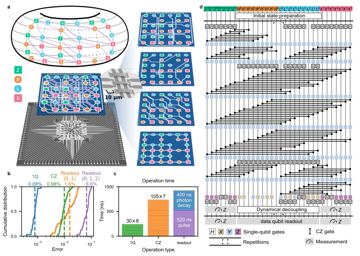
- Kunlun Tsinghua University IIIS (D.-L. Deng) with Zhejiang University (H. Wang, C. Song groups) paper paper ▣ Fig. 1a (84 couplers in four length sets, long-range in purple); Fig. 2a; SI: Multi-length couplers ✅
- quantum annealers 2
- Advantage D-Wave Quantum docs ▣ Fig. 1 (roadway drawing of Pegasus P3: internal/external/odd couplers); §2 Pegasus family of topologies ✅
- Advantage2 D-Wave Quantum paper docs docs ▣ §Zephyr Graph; figures 'Couplers in the Zephyr topology', 'Unit cell in the Zephyr topology' ✅
Pictures
Every picture carries the story of what it shows and its credit line.
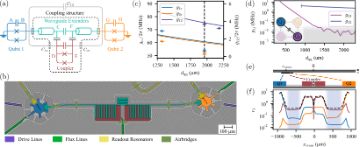
Long-range on-chip couplers (c-couplers, mm-scale)
Waveguide- or resonator-extended tunable couplers that entangle fixed superconducting qubits millimetres apart, buying the degree-6 graphs that qLDPC codes need.
Verdict. One 2 mm CZ at 99.81% (IQM, 2023) and IBM's Loon components without numbers; demote if no coupler of ≥ 5 mm reports a CZ ≥ 99.5% with error bars by end-2027.
Λ = error-suppression factor per code-distance step; QBI = DARPA Quantum Benchmarking Initiative (Stage A concept → B R&D plan → C government V&V); G1–G7 = the report's goal classes (see Actors & economics).
Identity & lineage
A long-range on-chip coupler is a microwave element — an extended capacitor, a transmission-line section, a resonator or a chain of them, usually with a flux-tunable transmon or SQUID in the middle — that mediates an exchange or ZZ interaction between superconducting qubits that are not lattice neighbours, millimetres apart, by virtual-photon exchange through the structure's detuned mode. Yale's cavity bus of 2007-09 moved quantum information between qubits "on opposite sides of a chip" through a cavity "a few millimetres long" D[477]; MIT's giant atoms, coupled to one waveguide at several points, gave distant qubits decoherence-free exchange in 2020-07 D[478]; Caltech's metamaterial bus gave ten qubits a tunable hopping range in 2023 D[479]. The graph record dates the node to 2023, when IQM published a CZ of 99.81 ± 0.02% between transmons 1.96 mm apart through a floating transmon coupler whose two "waveguide extenders" carry both the qubit–coupler and the direct qubit–qubit coupling D[480]. IBM's "c-coupler" (2025-06 vocabulary; "l-couplers" link chips C[481]) is the same object built for a code, and Loon (2025-11) the first chip claiming a lattice of them C[49].
Attributes (legend: a = affinity natural↔fabricated; b = time, deterministic/heralded; c = readout; d = mobility; e = control @ placement; f = error structure; g = manufacturing), quoting the graph record:
- a = 1.0: a fully fabricated carrier.
- b = no characteristic time, determinism not applicable: the link sets no clock; the CZ it hosts is deterministic, 33 ns in the record device D[480].
- c = no readout function.
- d = long-range: connectivity beyond nearest neighbour without moving the qubit.
- e = no control modality at no placement: the flux line is booked under the qubits joined.
- f = coherent: residual ZZ, phase miscalibration, crosstalk.
- g = superconducting lithography.
Rank 2 of 111; shared by the superconducting and annealing architectures; it pairs a fabricated carrier with far-range mobility.
Physics & limits
At 4 GHz on silicon the guided wavelength is about 30 mm, so IQM's 2 mm extenders are electrically short capacitors; the coupler idles at 3.195 GHz below qubits at 4.10 and 3.89 GHz, with qubit–coupler couplings of 51.5 and 53.9 MHz against a direct 3.7 MHz, the net exchange being their difference D[480]. The gate is a coupler flux excursion that turns on the |11⟩↔|20⟩ interaction for 22 ns plus 11 ns idle; the separation also cuts next-nearest-neighbour coupling below 30 kHz D[480]. Beyond a few millimetres the extender's own standing-wave modes enter the qubit band (a 1 cm half-wave line resonates near 6 GHz), so the coupling must come from a hybridised resonator–transmon mode: Nanjing's 1 cm coupler measures 23.5 MHz of XX coupling and up to 100 MHz of ZZ, switchable by more than 10² and 10⁴ respectively D[482]. Links of 1 cm to 0.5 m exist only in simulation S[483]–[485].
Four floors. Loss: a coupler mode with T1 > 40 µs D[480] costs at most 33 ns/40 µs ≈ 8×10⁻⁴ per gate, ~10⁻⁵ at dispersive participation — below the record's 1.9 ± 0.2 ×10⁻³, attributed "mostly" to one qubit's T1 falling to 14 µs during the flux excursion D[480]. Crowding: each extra mode is a frequency collision, and a degree-6 vertex holds six couplers off resonance at once. Coherent error: residual ZZ under 2 kHz D[480] is 0.013 rad of conditional phase per microsecond of idling per pair, correlated rather than stochastic. Geometry: degree above four needs crossings, hence routing layers; the bivariate bicycle Tanner graph is "a degree-6 graph that consists of two edge-disjoint planar subgraphs" D[248], so two suffice topologically. The floor moves with lower-loss routing layers — Loon claims "multiple high-quality, low-loss routing layers" C[49] — and qubits whose T1 survives flux tuning.
Engineering state of the art
Best demonstrated: 99.81(2)% CZ at 1.96 mm in 33 ns (IQM, published 2023-02) D[480]. Typical at scale, as of 3 Sep 2026: none — no multi-qubit processor with mm-scale couplers has published gate fidelities; Loon shows "6-way qubit connections" without numbers C[49], [486], and IQM's resonator-hub Star devices reach "above 99.3%" on a MOVE–CZ–MOVE sequence C[487].
table
| Year | Figure | Who | Tag | Src |
|---|---|---|---|---|
| 2007-09 | Two qubits on opposite sides of a chip coupled through a few-mm cavity bus | Yale | D | [477] |
| 2023-02 | CZ 99.81(2)% across 1.96 mm, 33 ns, ZZ < 2 kHz | IQM | D | [480] |
| 2025-03 | 6-qubit star resonator: [[4,2,2]] logical error per cycle 0.25(2)–0.91(3)% | IQM | D | [488] |
| 2025-05-20 | Advantage2 GA, 4,400+ qubits at degree 20 (16 internal + 2 external + 2 odd couplers) | D-Wave | C | [489] fact |
| 2025-06 | 1 cm hybrid-mode coupler, XX 23.5 MHz, ZZ contrast > 10⁴, no gate | Nanjing | D | [482] |
| 2025-11-12 | Loon: 6-way connections, longer couplers, multilayer routing, no numbers | IBM | C | [49], [486] |
Dominant error term today: qubit relaxation during the flux excursion (T1,eff 14 µs on one qubit, 43 µs on the other) D[480]; for degree-6 lattices the budget is unpublished.
Manufacturing, materials & supply chain
Standard Nb/Al Josephson lithography plus multilayer, low-loss routing so couplers can cross qubit rows. IBM builds Loon on 300 mm wafers at Albany NanoTech and credits the line with "a ten-fold increase" in chip complexity C[49], [486]; D-Wave's 10-K describes "a multilayer integrated circuit process" G[490]. Each tunable coupler adds a junction and a flux line: a 288-qubit gross-code module at degree 6 D[248] carries 864 couplers if all are tunable, three per qubit against 1.8 on Nighthawk (218 couplers, 120 qubits) C[49]. Yield per coupler is unpublished.
Supply chain: IBM fabricates in-house with NY CREATES C[49]; IQM in Espoo D[480]; D-Wave uses "existing third-party foundries", demonstrated a second source with the 2000Q LN G[491], and its 10-K filings mention SkyWater (nine full-text hits, 2023–2026) G[492] — a foundry that IonQ, a platform competitor, has owned since 2026-07-31 C[493] fact. The single points of failure are the three or four fabs with qualified low-loss multilayer processes. Export exposure: the BIS rule of 2024-09-06 G[301] fact controls dilution refrigerators (3A904) and quantum computers only where qubit count and C-NOT error fall in the same band, from 34–99 qubits at ≤ 10⁻⁴ to any error from 2,000 qubits (4A906), not coupler designs.
Control, readout & I/O burden
A tunable long-range coupler needs one flux line and a 22 ns-class flux pulse D[480]; a fixed resonator hub needs none but pays with MOVE operations C[487], [494]. At degree 6 the coupler flux lines alone are three per qubit, on top of drive, qubit flux and multiplexed readout — five to six lines per qubit. At 10³ qubits that is 5,000–6,000 lines and cold multiplexing; at 10⁴ it is the 40,000 lines QuantWare promises for 2028 C[536] fact; at 10⁶ only on-chip flux generation (cryo-CMOS or SFQ, SEEQC's mK control being the published pointer fact) closes the gap. Loop latency is unchanged: a bivariate bicycle round is "a depth-7 circuit composed of nearest-neighbor CNOT gates" D[248]; what the coupler moves is the decoder, since bicycle codes lack the matching decoders that keep surface-code decoding within a microsecond.
Role in the stack
Two architectures: superconducting transmons and quantum annealing. It requires superconducting lithography with multilayer routing and provides the degree-6 long-range checks bivariate bicycle codes consume: 12 logical qubits in 288 physical where a surface code needs "nearly 3000" at 0.1% physical error D[248], and 121 logical qubits from a 5,000-qubit gross system at p = 10⁻³ in IBM's architecture study, whose degree "does not exceed seven" S[496]. It replaces nearest-neighbour couplers at the price of one junction and flux line per added edge, two or more routing layers, and a coupler whose T1 and spurious modes enter the budget — paid per design, not per gate. Across families: a fabricated carrier that buys in lithography the far-range mobility atoms and ions get from motion. Derived clock = sum of the syndrome round: gate layers + transport + readout + reset for the architecture: on the transmon architecture the round is 0.65 µs with readout 282 ns its largest term, and the 33 ns long-range CZ D[480] is 5% of the round, binding only if a MOVE–CZ–MOVE sequence outruns the readout term; on the annealing architecture the anneal schedule is the clock. Neighbouring empty slots: the chip-to-chip l-coupler promised for IBM's Cockatoo in 2027 R[481], and the spin-qubit resonator link, where Delft showed iSWAP oscillations between spins 250 µm apart D[497] without a gate fidelity.
Evidence — how the numbers were measured
The 99.81% is interleaved randomised benchmarking, its 1.9(2)×10⁻³ error decomposed by simulation into a coherence-limited part dominated by one qubit's T1,eff of 14 µs; ZZ < 2 kHz is measured at the idle point D[480]. Nanjing's figures are spectroscopic couplings, not gates D[482]. IQM's star results are logical-state fidelities of a [[4,2,2]] code, folding in readout and idling D[488]; its "above 99.3%" is a company figure without protocol C[487]. Loon's claims are release text C[49], [486].
Not captured: crosstalk on shared extenders when several couplers of one vertex fire together; T1 at the flux points every coupler forces on its qubits; leakage into extender modes; drift of the ZZ null. Independent replications of a mm-scale CZ with error bars: none as of 3 Sep 2026. Conflicts: degree 6 D[248] against "does not exceed seven" S[496] — the seventh edge is the logic-unit adapter, so both hold; the graph record's "≥ 2 mm" is the paper's 1.96 mm D[480]; IQM's 99.3% (Constellation cell) and 99.81% (isolated pair) are different operations, not a regression.
D-Wave's reliance on SkyWater rests on nine EDGAR full-text hits G[492]; D-Wave's own text says "existing third-party foundries", with a second source demonstrated on the 2000Q LN G[491]. IQM's Constellation "above 99.3%" carries no protocol or error bar C[487]. Nanjing's 1 cm coupler has a measured XX of 23.5 MHz, while its 100 MHz ZZ is stated without saying whether it is measured or simulated D[482]. The 282 ns readout behind the derived clock is the superconducting architecture's typical value, not a figure specific to long-range couplers. Patent metadata for [498] comes from Justia's index, not USPTO full-text records. Not published: IBM Loon's qubit count, c-coupler length and any gate fidelity C[49], [486]; the cost, energy and yield per coupler, from any actor; a patent-family count for long-range couplers; and whether IQM's shipped Crystal products use the 2 mm extended coupler of [480].
Actors & economics
Who.
| Organisation | Role | Country | What it does with this technology | Evidence |
|---|---|---|---|---|
| IBM | developer | US | c-couplers on Loon; Kookaburra qLDPC module (2026); Starling (2029) | C[49], [481] fact |
| IQM Quantum Computers | developer | Finland | 2 mm coupler record; Star hubs; Constellation 2030+ | D[480] C[70], [487], [494] |
| D-Wave Quantum | developer | US | Zephyr degree-20 annealers | C[489] fact |
| Nanjing University | research | China | 1 cm hybrid-mode coupler; long-range ZZ theory | D[482] S[484] |
| QuTech | research | Netherlands | Resonator link between spins 250 µm apart | D[497] |
| SkyWater Technology | supplier | US | Foundry named in D-Wave's 10-Ks; IonQ-owned since 2026-07-31 | G[492] C[493] |
| QuantWare | supplier | Netherlands | 3D-routed chips; VIO-40K roadmap | P[495] |
| DARPA | funder | US | QBI Stage B includes IBM (up to $15 M) | G[65] fact |
Money.
- 2025-09-03 · IQM · Series B · $320 M · closed fact
- 2025-11-06 · DARPA QBI Stage B · IBM among eleven teams · up to $15 M each · official G[65] fact
- 2026-05-21 · IBM/Anderon; D-Wave; GlobalFoundries · US DoC CHIPS letters of intent · $1 B (+ $1 B IBM cash); $100 M; $375 M · LOI, non-binding G[300] fact
- 2026-06-02 · IBM · quantum investment commitment · > $10 B over five years · announced C[57] fact
- 2026-07-02 · IQM · Nasdaq and Helsinki listing · pro-forma cash €337 M; H1-2026 revenue €8.9 M · closed C[58] fact
- 2026-07-31 · IonQ · acquisition of SkyWater · ~$1.8 B · closed C[19] fact
- 2026-08-06 · D-Wave · Q2-2026 results · H1 revenue $5.9 M (Q2 $3.1 M), cash $546.2 M · reported C[15] fact
Market & supply chain. Nobody sells a long-range coupler; it is a design block inside a vendor's chip, and the market is the three or four fabs that can print it — Albany C[49], IQM's own D[480], D-Wave's third-party foundries G[491], [492], GlobalFoundries under its LOI fact — plus QuantWare as the only merchant seller of 3D-routed chips P[495]. The structural cost is 1.5–3 extra couplers per qubit against a 10× saving in physical qubits per logical qubit D[248]. Who pays: G4 (IBM's Starling), G3 if Kookaburra runs, G5 on the annealing architecture C[489], G1/G2 through fewer SWAPs on Star hubs C[494].
IP & standards. IBM: US 12,517,856 (filed 2022-09-28, granted 2026-01-06) on modular connectivity levels, US 12,587,192 (granted 2026-03-24) on resonator chains with tunable inductive couplers, US 2024/0169232 A1 (filed 2022-11-18) on fluxonium long-range coupling G[498]. D-Wave: US 10,268,622 (granted 2019-04-23), US 11,507,871 and US 11,494,683 (both 2022-11) on long-range couplers G[498]. No litigation found; no standard. PatSnap's landscape published on 2026-06-30 counts IBM at 4,388 quantum families, 783 in superconducting devices Pfact; no count exists for long-range couplers.
Roadmaps & track record.
- IBM: promised 2025-06-10 · Loon in 2025 with c-couplers · delivered 2025-11-12 as components without performance numbers C[49], [481].
- IBM: promised 2025-06-10 · Kookaburra 2026, Cockatoo 2027 (l-couplers), Starling 2029 (200 logical, 10⁸ gates) · Kookaburra not delivered as of 2026-09-03, the rest pending R[481] C[72] fact.
- IQM: promised 2026-01-05 · 2Q fidelity above 99.94% in 2025–26; qLDPC demonstrators 2027–28; Constellation with long-range couplers 2030+ · pending R[70].
- D-Wave: described 2021-09-22 · Zephyr topology · delivered with Advantage2 GA 2025-05-20 C[489] fact.
Credibility: IBM ships the processor it names in the year it names (Nighthawk delivered 2025-12 fact) but has published no coupler number ten months after Loon; IQM delivered its 2023 physics and ships Star systems, with a roadmap that carries no qubit counts; D-Wave delivered its topology at scale, for annealing only.
Strategic reading. If mm-scale couplers reach nearest-neighbour fidelity at degree 6, physical qubits per logical qubit fall by an order of magnitude D[248]; the winners are the vendors owning both coupler and code — IBM and, later, IQM — plus the fabs holding multilayer processes; the losers are surface-code roadmaps on nearest-neighbour lattices, Google's included fact. Substitution threats: chip-to-chip l-couplers R[481]; atoms and ions, which get connectivity from motion; better nearest-neighbour gates with SWAP networks. Bargaining power sits with platform vendors on design and with the few fabs on routing layers; IonQ–SkyWater is the first platform vendor owning a rival's named foundry G[492] fact.
Outlook & open questions
Confirm within 12–24 months if: IBM publishes c-coupler CZ fidelities ≥ 99.5% with error bars at ≥ 5 mm and a gross-code memory experiment on Kookaburra by end-2027 fact; any group demonstrates a ≥ 1 cm on-chip CZ at ≥ 99.5% D[482]; IQM shows a Constellation cell at ≥ 99.9% C[487]. Demote if by end-2027 no mm-scale coupler reports ≥ 99.9% or no code with long-range checks on superconducting hardware reports Λ > 1. Best case by 2029: Starling-class modules of 288-qubit gross codes with couplers at 99.9% D[248] R[481]. Worst case: couplers stay at 99.8% on isolated pairs, qLDPC codes migrate to atoms and ions, and IBM's 2029 machine becomes a surface-code machine.
Open questions: (1) does a qubit's T1 survive the flux points six couplers force on it? (2) what is the parallel-gate crosstalk on a vertex whose extenders share a routing layer? (3) which decoder runs bicycle codes within the cycle time? Watch: any IBM coupler paper, Kookaburra's 2026 status, IQM's Constellation product date, Nanjing's 1 cm gate.
References
- [15] D-Wave Quantum Inc., “D-Wave Reports Second Quarter 2026 Results,” Aug. 6, 2026. [Online]. Available: https://www.dwavequantum.com/
company/ Cnewsroom/ press-release/ d-wave-reports-second-quarter-2026-results/ - [19] IonQ, “IonQ Completes Acquisition of SkyWater Technology,” Jul. 31, 2026. [Online]. Available: https://www.ionq.com/
news/ Cionq-completes-acquisition-of-skywater-technology - [49] IBM, “IBM Delivers New Quantum Processors, Software, and Algorithm Breakthroughs on Path to Advantage and Fault Tolerance,” Nov. 12, 2025. [Online]. Available: https://newsroom.ibm.com/
2025-11-12-ibm-delivers-new-quantum-processors,-software,-and-algorithm-breakthroughs-on-path-to-advantage-and-fault-tolerance C - [57] IBM Quantum, “Why IBM is investing $10 billion into quantum computing,” Jun. 2, 2026. [Online]. Available: https://www.ibm.com/
quantum/ Cblog/ 10-billion-investment-faq - [58] IQM Quantum Computers, “IQM Quantum Computers Becomes First European Quantum Computing Company Listed on a Major U.S. Exchange,” Jul. 2, 2026. [Online]. Available: https://iqm.tech/
press-releases/ Ciqm-quantum-computers-becomes-first-european-quantum-computing-company-listed-on-a-major-u-s-exchange/ - [65] DARPA, “Stage B selection,” Nov. 6, 2025. [Online]. Available: https://www.darpa.mil/
research/ Gprograms/ quantum-benchmarking-initiative/ stage-b-selection - [70] IQM Quantum Computers, “Development Roadmap,” Jan. 5, 2026. [Online]. Available: https://iqm.tech/
technology/ Croadmap - [72] IBM, “Quantum Roadmap.” [Online]. Available: https://www.ibm.com/
roadmaps/ Cquantum/ - [248] S. Bravyi et al., “High-threshold and low-overhead fault-tolerant quantum memory,” Nature, vol. 627, no. 8005, pp. 778–782, Mar. 2024, doi: 10.1038/s41586-024-07107-7. arXiv:2308.07915. D
- [300] National Institute of Standards and Technology, “Department of Commerce Announces Letters of Intent With 9 Companies for $2 Billion to Accelerate U.S. Leadership in Quantum Computing,” NIST News, May 21, 2026. [Online]. Available: https://www.nist.gov/
news-events/ Gnews/ 2026/ 05/ department-commerce-announces-letters-intent-9-companies-2-billion - [301] US Department of Commerce, Bureau of Industry and Security, “Commerce Control List Additions and Revisions; Implementation of Controls on Advanced Technologies Consistent With Controls Implemented by International Partners,” Federal Register, vol. 89, p. 72926, Sep. 6, 2024. [Online]. Available: https://www.federalregister.gov/
documents/ G2024/ 09/ 06/ 2024-19633/ commerce-control-list-additions-and-revisions-implementation-of-controls-on-advanced-technologies - [477] J. Majer et al., “Coupling superconducting qubits via a cavity bus,” Nature, vol. 449, no. 7161, pp. 443–447, Sep. 2007, doi: 10.1038/nature06184. D
- [478] B. Kannan et al., “Waveguide quantum electrodynamics with superconducting artificial giant atoms,” Nature, vol. 583, no. 7818, pp. 775–779, Jul. 2020, doi: 10.1038/s41586-020-2529-9. D
- [479] X. Zhang, E. Kim, D. K. Mark, S. Choi, and O. Painter, “A scalable superconducting quantum simulator with long-range connectivity based on a photonic bandgap metamaterial,” arXiv:2206.12803, Jun. 2022. D
- [480] F. Marxer et al., “Long-Distance Transmon Coupler with cz-Gate Fidelity above 99.8%,” PRX Quantum, vol. 4, no. 1, Art. no. 010314, Feb. 2023, doi: 10.1103/PRXQuantum.4.010314. arXiv:2208.09460. D
- [481] R. Mandelbaum et al., “How IBM will build the world's first large-scale, fault-tolerant quantum computer,” IBM Quantum Computing Blog, Jun. 10, 2025. [Online]. Available: https://www.ibm.com/
quantum/ Rblog/ large-scale-ftqc - [482] J. Xu et al., “Tunable hybrid-mode coupler enabling strong interactions between transmons at centimeter-scale distance,” Phys. Rev. Appl., vol. 25, no. 1, Art. no. 014016, Jan. 2026, doi: 10.1103/ls5b-279m. arXiv:2506.14128. D
- [483] P. Zhao, P. Xu, and Z.-Y. Xue, “Long-range tunable coupler for modular fluxonium quantum processors,” arXiv:2604.12261, Apr. 2026. S
- [484] X. Deng et al., “Long-Range ZZ Interaction via Resonator-Induced Phase in Superconducting Qubits,” Phys. Rev. Lett., vol. 134, no. 2, Art. no. 020801, Jan. 2025, doi: 10.1103/PhysRevLett.134.020801. arXiv:2408.16617. S
- [485] P. Zhao, Y. Zhang, G. Xue, Y. Jin, and H. Yu, “Tunable coupling of widely separated superconducting qubits: A possible application towards a modular quantum device,” Appl. Phys. Lett., doi: 10.1063/5.0097521. arXiv:2201.03184. S
- [486] R. Mandelbaum, “Scaling for quantum advantage and beyond,” IBM Quantum Computing Blog, Nov. 12, 2025. [Online]. Available: https://www.ibm.com/
quantum/ Cblog/ qdc-2025 - [487] F. Vigneau, “IQM Constellation: A New Quantum Processor Architecture for Scalable Error Correction,” IQM Quantum Computers, Sep. 30, 2025. [Online]. Available: https://iqm.tech/
blog/ Ciqm-constellation-a-new-quantum-processor-architecture-for-scalable-error-correction/ - [488] F. Vigneau et al., “Quantum error detection in qubit-resonator star architecture,” arXiv:2503.12869, Mar. 2025. D
- [489] K. Boothby, A. D. King, and J. Raymond, “Zephyr Topology of D-Wave Quantum Processors,” D-Wave Systems Inc., Sep. 2021. [Online]. Available: https://www.dwavequantum.com/
media/ C2uznec4s/ 14-1056a-a_zephyr_topology_of_d-wave_quantum_processors.pdf - [490] D-Wave Quantum Inc., “Form 10-K for the fiscal year ended December 31, 2025,” U.S. Securities and Exchange Commission (EDGAR), Feb. 2026. [Online]. Available: https://www.sec.gov/
Archives/ Gedgar/ data/ 1907982/ 000190798226000026/ qbts-20251231.htm - [491] D-Wave Quantum Inc., “Form 10-K for fiscal year 2024,” SEC EDGAR, Mar. 14, 2025. [Online]. Available: https://www.sec.gov/
Archives/ Also https://www.sec.gov/edgar/ data/ 1907982/ 000190798225000060/ qbts-20241231.htm Archives/ . Gedgar/ data/ 1907982/ 000190798225000060/ 0001907982-25-000060-index.htm - [492] U.S. Securities and Exchange Commission, “EDGAR full-text search: ‘SkyWater’ in D-Wave Quantum Inc. 10-K filings,” SEC EDGAR Full-Text Search, Feb. 26, 2026. [Online]. Available: https://efts.sec.gov/
LATEST/ Gsearch-index?q=%22SkyWater%22&forms=10-K&ciks=0001907982 - [493] IonQ, “IonQ to Acquire SkyWater Technology, Creating the Only Vertically Integrated Full-Stack Quantum Platform Company,” Jan. 26, 2026. [Online]. Available: https://investors.ionq.com/
news/ Cnews-details/ 2026/ IonQ-to-Acquire-SkyWater-Technology-Creating-the-Only-Vertically-Integrated-Full-Stack-Quantum-Platform-Company/ default.aspx - [494] E. Stuart, “Jumping Off the Grid in Quantum Processor Innovation: Introducing IQM Star,” IQM Quantum Computers blog, Apr. 30, 2025. [Online]. Available: https://iqm.tech/
blog/ Cjumping-off-the-grid-in-quantum-processor-innovation-introducing-iqm-star/ - [495] M. Abdel-Kareem, “QuantWare Debuts VIO-40K™ Architecture to Enable 10,000-Qubit Superconducting Processors,” Quantum Computing Report, Dec. 10, 2025. [Online]. Available: https://quantumcomputingreport.com/
quantware-debuts-vio-40k-architecture-to-enable-10000-qubit-superconducting-processors/ P - [496] T. J. Yoder et al., “Tour de gross: A modular quantum computer based on bivariate bicycle codes,” arXiv:2506.03094, Jun. 2025. S
- [497] J. Dijkema et al., “Cavity-mediated iSWAP oscillations between distant spins,” Nat. Phys., vol. 21, no. 1, pp. 168–174, Dec. 2024, doi: 10.1038/s41567-024-02694-8. arXiv:2310.16805. D
- [498] Justia Patents, “Patent search: ‘long-range coupler’ qubit (results as of Sep. 3, 2026).” [Online]. Available: https://patents.justia.com/
search?q=%22long-range+coupler%22+qubit Also https://patents.google.com/patent/ . Also https://patents.google.com/US12517856B2/ en patent/ . GUS12587192B2/ en - [536] QuantWare, “QuantWare announces scaling breakthrough with VIO-40K™, delivering 10,000 qubit Quantum Processors for the first time,” Dec. 8, 2025. [Online]. Available: https://quantware.com/
news/ Cquantware-announces-scaling-breakthrough-with-vio-40k