Quantum annealing (analogue evolution) g_anneal
Continuous-time Hamiltonian evolution (coherent quench, 3.6–27 ns) driving Ising or Rydberg spins toward a ground state; not a discrete gate.
Quantum annealing (analogue evolution)
Coherent quenches 3.6–27 ns on 1,222–5,627 qubits; not a gate.
Brief →Key references
Design space — attributes
- (a) carrier affinity
- fabricated
- (b) time · entangling
- 4.0 ns
- (c) readout
- —
- (d) mobility
- long-range static couplers
- (e) control
- low-frequency electrical @ millikelvin stage
- (f) error structure
- coherent / calibration, stochastic Pauli
- (g) manufacturing
- superconducting lithography
Evaluation space — dated attributes
Pasqal's 10,000 physical qubits slipped from 2026 to 2028 (100 logical in 2029); QuEra's Series B expansion closed 2025-09-09 (Google, SoftBank Vision Fund 2, NVentures); Quantinuum's magnetism result is Trotterised *digital* simulation, not analogue evolution.
Standard records
Actors & goals — annotations
Edges
Used by 4 machines (4 primary · 0 alternate)
- quantum annealers 4
- Advantage D-Wave Quantum docs ▣ §Quantum annealing (Methods); Fig. 5 (dynamical scaling, ta = 7 ns and 20 ns quenches) ✅
- Advantage2 D-Wave Quantum paper docs docs ▣ §Quantum annealing (Methods); Fig. 1 (sampling post-quench states); Fig. 5 (ta = 7 ns and 20 ns) ✅
- Advantage3 D-Wave Quantum press link ▨ 'to scale the annealing architectures to multi-chip fabrics' ✅
- Qilimanjaro AQPU (Adiabatic Quantum Processing Unit) at BSC Qilimanjaro Quantum Tech paper ▤ §2 Full-stack coherent quantum annealing technology ✅
Pictures
Every picture carries the story of what it shows and its credit line.
Quantum annealing (analogue evolution)
Continuous-time Hamiltonian evolution (coherent quench, 3.6–27 ns) driving Ising or Rydberg spins toward a ground state; not a discrete gate.
Verdict. No platform has an unchallenged advantage claim as of 4 Sep 2026; falsified if one survives a full classical-rebuttal round by 2028, confirmed non-advantage if erosion keeps repeating.
Λ = error-suppression factor per code-distance step; QBI = DARPA Quantum Benchmarking Initiative (Stage A concept → B R&D plan → C government V&V); G1–G7 = the report's goal classes (see Actors & economics).
Identity & lineage
Continuous-time Hamiltonian evolution — sweeping a transverse field, laser detuning or blockade radius — carrying a many-body system toward a ground state with no discrete gate. Kadowaki–Nishimori (1998) and Farhi et al. (2000) gave it its form; D-Wave commercialised it from 2011, and Rydberg arrays run it with optics instead of flux.
Fabricated carriers; ~4 ns characteristic quench, no deterministic entangling operation; no readout of its own — a mechanism, not a qubit.
Long-range interaction; low-frequency or optical control at mK or in vacuum; coherent plus Pauli error; superconducting lithography or tweezer optics.
Physics & limits
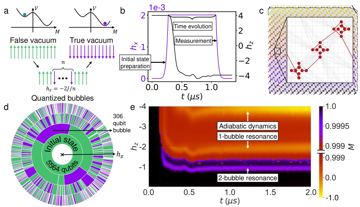
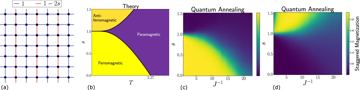
Two clocks bound the schedule. From below, control bandwidth — DAC slew for flux, AOM switching for Rydberg: D-Wave's fastest coherent quenches run 3.6–27 ns across 1,222–5,627 qubits D[221]. From above, decoherence. Between them sits the adiabatic condition, which for hard instances demands time scaling inversely with the square of a gap that itself closes exponentially — so the useful regime is a fast diabatic quench whose output is a sample, not a certified minimum. Rydberg adds spontaneous emission, flux adds 1/f noise. The floor moves not with faster electronics but with a way to certify the sample.
Engineering state of the art
table
| Year | Figure | Who | Tag+key |
|---|---|---|---|
| 2025-03 | Coherent quench 3.6–27 ns, up to 5,627 qubits; beyond-classical claim | D-Wave | D[221] |
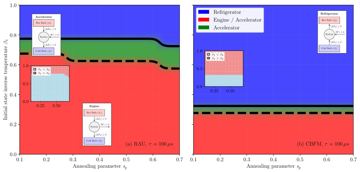
| 2025–26 | Claim eroded by tensor networks and t-VMC | Tindall; Mauron & Carleo | D[222], [223] |
| 2025 | 69-qubit analogue-digital simulator, beyond-classical on XEB only | D[225] | |
| 2025 | Aquila, 256 atoms, analogue Rydberg evolution: gauge-theory string breaking, no claim | QuEra | D[226] |
Dominant limitation: no accepted certificate that analogue output matches the Hamiltonian.
QuEra's cumulative funding (">$250 M") and its fuller investor list (Valor Equity, Rakuten, Commonwealth of Massachusetts) appear only in secondary reporting; the primary release of 2025-09-09 names Google, SoftBank Vision Fund 2 and NVentures. Pasqal's 2025 revenue of €16.5 M is from trade press, not a filed statement. Not published: the date of Pasqal's Aeponyx acquisition, in any primary source, and a further classical test of D-Wave's "most frustrated instances" beyond Tindall and Mauron/Carleo.
Manufacturing, materials & supply chain
Two supply chains carry one mechanism: Nb/Al superconducting lithography (D-Wave) and vacuum/laser/AOM tweezer stacks (QuEra, Pasqal). The I/O burdens scale oppositely: flux annealers push everything through one mK stage on multiplexed on-chip DACs, while tweezer machines add laser power, deflectors and imaging per atom — the optical table is the constraint. Pasqal has begun displacing bulk optics with a silicon-nitride photonic IC: four traps from one chip, atom lifetime ~27.5 s Cfact. No export rule names analogue evolution: exposure is inherited from the carrier — ECCN 4A906 and 3A904 for the flux line, nothing for tweezer optics.
Role in the stack
Architecture: quantum annealer — flux qubits, where it is the only gate mechanism. The register lists 4 machines using it, among them D-Wave's Advantage2 and Advantage and Qilimanjaro's AQPU. It runs on the flux-qubit carrier only — Rydberg arrays use the separate analogue Rydberg Hamiltonian evolution — and provides nothing to a gate-model stack; the field's standard error is reading an analogue sampling claim as gate-model advantage. Quantinuum's magnetism result is quoted alongside these but is Trotterised digital simulation competing for the same budget D[227]. No derived clock applies; the figure is quench time, ~4 ns to µs, plus one measurement. Verification is comparison against classical solvers, never randomised benchmarking, and the target moves: D-Wave's March 2025 claim was eroded within weeks [222], [223], its counter arguing the tensor-network scaling used against it is unvalidated P[224]. Unresolved as of 4 Sep 2026.
Actors & economics
Who.
| Organisation | Role | Country | What they do | Evidence |
|---|---|---|---|---|
| D-Wave Quantum | developer | US/Canada | Coherent-quench annealer; the disputed claim | D[221] |
| QuEra Computing | developer | US | Aquila Rydberg on Braket (analogue Rydberg evolution, not annealing); Libra 2028 | D[226] |
| Pasqal | developer | France | Analogue Rydberg arrays; Nasdaq since 2026-08 | P[156] |
| Google Quantum AI | developer | US | Analogue-digital simulator; atom track 2026-03 | fact |
Money. 2025-09-09 · QuEra · Series B expansion · $230 M+ USD · Google, SoftBank Vision Fund 2, NVentures · closed C[153]. 2026-08-28 · Pasqal · SPAC merger · ~$360 M USD cash · Nasdaq PSQL · closed P[156]. 2026-08-06 · D-Wave · H1-2026 revenue $5.9 M (−67% YoY) · reported Cfact.
Market & supply chain. Rydberg buys lasers, deflectors, vacuum and cameras from a thin supplier base; flux buys foundry runs and refrigerators. Money here is G1 instrument spend plus D-Wave's hybrid-solver G5 line; G3/G4 pay nothing.
IP & standards. No mechanism-specific patent family or standards body apart from the carrier hardware.
Roadmaps & track record. (2024-01 · for 2026 · QuEra 100 logical qubits · missed, replaced by Libra 2028 at >256 logical) R[162]; (2024 · for 2026 · Pasqal 10,000 physical · missed, restated to 2028) P[156]; (2025-05 · for 2029 · D-Wave 20,000 qubits · open) Rfact. Both atom vendors slipped a flagship target by two years; only D-Wave delivers on schedule.
Strategic reading. If one analogue claim survives a full classical round, the tweezer vendors capture the value, holding a path to digital; otherwise this is a bridge product and whoever reaches gate operation fastest wins. Laser and cryoplant suppliers keep the pricing power.
Outlook & open questions
Confirm if any platform defends an unchallenged claim through 2028; demote if erosion repeats. Best case 2029: Rydberg vendors convert analogue arrays into error-corrected digital machines. Worst case: analogue stays a physics instrument. Open: does Pasqal reach 10,000 physical by 2028; does Libra hold at >256 logical?
References
- [153] QuEra Computing, “QuEra Expands $230 Million Financing Round Advancing Quantum-Accelerated Supercomputing,” Sep. 9, 2025. [Online]. Available: https://www.quera.com/
press-releases/ Cquera-expands-230-million-financing-round-advancing-quantum-accelerated-supercomputing - [156] M. Swayne, “Pasqal Completes SPAC Merger With $360 Million in Cash,” The Quantum Insider, Aug. 28, 2026. [Online]. Available: https://thequantuminsider.com/
2026/ P08/ 28/ pasqal-completes-spac-merger-with-360-million-in-cash/ - [162] QuEra Computing, “QuEra Announces 2028 Fault-Tolerant Quantum Computer and Expanded Multi-Year Strategic Collaboration with AWS,” Jun. 15, 2026. [Online]. Available: https://www.quera.com/
press-releases/ Rquera-announces-2028-fault-tolerant-quantum-computer-and-expanded-multi-year-strategic-collaboration-with-aws - [221] A. D. King et al., “Beyond-classical computation in quantum simulation,” Science, vol. 388, pp. 199–204, 2025, doi: 10.1126/science.ado6285. arXiv:2403.00910. D
- [222] J. Tindall, A. Mello, M. Fishman, M. Stoudenmire, and D. Sels, “Dynamics of disordered quantum systems with two- and three-dimensional tensor networks,” Science, vol. 392, pp. 868–872, 2026, doi: 10.1126/science.adx2728. arXiv:2503.05693. D
- [223] L. Mauron and G. Carleo, “Challenging the Quantum Advantage Frontier with Large-Scale Classical Simulations of Annealing Dynamics,” arXiv:2503.08247, Mar. 2025. D
- [224] A. Nocera, J. Raymond, W. Bernoudy, M. H. Amin, and A. D. King, “Evaluating classical simulations with a quantum processor,” arXiv:2508.15759, Aug. 2025. P
- [225] T. I. Andersen et al., “Thermalization and criticality on an analogue–digital quantum simulator,” Nature, vol. 638, no. 8049, pp. 79–85, Feb. 2025, doi: 10.1038/s41586-024-08460-3. D
- [226] D. González-Cuadra et al., “Observation of string breaking on a (2 + 1)D Rydberg quantum simulator,” Nature, vol. 642, no. 8067, pp. 321–326, Jun. 2025, doi: 10.1038/s41586-025-09051-6. D
- [227] R. Haghshenas et al., “Digital quantum magnetism on a trapped-ion quantum computer,” Nature, vol. 653, pp. 56–62, 2026, doi: 10.1038/s41586-026-10445-3. arXiv:2503.20870. D