Programmable linear-optical interferometer (no entangling primitive) g_lointer
A programmable passive unitary on N optical modes — a beamsplitter/phase-shifter mesh or time-bin fibre loops — that scatters squeezed light or single photons into detectors for sampling, with no entangling gate and no feed-forward.
Programmable linear-optical interferometer (no entangling primitive)
A mesh of beamsplitters and phase shifters, or a time-multiplexed fibre loop, that scatters photons or squeezed light for sampling; it implements no entangling gate and no correction, so a machine built on it is a sampler, not a computer.
Brief →Key references
Design space — attributes
- (a) carrier affinity
- photon (natural particle, engineered modes)
- (b) time · entangling
- —
- (c) readout
- —
- (d) mobility
- flying qubits (photons)
- (e) control
- electro-optic @ room temperature
- (f) error structure
- loss (erasure)
- (g) manufacturing
- optical / mechanical assembly
Evaluation space — dated attributes
no dated attribute
Loss per element and the number of modes set what can be sampled; classical spoofing of lossy samplers is the standing challenge.
Actors & goals — annotations
Edges
Used by 7 machines (7 primary · 0 alternate)
- photonics 7
- PT-1 ORCA Computing paper product page ▤ §2.2 Physical devices ✅
- PT-2 ORCA Computing product page press ▤ §2.2 Physical devices ✅
- Jiuzhang (1.0) USTC (Pan Jianwei group) press ▤ Abstract ('100-mode ultralow-loss interferometer') ✅
- Jiuzhang 2.0 USTC (Pan Jianwei group) paper press ▤ Abstract ('This GBS is programmable by tuning the phase of the input squeezed states') ✅
- Jiuzhang 3.0 USTC (Pan Jianwei group) paper press ▨ 'The Jiuzhang 3.0, which had a fixed optical circuit' ✅
- Jiuzhang 4.0 USTC (Pan Jianwei group) paper press ▤ main text (photonic circuit; source filtering, Fig. S5) ✅
- Borealis Xanadu paper link ▣ Fig. 1 (three dynamically programmable loop-based interferometers); Methods: Programmable photonic processor ✅
Pictures
Every picture carries the story of what it shows and its credit line.
Programmable linear-optical interferometer (no entangling primitive)
A programmable passive unitary on N optical modes — a beamsplitter/phase-shifter mesh or time-bin fibre loops — that scatters squeezed light or single photons into detectors for sampling, with no entangling gate and no feed-forward.
Verdict. A working sampler, not a gate: 8,176 modes and up to 3,050 detected photons (Jiuzhang 4.0, 2026). Every earlier advantage claim was matched on its own benchmarks by a published classical sampler; as of 2026-09-26 none was found for Jiuzhang 4.0, and ORCA publishes no mode, loss or clock figure for PT-2.
GBS = Gaussian boson sampling; MZI = Mach–Zehnder interferometer; EOM = electro-optic modulator; PNR = photon-number-resolving; SNSPD = superconducting nanowire single-photon detector; TES = transition-edge sensor; MPS = matrix-product state (a tensor network); USTC = University of Science and Technology of China; NQCC = UK National Quantum Computing Centre; G1–G7 = the report's goal classes (G1: analogue and NISQ simulation).
Identity & lineage
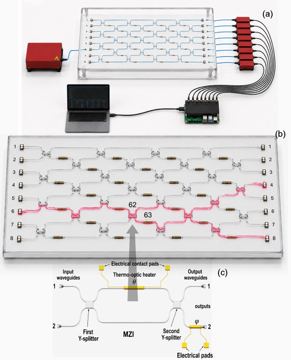
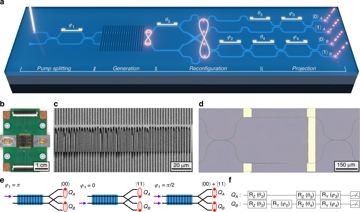
A passive network maps input modes onto outputs, a†ᵢ → Σⱼ Uⱼᵢ a†ⱼ, with U an N×N unitary. Reck et al. factorised any U into N(N−1)/2 beamsplitter–phase-shifter pairs G[452]; Clements et al. halved the footprint and balanced the loss G[453]; loops reuse one interference point on every time bin G[454]. A six-mode, 15-MZI chip set 100 Haar-random unitaries at fidelity 0.999 ± 0.001 D[455]. Machines on this technology use the network only to sample — single photons after Aaronson and Arkhipov G[456], squeezed light after Hamilton et al. G[268]. Attributes: flying carrier, no gate time or determinism class, loss-dominated error, electro-optic room-temperature control, bulk or photonic-IC fabrication.
Physics & limits
Output probabilities are permanents of n×n submatrices of U; exact polynomial-time classical sampling would collapse the polynomial hierarchy, and approximate hardness rests on two conjectures G[456]. With squeezed inputs they are hafnians, also #P-hard G[268]. The mesh entangles modes when fed squeezed light D[270] but has no entangling gate on encoded qubits: linear optics without ancilla photons distinguishes Bell states with at most 50% probability G[457], and universality needs detector feed-forward G[337]. The limits are loss and distinguishability. Transmission compounds with depth: at 0.99 per MZI, a 100-mode Clements mesh passes ~0.37 S[453]. Noisy GBS is efficiently simulable once squeezing, transmission and detector quality satisfy an inequality S[269]; tensor networks are likely efficient when surviving photons scale as √N for N inputs S[458]; at fixed partial distinguishability, simulation cost grows only polynomially with photon number S[459].
Coarse-grained outputs of a linear-optical interferometer are classically reproducible. Any linear statistic of the output — an integer-weighted sum of the photon counts per mode, which covers mode binning, molecular vibronic spectra and the 'most probable bin' one-way function — can be estimated classically to the same additive error as the experiment, in time polynomial in the number of modes, for single-photon and Gaussian inputs P[889]. An advantage or application claim for this mechanism must rest on fine-grained sampling or on a non-linear statistic; hash-function and proof-of-work variants remain open.
Engineering state of the art
table
| Year | Figure | Who | Tag+key |
|---|---|---|---|
| 2015-05 | Six-mode universal chip, fidelity 0.999 ± 0.001 | Carolan et al. | D[455] |
| 2020-12 | 50 squeezed states, 100 modes, up to 76 clicks | USTC, Jiuzhang 1.0 | D[460] |
| 2021-09 | Workstation samplers beat Jiuzhang 1.0/2.0 on marginal distances | Google Quantum AI | S[461] |
| 2022-06-01 | 216 time-bin modes, three loops, up to 219 photons, ~33% transmittance | Xanadu, Borealis | D[270] |
| 2023-10-10 | Up to 255 clicks; 1.27 µs per sample vs ~600 years on Frontier | USTC, Jiuzhang 3.0 | D[462] |
| 2024-06-25 | MPS sampler beats Jiuzhang 2.0/3.0 and Borealis on correlations; 288 GPUs, ~72 min for 10⁷ samples | Univ. of Chicago / Argonne | S[463] |
| 2026-05-13 | 1,024 squeezed states, 8,176 modes, up to 3,050 photons, 25.6 µs per sample | USTC, Jiuzhang 4.0 | D[175] |
Jiuzhang 4.0 answers the MPS attack with efficiency — 92% at the source, 51% end to end — which by the authors' estimate needs bond dimension above 8×10²¹, over 10⁴² years on El Capitan S[175]; validation is on subsystems, with a margin growing with size, not at full scale D[175].
Manufacturing, materials & supply chain
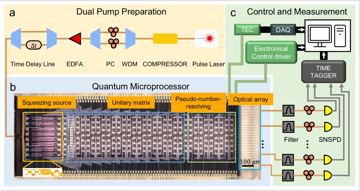
Borealis is fibre and bulk optics: three delays with EOM-driven variable beamsplitters from QUBIG GmbH, 16 TES detectors at 95% behind a 1-to-16 demultiplexer D[270]. Jiuzhang 4.0 cascades three 16-mode interferometers through two delay-loop arrays onto 16 SNSPDs at 93% D[175]. ORCA builds rack-mounted room-temperature systems from telecom-grade fibre components C[464]. Only detectors are cryogenic. No per-element loss of a fielded sampling mesh is published as of 2026-09-26; the 99.8% transmission and >40 dB extinction quoted for Jiuzhang 4.0 belong to its squeezed-light filter D[175].
Control, readout & I/O burden
Borealis sets every loop beamsplitter per 167 ns time bin and samples at 10 kHz between loop stabilisations D[270]. Jiuzhang 4.0 tunes its meshes thermally and loop phases with piezo stretchers; no per-bin electro-optic setting is reported D[175], so the technology's electro-optic attribute fits Borealis best. Readout is terminal; nothing is fed forward. Time multiplexing decouples detectors from modes: 16 detectors read 216 or 8,176 modes D[175], [270]. The heavy I/O is classical: checking a sample exactly means computing hafnians G[268].
Role in the stack
The gate slot of the Boson sampler architecture (ph_sampler, goal G1). It requires photon (single photons or squeezed light in the mesh) and ct_eo (phase shifters and switches); it provides no edge — its output is a sample; it replaces nothing, and g_fusion replaces it (fusion vs sampling interferometer): the same optics become a gate only when heralded Bell outcomes (g_fusion) or homodyne results (g_cv) are fed forward. This answers gap G-lointer — samplers had a gate layer with nothing gate-like in it — with an architecture of their own rather than the proposed technology on ph_cv and ph_fusion. Register machines, all primary: Borealis (Xanadu, deployed 2022-06), Jiuzhang 4.0 (USTC, demonstrated 2026-05-13), PT-2 (ORCA, deployed 2024–2026). The clock is a sample period: 36 µs (Borealis), 25.6 µs (Jiuzhang 4.0) D[175], [270].
Evidence — how the numbers were measured
No gate exists to benchmark; samples are compared with the ideal distribution, and the benchmarks used — low-order correlations, marginal distances — were matched or beaten classically S[461], [463]. The Borealis ✅ and Jiuzhang 4.0 ✅ cells hold against their papers, the latter with the filter correction above. PT-2 stays 🔎: its evidence page gives no architecture C[465]. The one description found is third-party — fibre delay loops with variable beamsplitters, capable of two loops where that paper puts the classically hard regime at three, sampling photon-subtracted squeezed states with a PNR detector P[271] — not the single photons the register records. An ORCA co-authored PT-1 study used one delay line D[466].
ORCA's release of 2025-06-11 names the NQCC system only as "PT Series"; the PT-2 page lists the NQCC testbed as a 2025 deployment. No classical rebuttal of Jiuzhang 4.0 has appeared as of 2026-09-26. Not published: the PT-2 input state in any ORCA primary source.
Actors & economics
Who.
| Organisation | Role | Country | What exactly they do with this technology | Evidence |
|---|---|---|---|---|
| USTC | developer | CN | Jiuzhang series; 4.0 joins 16-mode meshes with delay-loop arrays, SNSPD readout | D[175] |
| Xanadu | developer | CA | Borealis: three EOM-programmed fibre loops | D[270] |
| ORCA Computing | developer | UK | PT-series time-bin loop samplers, rack-mounted | C[465] |
| QUBIG GmbH | supplier | DE | EOMs in the Borealis loops | D[270] |
| Google Quantum AI; Univ. of Chicago / Argonne | classical challengers | US | Marginal-matching and MPS samplers | S[461], [463] |
Money.
- 2024-02-05 · NQCC · £30 M testbed competition, ORCA one of seven winners · per-company value undisclosed · awarded G[467]
- 2024-06-05 · Montana State University · two PT-1 systems, US Air Force-funded · undisclosed · contracted C[468]
- 2025-06-11 · ORCA · NQCC testbed installed under the UK's £121 M initiative · undisclosed · delivered C[469]
Market & supply chain. Of the register's seven machines only ORCA's PT-1 and PT-2 are sold as systems; USTC is academic, and the register marks Borealis superseded by Aurora. ORCA does not publicise most of its fundraising P[470].
IP & standards. No sampler-specific patent count or benchmark standard found as of 2026-09-26.
Roadmaps & track record. NQCC testbeds were due by March 2025 G[467]; ORCA announced its installation on 2025-06-11, a quarter later C[469]. PT-3 is "due for release later in 2026" with three switchable modules, claimed to beat classical solvers on up to 25,000-variable problems R[470].
Strategic reading. A contest between loss and classical simulation, not a route to computation; what lasts are the loops, squeezers and number-resolving detectors that fusion and CV machines also need. If PT-3 reaches the three-loop regime with published loss, ORCA holds the only commercial sampler beyond easy simulation; if not, the technology stays academic.
Outlook & open questions
Confirm if, by 2027-12-31, no classical sampler matches Jiuzhang 4.0 on its subsystem benchmarks and ORCA publishes PT-3 modes, loops and loss with a classical comparison; demote if one matches Jiuzhang 4.0 by then, or PT-3 ships in 2026 without those figures. Open questions. (1) What is the per-element loss of Jiuzhang 4.0's programmable meshes? (2) Does subsystem validation extrapolate to full scale? (3) What does PT-2 inject, and through how many loops? (4) Does any GBS application keep a speed-up at 33–51% transmission? (5) Can a loop sampler become a fusion machine by adding heralding and feed-forward?
References
- [175] H.-L. Liu et al., “Gaussian boson sampling with 1,024 squeezed states in 8,176 modes,” Nature, vol. 653, no. 8115, pp. 687–692, May 2026, doi: 10.1038/s41586-026-10523-6. arXiv:2508.09092. D
- [268] C. S. Hamilton et al., “Gaussian Boson Sampling,” Phys. Rev. Lett., vol. 119, no. 17, Art. no. 170501, Oct. 2017, doi: 10.1103/PhysRevLett.119.170501. arXiv:1612.01199. G
- [269] H. Qi, D. J. Brod, N. Quesada, and R. García-Patrón, “Regimes of Classical Simulability for Noisy Gaussian Boson Sampling,” Phys. Rev. Lett., vol. 124, no. 10, Art. no. 100502, Mar. 2020, doi: 10.1103/PhysRevLett.124.100502. arXiv:1905.12075. S
- [270] L. S. Madsen et al., “Quantum computational advantage with a programmable photonic processor,” Nature, vol. 606, no. 7912, pp. 75–81, Jun. 2022, doi: 10.1038/s41586-022-04725-x. D
- [271] J. Park, S. Stepney, and I. D'Amico, “Benchmarking the ORCA PT-2 Boson Sampler using Minimum Dominating Set Problems,” arXiv:2605.30935, May 2026. P
- [337] E. Knill, R. Laflamme, and G. Milburn, “Efficient Linear Optics Quantum Computation,” Nature, vol. 409, pp. 46–52, Jun. 2000, doi: 10.1038/35051009. arXiv:quant-ph/0006088. G
- [452] M. Reck, A. Zeilinger, H. J. Bernstein, and P. Bertani, “Experimental realization of any discrete unitary operator,” Phys. Rev. Lett., vol. 73, no. 1, pp. 58–61, Jul. 1994, doi: 10.1103/PhysRevLett.73.58. G
- [453] W. R. Clements, P. C. Humphreys, B. J. Metcalf, W. S. Kolthammer, and I. A. Walmsley, “Optimal design for universal multiport interferometers,” Optica, vol. 3, no. 12, p. 1460, Dec. 2016, doi: 10.1364/OPTICA.3.001460. arXiv:1603.08788. G
- [454] K. R. Motes, A. Gilchrist, J. P. Dowling, and P. P. Rohde, “Scalable Boson Sampling with Time-Bin Encoding Using a Loop-Based Architecture,” Phys. Rev. Lett., vol. 113, no. 12, Art. no. 120501, Sep. 2014, doi: 10.1103/PhysRevLett.113.120501. arXiv:1403.4007. G
- [455] J. Carolan et al., “Universal Linear Optics,” arXiv:1505.01182, May 2015. D
- [456] S. Aaronson and A. Arkhipov, “The Computational Complexity of Linear Optics,” Theory of Computing, vol. 9, pp. 143–252, 2013, doi: 10.4086/toc.2013.v009a004. arXiv:1011.3245. G
- [457] J. Calsamiglia and N. Lütkenhaus, “Maximum efficiency of a linear-optical Bell-state analyzer,” Appl. Phys. B, vol. 72, no. 1, pp. 67–71, Jan. 2001, doi: 10.1007/s003400000484. arXiv:quant-ph/0007058. G
- [458] M. Liu, C. Oh, J. Liu, L. Jiang, and Y. Alexeev, “Simulating lossy Gaussian boson sampling with matrix-product operators,” Phys. Rev. A, vol. 108, no. 5, Art. no. 052604, Nov. 2023, doi: 10.1103/PhysRevA.108.052604. arXiv:2301.12814. S
- [459] J. J. Renema et al., “Efficient Classical Algorithm for Boson Sampling with Partially Distinguishable Photons,” Phys. Rev. Lett., vol. 120, no. 22, Art. no. 220502, May 2018, doi: 10.1103/PhysRevLett.120.220502. arXiv:1707.02793. S
- [460] H.-S. Zhong et al., “Quantum computational advantage using photons,” Science, vol. 370, no. 6523, pp. 1460–1463, Dec. 2020, doi: 10.1126/science.abe8770. arXiv:2012.01625. D
- [461] B. Villalonga et al., “Efficient approximation of experimental Gaussian boson sampling,” arXiv:2109.11525, Sep. 2021. S
- [462] Y.-H. Deng et al., “Gaussian Boson Sampling with Pseudo-Photon-Number-Resolving Detectors and Quantum Computational Advantage,” Phys. Rev. Lett., vol. 131, no. 15, Art. no. 150601, Oct. 2023, doi: 10.1103/PhysRevLett.131.150601. arXiv:2304.12240. D
- [463] C. Oh, M. Liu, Y. Alexeev, B. Fefferman, and L. Jiang, “Classical algorithm for simulating experimental Gaussian boson sampling,” Nat. Phys., vol. 20, pp. 1461–1468, Jun. 2024, doi: 10.1038/s41567-024-02535-8. arXiv:2306.03709. S
- [464] ORCA Computing, “Technology — ORCA Computing.” [Online]. Available: https://orcacomputing.com/
technology/ C - [465] ORCA Computing, “ORCA PT-2 — ORCA Computing.” [Online]. Available: https://orcacomputing.com/
orca-pt-2/ C - [466] A. Makarovskiy et al., “A Binary Optimisation Algorithm for Near-Term Photonic Quantum Processors,” arXiv:2510.08274, Oct. 2025. D
- [467] National Quantum Computing Centre, “Science Minister Andrew Griffith announces the results of the £30m quantum computing testbed competition,” NQCC, Feb. 5, 2024. [Online]. Available: https://www.nqcc.ac.uk/
updates/ Gscience-minister-andrew-griffith-announces-the-results-of-the-30m-quantum-computing-testbed-competition/ - [468] ORCA Computing, “Montana State University Selects ORCA Computing to Advance Distributed Quantum Computing and Communications,” Jun. 5, 2024. [Online]. Available: https://orcacomputing.com/
montana-state-university-selects-orca-computing/ C - [469] ORCA Computing, “ORCA Computing Delivers First Photonic Quantum Computing System to UK's National Quantum Computing Centre,” Jun. 11, 2025. [Online]. Available: https://orcacomputing.com/
installation-marks-key-milestone-in-the-uks-121m-quantum-initiative-advancing-practical-quantum-research/ C - [470] Tech Journal UK, “ORCA aims to beat classical computers with PT-3 quantum system,” Jul. 1, 2026. [Online]. Available: https://www.techjournal.uk/
p/ Rorca-aims-to-beat-classical-computers - [889] B. Seron, H. Thomas, E. Araujo, A. Arkhipov, C. Oh, and L. Novo, “Efficient classical algorithm for estimating linear statistics of Boson Sampling,” arXiv:2609.35447, Sep. 2026. P