Vertical (out-of-plane) signal delivery — VIO, coaxmon, 3D wiring ct_vio
Control and readout lines from room-temperature electronics reach each superconducting qubit through the face of the chip — coaxial pins, contact probes, superconducting vias or a stacked signal die — instead of being routed in the chip plane to its edge.
Vertical (out-of-plane) signal delivery — VIO, coaxmon, 3D wiring
Room-temperature electronics reach every qubit through wiring that leaves the chip plane — coaxial pins, through-substrate vias, a signal-routing interposer — instead of in-plane lines; it is what lets a lattice grow beyond the edge-routed few hundred qubits.
Brief →Key references
Design space — attributes
- (a) carrier affinity
- fabricated
- (b) time · entangling
- —
- (c) readout
- —
- (d) mobility
- —
- (e) control
- microwave @ room temperature
- (f) error structure
- coherent / calibration
- (g) manufacturing
- superconducting lithography
Evaluation space — dated attributes
no dated attribute
Lines per qubit stay ~1–2; the price is a packaging process and the crosstalk of dense vertical pins.
Actors & goals — annotations
Edges
Used by 10 machines (10 primary · 0 alternate)
- superconducting circuits 10
- Fujitsu 1,000-qubit machine Fujitsu (+ RIKEN) link ▨ release 22 Apr 2025 (3D unit-cell configuration; 1,000-qubit plan) 🔎
- OQC ATHENA Oxford Quantum Circuits product page ◌ 🔎
- OQC ATLAS Oxford Quantum Circuits product page ◌ 🔎
- OQC GENESIS Oxford Quantum Circuits product page product page press ▣ Fig. 1b (coaxial unit cell); §II (shared coaxial control line) ✅
- OQC TITAN Oxford Quantum Circuits product page ◌ 🔎
- OQC Toshiko Oxford Quantum Circuits product page ▣ Fig. 2A (cross-section of out-of-plane wiring addressing a qubit); Fig. 1A-B (through-holes for out-of-plane wiring) ✅
- QuantWare Bass-A10K (VIO-40K) QuantWare press ▦ §VIO-40K announcement (40,000 input–output lines; VIO 3D scaling architecture) ✅
- RIKEN 64-qubit superconducting processor RIKEN with AIST, NICT, Osaka University, Fujitsu, NTT press press ▥ Fig. 2 (perpendicular wiring package: control/readout lines via contact probes); Fig. 5 (wiring in DR) ✅
- RIKEN-Fujitsu 256-qubit superconducting quantum computer RIKEN RQC + Fujitsu press press ▥ §High-density implementation (quadrupled density in the same dilution refrigerator; thermal design) ✅
- RIKEN RQC-Fujitsu 64-qubit superconducting quantum computer RIKEN RQC + Fujitsu press ◌ 🔎
Pictures
Every picture carries the story of what it shows and its credit line.
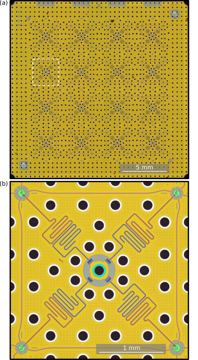

Vertical (out-of-plane) signal delivery — VIO, coaxmon, 3D wiring
Control and readout lines from room-temperature electronics reach each superconducting qubit through the face of the chip — coaxial pins, contact probes, superconducting vias or a stacked signal die — instead of being routed in the chip plane to its edge.
Verdict. Carries a 256-qubit processor (RIKEN/Fujitsu) and a >500-qubit wafer-scale package (OQC); it removes the edge-routing wall but not the line count, and line crosstalk has been published only for a four-qubit device as of 2026-09-26.
TSV = through-silicon via; MXC = mixing chamber, the coldest refrigerator stage; T1, T2e = relaxation and echoed dephasing times; G1–G7 = the report's goal classes (see Actors & economics).
Identity & lineage
Lines still start in room-temperature racks (ct_rt); only the last centimetre changes. Instead of a coplanar line routed to a wire-bond pad at the die edge, the signal enters through the chip's face — a spring-loaded or coaxial pin, a contact probe, a superconducting via, or a bump-bonded signal die. Waterloo's quantum socket (2016) pressed spring-mounted coaxial wires onto the chip D[532]; Oxford's coaxial circuit QED (2017) put qubit and resonator on opposite faces with all wiring perpendicular D[533], the root of OQC's coaxmon. RIKEN chose backside superconducting vias over flip-chip interfaces that still bring pads to the edge C[534] and reviewed the packaging this needs G[535].
Attributes: microwave control at room temperature; coherent error; superconducting-lithography fabrication.
Physics & limits
Edge routing. In an m × m lattice every line serving a qubit inside a ring crosses the ring's ~4m inter-qubit gaps; with k lines per qubit and c per gap, routing closes at m = 4c/k — for k = 2 and c = 3–5, N ≈ 36–100 S. That is the ~100-qubit plateau QuantWare cites C[536], with "almost 90% of the chip" spent on routing C[537]. A flip-chip signal die raises c, but lines still leave through a perimeter ∝ √N while their number grows ∝ N — polynomial, not the vendor's "exponential fan-out" S. Vertical entry keeps lines per unit area constant, so the lattice tiles.
The line. A vacuum coaxial hole is 50 Ω at a diameter ratio of 2.3 S. OQC's 50 ± 2.5 Ω pins end 0.9 mm (qubit) or 0.4 mm (resonator) from the circuit and couple evanescently below the hole's cutoff: control-line selectivity −40 to −60 dB at 2 mm pitch D[538]. Non-galvanic pins carry no DC, so flux-tuned qubits and couplers need probes, vias or bumps S.
Box modes. A 20 mm silicon die can resonate as low as ~3 GHz, inside the qubit band S; OQC's inductive pillar lifts the enclosure cutoff to 34.3 GHz and bounds parasitic coupling to |J|/2π < 250 kHz D[538].
Heat is set per line, not by the route: OQC's fully wired wafer-scale package is estimated at ≤~3 µW on the MXC against 25–30 µW of cooling at 20 mK D[311].
Engineering state of the art
table
| Year | Figure | Who | Tag+key |
|---|---|---|---|
| 2016-05 | Spring-mounted coaxial wires, DC–8 GHz, contact ~150 mΩ, mismatch ~10 Ω | Univ. of Waterloo | D[532] |
| 2017-08 | Superconducting TSVs, zero via-to-via resistance below aluminium's critical temperature | Rigetti | D[539] |
| 2020 | 10 × 20 × 200 µm TSVs carry control and readout in a bump-bonded stack | MIT Lincoln Laboratory | D[540] |
| 2021-11 | 127 qubits, wiring on "multiple physical levels" | IBM Eagle | C[541] |
| 2022-04 | 2 × 2 coaxmons; T1 149(38) µs; single-qubit fidelity 99.982(4)% | Oxford / OQC | D[538] |
| 2023-03 | 64 qubits, 2 cm chip, contact probes, 96 input + 16 output lines | RIKEN consortium | C[542] |
| 2025-04 | 256 qubits; density ×4 in the same refrigerator | RIKEN / Fujitsu | C[51] |
| 2026-02 | >500 qubits on a 3-inch die; median T1 97 µs, T2e 129 µs | OQC | D[311] |
Among the register's carriers, beyond 256 gate-coupled qubits only claims exist: VIO-40K (VIO is QuantWare's vertical-wiring architecture), 40,000 lines for 10,000 qubits in chiplet modules, shipping 2028 C[536]. No Japanese machine has a two-qubit error in the register, and OQC's package reports coherence and readout, not gates D[311].
Manufacturing, materials & supply chain
Vias: MIT Lincoln Laboratory fabricates qubits on a TSV-bearing surface D[540]; Rigetti's sloped walls let evaporated or sputtered films coat the via D[539]. Pins: OQC's package manages differential thermal contraction across 3 inches with 0.5 mm pin gaps D[311]. Stacks: QuantWare integrates "all signal conditioning components" C[537] and opens KiloFab, Delft, in 2026 at 20× its 2025 capacity C[536]. Pin, via and bump yields at 10³–10⁴ contacts are unpublished as of 2026-09-26.
Control, readout & I/O burden
Vertical delivery moves lines; it does not remove them. RIKEN's 64 qubits take 112 lines C[542], 1.75 per qubit S; OQC's four-qubit device two per qubit D[538]; VIO-40K four C[536]. OQC's wafer-scale package shares each line among nine qubits, control riding on readout D[311] — ~0.11 per qubit S; the dimon, GENESIS's qubit C[543], drives both modes through one control line D[250]. At 10³ qubits that is 10²–4×10³ lines S; at 10⁴ QuantWare claims one cryostat C[537]; at 10⁶ only cold multiplexing — ct_cryocmos, ct_sfq — closes the gap S. Loop latency is unchanged S.
Role in the stack
Slot 5 of "Transmon lattice with tunable couplers" and "Dual-rail erasure qubits". It requires ct_rt's electronics behind the vertical wiring and fab_sc's vias, pins and interposers; it and ct_rt replace one another ("edge-routed vs vertical signal delivery"); no provides edge is recorded. What it frees is the die edge, for chip-to-chip links between edge qubits C[537] — a precondition for ic_multidie. Ten register machines carry it (10 as primary). RIKEN 64 and RIKEN–Fujitsu 256 are ✅ on vendor figures; Toshiko's ✅ rests on the four-qubit paper, GENESIS's on the dual-rail paper, VIO-40K's on its announcement. The Fujitsu 1,000-qubit machine is 🔎: the cited article names high-density packaging, not perpendicular wiring P[546]; the 10,000-qubit cell's wiring is undisclosed. Contralto-A17 and Tenor-D64 are not among them: the source presents Contralto-A as "a cost-efficient upgrade path to QuantWare's VIO-powered QPUs", not as one C[544], and the D-line page pictures "VIO 1K" and "VIO 40K" modules without naming a processor C[545]. Gap G-vio, answered: lines per qubit span 0.11–4; routing-layer count is undisclosed by every carrier.
Evidence — how the numbers were measured
Line crosstalk exists only as OQC's four-qubit selectivity matrix D[538]; RIKEN, Fujitsu and QuantWare publish none in the sources opened, as of 2026-09-26. OQC's package is the one many-qubit dataset: median T1, T2e ~100 µs over ~100 qubits, readout fidelity 97.5% and qubit temperature 36 mK over 54 D[311]. Missing: simultaneous benchmarks over >100 lines; contact yield across thermal cycles.
Not published: whether IBM's Eagle-generation signals enter through the chip face; Rigetti Ankaa's signal delivery; QuantWare's impedance, yield and heat-load data for VIO, and which processor carries "VIO 1K"; and, for OQC's package with nine-way sharing over 56 cells, the number of lines entering the package and whether its qubits are coupled.
Actors & economics
Who.
| Organisation | Role | Country | What exactly they do with this technology | Evidence |
|---|---|---|---|---|
| RIKEN | research | JP | Contact-probe package, 64 qubits | C[542] |
| Fujitsu | developer | JP | 256-qubit unit-cell tiling; 1,000 qubits listed for 2026 | C[51] |
| Oxford Quantum Circuits | developer | UK | Coaxmon on Toshiko and GENESIS; wafer-scale package | C[543]D[311] |
| QuantWare | supplier | NL | VIO chip stack; VIO-40K for 2028 | C[537] |
| MIT Lincoln Laboratory | research | US | TSVs in bump-bonded stacks | D[540] |
| Rigetti Computing | developer | US | Superconducting TSV process | D[539] |
| IBM | developer | US | Multi-level wiring (Eagle) | C[541] |
Money.
- 2026-05-05 · QuantWare · Series B led by Intel Capital and In-Q-Tel, naming VIO-40K and KiloFab · USD 178 M · announced C[547]
- 2026-06-02 · OQC · Series C led by Bullhound Capital, coaxmon not named · GBP 260 M · announced C[60]
Market & supply chain. RIKEN/Fujitsu and OQC build their own packages; QuantWare sells VIO to "scale the qubit chiplets and designs of third parties" C[547]. Serves G2–G4 (transmon) and G3–G4 (dual-rail).
IP & standards. OQC calls the coaxmon "patented" C[543], no number traced; QuantWare pitches VIO-40K as the standard of its Quantum Open Architecture P[495]. No standards body, as of 2026-09-26.
Roadmaps & track record. In July 2020 RIKEN aimed for a 64-qubit device "within the next three years" C[534] and opened it on 2023-03-27 C[542] — kept. Fujitsu still lists 1,000 qubits for 2026 C[75], no launch found as of 2026-09-26. QuantWare: VIO-40K 2028 C[536]; no interim VIO data, as of 2026-09-26.
Strategic reading. Past ~100 qubits vertical entry decides whether a die tiles, not whether a refrigerator can feed it; value moves to via, bump and pin capacity and to whoever first publishes crosstalk and yield at scale.
Outlook & open questions
Confirm if, by 2027-12-31, a vertically wired processor above 256 qubits publishes two-qubit errors with simultaneous crosstalk; demote if Fujitsu's 1,000-qubit machine passes 2026-12-31 undisclosed or VIO-40K slips past 2028. Open questions. (1) What pitch holds selectivity below −40 dB at 1 mm qubit spacing? (2) Can non-galvanic pins serve flux-tuned couplers? (3) What is contact yield per thermal cycle at 10⁴ pins? (4) Does nine-way line sharing survive coupled qubits and gates? (5) At what scale does the stack's own heat bind?
References
- [51] Fujitsu Limited and RIKEN, “Fujitsu and RIKEN develop world-leading 256-qubit superconducting quantum computer,” Fujitsu Global, Apr. 22, 2025. [Online]. Available: https://info.archives.global.fujitsu/
global/ Cabout/ resources/ news/ press-releases/ 2025/ 0422-01.html - [60] A. Curbison, “OQC raises £260m in Europe's largest ever private quantum computing funding round,” OQC, Jun. 2, 2026. [Online]. Available: https://oqc.tech/
company/ Cnewsroom/ series-c - [75] Fujitsu, “Fujitsu Quantum.” [Online]. Available: https://global.fujitsu/
en-global/ Ctechnology/ research/ quantum - [250] J. Wills, M. T. Haque, and B. Vlastakis, “Error-detected coherence metrology of a dual-rail encoded fixed-frequency multimode superconducting qubit,” arXiv:2506.15420, Jun. 2025. D
- [311] O. W. Kennedy et al., “Design and Operation of Wafer-Scale Packages Containing >500 Superconducting Qubits,” arXiv:2602.12773, Feb. 2026. D
- [495] M. Abdel-Kareem, “QuantWare Debuts VIO-40K™ Architecture to Enable 10,000-Qubit Superconducting Processors,” Quantum Computing Report, Dec. 10, 2025. [Online]. Available: https://quantumcomputingreport.com/
quantware-debuts-vio-40k-architecture-to-enable-10000-qubit-superconducting-processors/ P - [532] J. H. Béjanin et al., “The Quantum Socket: Three-Dimensional Wiring for Extensible Quantum Computing,” Phys. Rev. Appl., vol. 6, Art. no. 044010, 2016, doi: 10.1103/PhysRevApplied.6.044010. arXiv:1606.00063. D
- [533] J. Rahamim et al., “Double-sided coaxial circuit QED with out-of-plane wiring,” Appl. Phys. Lett., vol. 110, no. 22, Art. no. 222602, May 2017, doi: 10.1063/1.4984299. arXiv:1703.05828. D
- [534] RIKEN, “Wiring a new path to scalable quantum computing,” Jul. 3, 2020. [Online]. Available: https://www.riken.jp/
en/ Cnews_pubs/ research_news/ rr/ 20200703_2/ index.html - [535] S. Tamate, Y. Tabuchi, and Y. Nakamura, “Toward Realization of Scalable Packaging and Wiring for Large-Scale Superconducting Quantum Computers,” IEICE Trans. Electron., vol. E105.C, no. 6, pp. 290–295, Jun. 2022, doi: 10.1587/transele.2021SEP0007. G
- [536] QuantWare, “QuantWare announces scaling breakthrough with VIO-40K™, delivering 10,000 qubit Quantum Processors for the first time,” Dec. 8, 2025. [Online]. Available: https://quantware.com/
news/ Cquantware-announces-scaling-breakthrough-with-vio-40k - [537] QuantWare, “Technology — VIO™ 3D Scaling Architecture.” [Online]. Available: https://quantware.com/
technology C - [538] P. A. Spring et al., “High coherence and low cross-talk in a tileable 3D integrated superconducting circuit architecture,” Sci. Adv., vol. 8, no. 16, Art. no. eabl6698, Apr. 2022, doi: 10.1126/sciadv.abl6698. arXiv:2107.11140. D
- [539] M. Vahidpour et al., “Superconducting Through-Silicon Vias for Quantum Integrated Circuits,” arXiv:1708.02226, Aug. 2017. D
- [540] D.-R. W. Yost et al., “Solid-state qubits integrated with superconducting through-silicon vias,” npj Quantum Inf., vol. 6, Art. no. 59, 2020, doi: 10.1038/s41534-020-00289-8. arXiv:1912.10942. D
- [541] J. Chow, O. Dial, and J. Gambetta, “IBM Quantum breaks the 100‑qubit processor barrier,” IBM Quantum Computing Blog, Nov. 16, 2021. [Online]. Available: https://www.ibm.com/
quantum/ Cblog/ 127-qubit-quantum-processor-eagle - [542] NTT (joint release of RIKEN, AIST, NICT, Osaka University, Fujitsu and NTT), “Japanese joint research group launches quantum computing cloud service: Opening access to Japan's first superconducting quantum computer,” Mar. 24, 2023. [Online]. Available: https://group.ntt/
en/ Cnewsrelease/ 2023/ 03/ 24/ 230324a.html - [543] Oxford Quantum Circuits, “Devices – OQC,” OQC. [Online]. Available: https://oqc.tech/
tech/ Cdevices/ - [544] QuantWare, “Introducing Contralto-A: a QPU for quantum error correction,” Feb. 25, 2025. [Online]. Available: https://quantware.com/
news/ Cintroducing-contralto-a-qpu-for-quantum-error-correction - [545] QuantWare, “D-line QPUs — Build bigger, scale faster.” [Online]. Available: https://quantware.com/
product/ Cprocessors/ d-line - [546] M. Swayne, “How Fujitsu Is Tackling a 10,000-Qubit Quantum Computer for Practical Applications,” The Quantum Insider, Dec. 8, 2025. [Online]. Available: https://thequantuminsider.com/
2025/ P12/ 08/ how-fujitsu-is-tackling-a-10000-qubit-quantum-computer-for-practical-applications/ - [547] QuantWare, “QuantWare Raises $178 Million to Build World’s Most Powerful Quantum Processors at an Industrial Scale,” May 5, 2026. [Online]. Available: https://quantware.com/
news/ Cquantware-raises-178-million