Free-space laser addressing of ions (AOM/AOD beams) ct_ionaod
Gate light from a room-temperature optical bench is switched and steered onto individual ions of one chain by multi-channel acousto-optic modulators or acousto-optic deflectors and focused through bulk optics above the trap.
Free-space laser addressing of ions (AOM/AOD beams)
Individual and global gate beams steered onto a chain by acousto-optic modulators or deflectors through bulk optics above the trap — the most common ion control in the register (sixteen machines), and the one that does not scale past one chain without integrated delivery.
Brief →Key references
Design space — attributes
- (a) carrier affinity
- natural
- (b) time · entangling
- —
- (c) readout
- —
- (d) mobility
- —
- (e) control
- optical @ room temperature
- (f) error structure
- coherent / calibration
- (g) manufacturing
- optical / mechanical assembly
Evaluation space — dated attributes
no dated attribute
Beam-pointing stability and crosstalk between neighbouring ions bound the fidelity; one optical assembly per chain.
Actors & goals — annotations
Edges
Used by 16 machines (16 primary · 0 alternate)
- trapped ions 16
- IBEX Q1 (Marmot / PINE) Alpine Quantum Technologies product page ▣ Fig. 5 (light delivery, AOM switching, addressing); Fig. 6 (microoptics vs crossed AODs); Fig. 13 (AOD addressing unit); Fig. 9 (M-ACTION control); §III.B.2; §III.C.1 ✅
- AQT LYNX Alpine Quantum Technologies press press ◌ 🔎
- Aria IonQ product page ▦ Specifications (connectivity: 32 individual beams) 🔎
- 40-ion Ba-133 qLDPC testbed (IonQ: a Tempo engineering test system) IonQ press press ▣ Fig. 1 (Raman beams steered with AODs); Fig. 10 (gate/MCM schedule) ✅
- Forte / Forte Enterprise IonQ paper product page press ▣ Fig. 1(a,b) (AODs + embedded control system); §2 ✅
- Tempo IonQ product page product page blog ▦ 🔎
- PIAST-Q Poznan Supercomputing and Networking Center (PCSS) ◌ 🔎
- System Model H1 (H1-1) Quantinuum blog press ▨ 🔎
- System Model H2 (H2-1, H2-2) Quantinuum paper paper paper ▨ 🔎
- Helios Quantinuum paper paper paper ▤ § Optical delivery ✅
- 70-qubit ion quantum computer (FIAN / Rosatom roadmap) Lebedev Physical Institute (FIAN) and the Russian Quantum Center, Rosatom roadmap ◌ 🔎
- QSCOUT (Quantum Scientific Computing Open User Testbed) Sandia National Laboratories paper paper product page ▦ ✅
- 2-D site-resolved ion simulator Tsinghua University (Duan group) paper paper ▤ Supp. §I.B Laser configuration; Fig. S1; Discussion 🔎
- University of Innsbruck trapped-ion demonstrator (Institut für Experimentalphysik) University of Innsbruck paper paper paper ▣ Fig. 1c (steerable tightly focused 729-nm beams) ✅
- Innsbruck trapped-ion analog quantum simulator (up to 51 ions) IQOQI Innsbruck (Austrian Academy of Sciences) with the University of Innsbruck (M. Joshi, C. Roos) paper press ▤ App. B2 (Local control) ✅
- Maryland / Duke Quantum Center (EURIQA lineage) University of Maryland / Duke University paper paper ▤ Methods: Experimental implementation ✅
Pictures
Every picture carries the story of what it shows and its credit line.
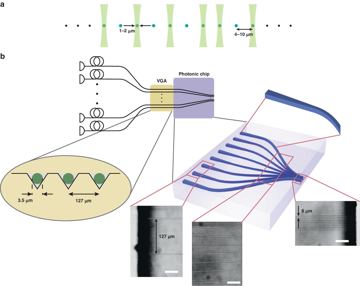
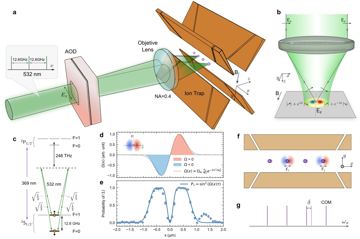
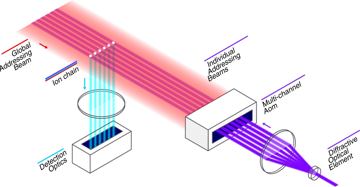
Free-space laser addressing of ions (AOM/AOD beams)
Gate light from a room-temperature optical bench is switched and steered onto individual ions of one chain by multi-channel acousto-optic modulators or acousto-optic deflectors and focused through bulk optics above the trap.
Verdict. The most common ion control in the register, published to 40 addressed ions per chain with neighbour crosstalk of 10⁻³–10⁻²; no per-pair benchmark of a longer free-space-addressed chain was found as of 2026-09-26, and IonQ's roadmap past Tempo rests on chips and photonic links.
AOM = acousto-optic modulator; AOD = acousto-optic deflector; MS = Mølmer–Sørensen gate; DRB = direct randomised benchmarking; ε = the neighbour's Rabi frequency over the target's; QV = quantum volume; G1–G7 = the report's goal classes (see Actors & economics).
Identity & lineage
An optical bench sends gate light through viewports and a high-aperture objective; acousto-optics set which ion is lit and the light's amplitude, frequency and phase. A multi-channel AOM gives one rf channel per fixed beam — 32 at 355 nm in the 2016 five-qubit Maryland machine, the technology's origin D[585]; an AOD maps rf frequency to angle, so a steered beam reaches any ion D[100]. Hyperfine qubits take a Raman pair — 355 nm for ¹⁷¹Yb⁺ D[586], 532 nm for ¹³³Ba⁺ D[109]; ⁴⁰Ca⁺ optical qubits take one 729 nm beam D[253].
Attributes: optical control at room temperature; coherent errors; bulk optics; one assembly per chain.
Physics & limits
Crosstalk. A Gaussian field falls as exp(−d²/w²) — ~10⁻¹² at EURIQA's 0.85 µm waist and 4.43 µm pitch S — yet the neighbour sees up to 2.5% of the target's Rabi frequency D[254]: aberration and scatter set the floor. Published neighbour figures, in differing measures, fall from <4% in 2016 D[585] to <9×10⁻⁴ D[587]. For a Rabi ratio ε, a spectator rotated by εθ loses ≈(εθ/2)², 2.5×10⁻⁴ at ε = 10⁻² for a π pulse S; being coherent, the error compensates — intensity-scaling light-shift pulses cut the AQT demonstrator's 0.5% neighbour figure to 1.3×10⁻⁴ D[253].
Pointing and phase. Jitter δx shifts the Rabi rate by ~(δx/w)² S; Forte sizes its 1.5 µm waist against pointing noise D[100]. At 355 nm, 56 nm of path between counter-propagating arms is 1 rad of gate phase S; Forte configures two of its four paths for phase-insensitive single-qubit gates D[100].
The AOD. θ = λf/v; resolution is aperture time × bandwidth; thermal drift needs in-situ angle calibration G[588]. Duke's UV AOD deflects 6 mrad over a 100 MHz band D[587], i.e. v ≈ 5.9 km/s S. The rf also shifts the optical frequency with position; AQT's crossed AODs cancel it D[253]. ~50 beam diameters of steering D[587] span 25–50 ions at 3–4 µm spacing S. Pairs are served in sequence D[109]: 15 disjoint pairs at Forte's median 672 µs MS gate take ~10 ms S. Field of view and serialisation hold a chain near 30–40 ions S.
Engineering state of the art
table
| Year | Figure | Who | Tag+key |
|---|---|---|---|
| 2016-08 | 5 ¹⁷¹Yb⁺; 32-channel UV AOM; crosstalk <4%; XX gate 235 µs | Univ. of Maryland | D[585] |
| 2019-11 | 11 qubits in 13 ions; global + addressed 355 nm beams; 2Q 97.5% | IonQ | D[586] |
| 2021-06 | Crossed AODs, 729 nm; neighbour crosstalk 0.5%; 24-ion GHZ 54.4(7)% | Innsbruck / AQT | D[253] |
| 2021-10 | 32 beams, 0.85 µm waist; 13 qubits in 15 ions; 2Q 98.5–99.3% | EURIQA (Maryland/Duke) | D[254] |
| 2023-08 | 4 AODs; 30 qubits in 36 ions; 2Q DRB median 4.64×10⁻³ | IonQ Forte | D[100] |
| 2026-01 | AOD module <1 ft²; crosstalk <9×10⁻⁴; 30-ion chain; 240 ns switching | Duke | D[587] |
| 2026-06 | 40 ¹³³Ba⁺; AOD-steered 532 nm Raman beams | IonQ | D[109] |
Above 40 ions, beyond Helios's 98 ions in a QCCD trap, only claims exist: Tempo's page lists 100 "target" qubits and 99.9% "target fidelity", with no addressing method C[101]. Tsinghua's 512-ion crystal runs global 411 nm beams — free space without addressing D[121].
Manufacturing, materials & supply chain
An assembly, not a wafer: a pulsed UV laser (EURIQA: Coherent Paladin 355-4000) D[254], acousto-optics — fused silica in the UV, TeO₂ in the visible G[588] — objectives and rf synthesis; Duke's module uses a Brimrose AOD D[587]. Gooch & Housego and AA Opto Electronic are also named P[322]; G&H deflectors steer 3,000- and 6,100-atom tweezer arrays too C[504], a supply shared with cx_aod. AQT fits 12 qubits in two 19-inch racks, 2 m², <2 kW C[382].
Control, readout & I/O burden
A multi-channel AOM needs one rf channel per ion at fixed pitch — EURIQA idles two end ions to keep the spacing uniform D[254]; Forte's four AODs, each behind an AOM that sets amplitude, frequency and phase, are designed to reach any of 40 ions — the benchmark ran 36, limited by its photon-detection channels — and free the trapping potential D[100]. Switching (~240 ns) D[587] is negligible; serialisation is the latency — Ba-testbed code cycles take 35–86 ms, all ions shelved to D₅/₂ during mid-circuit readout D[109]. At 10³ ions: ~25 benches plus photonic links S.
Role in the stack
Slot 5 of "Trapped ions — linear Paul trap with individual laser addressing" and "Trapped ions — QCCD (transport between zones)". It requires fab_optics (bulk optics above the trap), provides the free-space fields g_ms requires, and is replaced by ct_ionlaser (integrated delivery) and ct_ionmw (laser-free, microwave-driven electronic gates, two-qubit error 8.4(7)×10⁻⁵ D[102]). Sixteen register machines carry it (16 as primary), among them IonQ Aria, Forte, Tempo and the 40-ion Ba testbed; Quantinuum Helios, H1 and H2; AQT IBEX Q1 and LYNX; PIAST-Q; QSCOUT (Quantum Scientific Computing Open User Testbed); the FIAN / Rosatom 70-qubit ion machine; Tsinghua; Innsbruck; Maryland/Duke. Seven cells are ✅; Aria's is 🔎, its beam optics shown only for the 2019 predecessor D[586]; Tsinghua's is 🔎 and shows global beams; Tempo, PIAST-Q and the Rosatom machine are 🔎. Qudoor AbaQ is not among them: its control is undisclosed. AQT and Innsbruck are profiled as ⁴⁰Ca⁺ optical qubits, as their cited papers use D[253]D[255]. Gap G-ionaod is closed, with ion_chain in place of the proposed ion_elec.
Evidence — how the numbers were measured
Crosstalk is quoted as Rabi ratio, intensity ratio (ε²) or spectator error — Duke calls a Rabi ratio "intensity crosstalk" D[587] — and measured by moving one ion through the beam D[253], by flag ions D[254] or by simultaneous benchmarks D[109]. Forte's 435-pair DRB finds no significant dependence on ion distance but significant out-of-model errors D[100]. Of the vendor pages opened, only AQT's specifies crosstalk, neighbour <1.8×10⁻², as of 2026-09-26 C[382].
Not published: Tempo's species, gate time and addressing method, Aria's own architecture and Qudoor AbaQ's control; and any quantitative figure for rf power per tone, multi-tone intermodulation or AOD thermal pointing drift in ion systems.
Actors & economics
Who.
| Organisation | Role | Country | What exactly they do with this technology | Evidence |
|---|---|---|---|---|
| IonQ | developer | US | AOD addressing on Forte and the 40-ion Ba testbed | D[100]D[109] |
| Alpine Quantum Technologies | developer | AT | Crossed-AOD 729 nm addressing, rack systems | D[253]C[382] |
| University of Innsbruck | research | AT | Steerable 729 nm beams, 16 ions | D[255] |
| Univ. of Maryland / Duke | research | US | 32-channel AOM; compact AOD module | D[254]D[587] |
| Tsinghua University | research | CN | 512-ion crystal, global beams | D[121] |
| Qudoor | developer | CN | In-house lasers and control; addressing undisclosed | P[302] |
| Gooch & Housego | supplier | UK | AODs, AOMs | C[504] |
Money.
- 2023-12-05 · AQT · 20-qubit two-rack computer for LRZ and Munich Quantum Valley, Bavarian funding · ~EUR 9.8 M · contracted C[323]
- 2025-09-17 · IonQ · acquisition of Oxford Ionics (chip-manufactured traps) · not stated in the release · closed C[18]
Market & supply chain. Lasers, acousto-optics, objectives and rf are merchant parts; ytterbium's UV lines demand expensive, power-limited lasers P[322]. Both architectures serve G2, G3, G6 and G7.
IP & standards. IonQ filings on compensating Raman beam-geometry errors (JP 2024, EP 2025) P[375]; no crosstalk-reporting standard found as of 2026-09-26.
Roadmaps & track record. IonQ (2025-06-13): Tempo, 100 qubits, 2025; 10,000 on one chip, 2027; >2,000,000 by 2030, naming Oxford Ionics 2D traps and photonic links as the means R[132]. Tempo's figures remain targets C[101]; the 2026-04-14 two-system photonic link gave no rate or fidelity C[589]. AQT's LYNX claims QV 32,768 and lower laser phase-noise sensitivity, no qubit count C[128].
Strategic reading. The fastest route to a working 30–40-ion machine and the yardstick for integrated and electronic delivery, but not a scaling path; value moves to trap chips and links.
Outlook & open questions
Confirm if, by 2027-12-31, IonQ publishes Tempo's per-pair gate times, fidelities and addressing method, or an addressed chain above 60 ions is benchmarked; demote if IonQ's next systems ship on electronic or integrated delivery. Open questions. (1) What sets the neighbour floor below 10⁻³ — aberration, scatter or rf intermodulation? (2) Can multi-tone AODs run parallel gates without stray beams? (3) How does pointing drift scale with rf duty cycle? (4) Does double-sided steering hold at 100 ions? (5) When does a photonic link beat a longer chain?
References
- [18] IonQ, “IonQ Completes Acquisition of Oxford Ionics, Rapidly Accelerating Its Quantum Computing Roadmap,” Sep. 17, 2025. [Online]. Available: https://www.ionq.com/
news/ Cionq-completes-acquisition-of-oxford-ionics-rapidly-accelerating-its-quantum - [100] J.-S. Chen et al., “Benchmarking a trapped-ion quantum computer with 30 qubits,” Quantum, vol. 8, Art. no. 1516, Nov. 2024, doi: 10.22331/q-2024-11-07-1516. arXiv:2308.05071. D
- [101] IonQ, “IonQ Tempo: 100-Qubit Quantum Computer (#AQ 64).” [Online]. Available: https://ionq.com/
quantum-systems/ Ctempo - [102] A. C. Hughes et al., “Trapped-ion two-qubit gates with >99.99% fidelity without ground-state cooling,” arXiv:2510.17286, Oct. 2025. D
- [109] E. Tham et al., “Breakeven demonstration of quantum low-density parity-check codes,” arXiv:2606.06455, Jun. 2026. D
- [121] S.-A. Guo et al., “A site-resolved two-dimensional quantum simulator with hundreds of trapped ions,” Nature, vol. 630, no. 8017, pp. 613–618, May 2024, doi: 10.1038/s41586-024-07459-0. D
- [128] Alpine Quantum Technologies GmbH, “AQT Sets New European Industry Standard: Introducing the ‘LYNX’ Series with Record-Breaking Quantum Volume,” AQT, May 5, 2026. [Online]. Available: https://www.aqt.eu/
lynx-quantum-volume-record/ C - [132] IonQ, “IonQ's Accelerated Roadmap: Turning Quantum Ambition into Reality,” Jun. 13, 2025. [Online]. Available: https://www.ionq.com/
blog/ Rionqs-accelerated-roadmap-turning-quantum-ambition-into-reality - [253] I. Pogorelov et al., “Compact Ion-Trap Quantum Computing Demonstrator,” PRX Quantum, vol. 2, no. 2, Art. no. 020343, Jun. 2021, doi: 10.1103/PRXQuantum.2.020343. arXiv:2101.11390. D
- [254] L. Egan et al., “Fault-tolerant control of an error-corrected qubit,” Nature, vol. 598, no. 7880, pp. 281–286, Oct. 2021, doi: 10.1038/s41586-021-03928-y. arXiv:2009.11482. D
- [255] L. Postler et al., “Demonstration of fault-tolerant universal quantum gate operations,” Nature, vol. 605, pp. 675–680, 2022, doi: 10.1038/s41586-022-04721-1. arXiv:2111.12654. D
- [302] M. U. Rehman, “Top Chinese Quantum Computing Companies in 2026,” The Quantum Insider, May 15, 2026. [Online]. Available: https://thequantuminsider.com/
2026/ P05/ 15/ 10-plus-companies-leading-the-quantum-technologies-race-in-china/ - [322] M. Ivezic, “The Optical Table's Hidden Supply Chain: Who Really Wins If Trapped-Ion Quantum Computing Wins,” PostQuantum.com, Oct. 1, 2025. [Online]. Available: https://postquantum.com/
quantum-ecosystem/ Ptrapped-ion-quantum-ecosystem/ - [323] AQT, “AQT lands million euro contract,” Dec. 5, 2023. [Online]. Available: https://www.aqt.eu/
aqt-lands-million-euro-contract/ C - [375] PatSnap, “Trapped Ion Quantum Computing: Technology Landscape 2026,” Apr. 23, 2026. [Online]. Available: https://www.patsnap.com/
resources/ Pblog/ rd-blog/ trapped-ion-quantum-computing-2026-patsnap-eureka/ - [382] Alpine Quantum Technologies, “19-inch rack-mounted quantum computer,” AQT. [Online]. Available: https://www.aqt.eu/
products/ Cibex-q1/ - [504] Gooch & Housego (G&H), “G&H Acousto-Optic Deflectors Referenced in Nature Papers Demonstrating 3,000 & 6,100 Qubit Quantum Systems,” G&H, Mar. 2026. [Online]. Available: https://gandh.com/
news-and-resources/ Cg-and-h-acousto-optic-deflectors-in-nature-papers - [585] S. Debnath, N. M. Linke, C. Figgatt, K. A. Landsman, K. Wright, and C. Monroe, “Demonstration of a small programmable quantum computer with atomic qubits,” Nature, vol. 536, no. 7614, pp. 63–66, Aug. 2016, doi: 10.1038/nature18648. arXiv:1603.04512. D
- [586] K. Wright et al., “Benchmarking an 11-qubit quantum computer,” Nat. Commun., vol. 10, Art. no. 5464, Nov. 2019, doi: 10.1038/s41467-019-13534-2. arXiv:1903.08181. D
- [587] J. Yu et al., “Design and Characterization of Compact Acousto-Optic-Deflector Individual Addressing System for Trapped-Ion Quantum Computing,” arXiv:2601.01647, Jan. 2026. D
- [588] R. Paschotta, “Acousto-optic Deflectors,” RP Photonics Encyclopedia. [Online]. Available: https://www.rp-photonics.com/
acousto_optic_deflectors.html G - [589] IonQ, “IonQ Achieves Key Photonic Interconnect Milestone, Demonstrating Networked Quantum Systems Using Entanglement,” Apr. 14, 2026. [Online]. Available: https://www.ionq.com/
news/ Cionq-achieves-key-photonic-interconnect-milestone-demonstrating-networked-quantum-systems-using-entanglement