Fermion-parity encoding (tetron) enc_parity
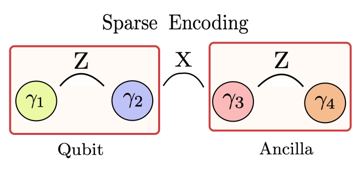
One logical qubit in the fermion parity of four Majorana zero modes on two wires; Z and X are parities of different mode pairs, both non-local.
Fermion-parity encoding (tetron)
Qubit in joint parity of two Majorana wires; X-measurement lifetime 1000× shorter than Z in 2025 data.
Brief →Key references
Design space — attributes
- (a) carrier affinity
- fabricated
- (b) time · entangling
- —
- (c) readout
- —
- (d) mobility
- —
- (e) control
- —
- (f) error structure
- unknown / contested
- (g) manufacturing
- —
Evaluation space — dated attributes
The gap is attributed to the larger quasiparticle-capture cross-section of the two-wire X loop — flux noise is not the stated cause. DARPA US2QC: final Validation & Co-Design stage since 2025-02-06, not QBI Stage B.
Actors & goals — annotations
Edges
Used by 2 machines (2 primary · 0 alternate)
- topological 2
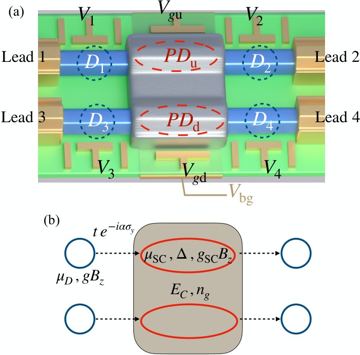
- Majorana 1 Microsoft paper press ▣ Fig. 2 (single-qubit tetron gate schematic with measurement loops); §II.B Device design ✅
- Majorana 2 Microsoft blog blog press ▤ Abstract ✅
Pictures
Every picture carries the story of what it shows and its credit line.
Fermion-parity encoding (tetron)
One logical qubit in the fermion parity of four Majorana zero modes on two wires; Z and X are parities of different mode pairs, both non-local.
Verdict. Not a working encoding as of 4 Sep 2026 — its X channel lives ~1000× shorter than its Z channel; falsified as fault-tolerance-relevant unless that ratio falls below 10× by 2028.
Λ = error-suppression factor per code-distance step; QBI = DARPA Quantum Benchmarking Initiative (Stage A concept → B R&D plan → C government V&V); G1–G7 = the report's goal classes (see Actors & economics).
Identity & lineage
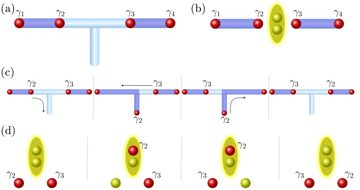
Four Majorana zero modes (MZMs) on two wires joined by a superconducting backbone hold one qubit: Z is the parity of one wire's mode pair, X of a pair spanning both, so neither logical operator is local. Karzig et al. defined the tetron and hexon layouts in 2017, with Cliffords by measurement rather than braiding S[421]. Only Z-type parity has been read with a stated fidelity; the X measurement the encoding requires has not D[21].
a fabricated (1.0) · b not a gate · c no readout · d no transport
e no control · f asymmetric, poisoning-dominated · g inherits the wire fab
Physics & limits
Protection is a length and a gap: parity splitting falls exponentially with length over coherence length, poisoning as the gap rises against temperature and quasiparticle density S[421]. Neither is published. Published instead: 12.4 ms on the Z loop against 14.5 µs on the X loop in one device D[20]. Both are fermion parities, so the ~1000× factor is geometric: the X loop encloses both wires and captures quasiparticles over a larger cross-section D[20]. A code needs comparable rates on both bases, and this is not usable bias: the short basis is the one a measurement-based gate projects most. Moving the floor means a larger gap (lead replaced aluminium D[21]), quasiparticle trapping and a smaller X loop.
Engineering state of the art
table
No logical state prepared, no X measurement, no coherence time or logical error rate for a tetron D[21].
The arXiv text of [20] also gives X ~4 µs and Z ~9.3 ms for other tunings, against the 14.5 µs / 12.4 ms quoted above. No non-Microsoft tetron exists. Not published: a Majorana splitting, a wire length over coherence length or a quasiparticle density for any tetron, so the protection claim cannot be checked numerically; and whether the X/Z asymmetry is geometric or intrinsic.
Manufacturing, materials & supply chain
No process of its own; the encoding fixes a geometry. Two wires, a backbone and the dots closing each loop cost more area and steps than a bare wire, and the X loop's coupling elements are exactly what a Z-only measurement avoids. Bring-up is per device: the 2026 rf technique resolves wire-end-state splitting to µeV so array devices can be tuned at all D[21]. Below it is in-house InAs–Pb epitaxy, unreplicated outside Microsoft; no export-control category specific to it.
Role in the stack
Architecture: topological — tetron (Majorana), where it is the primary encoding. It requires two wires per qubit and supplies the logical degree of freedom a measurement-based gate would act on; nothing else consumes it, and it sets no clock. Verification is one-sided: telegraph statistics on parity loops, no logical error per cycle, no Λ, no independent tetron. The dispute runs deeper: Legg's Matters Arising (2026-06-24) argues the regions read out in 2025 were disordered and gapless, making the encoded object trivial rather than protected; Microsoft's same-day reply concedes nothing D[22]. QuTech's parity qubit in coupled Kitaev chains is an alternative encoding with limited protection, not a tetron replication D[217].
Actors & economics
Who.
| Organisation | Role | Country | What they do | Evidence |
|---|---|---|---|---|
| Microsoft Quantum | developer | US | Defined the tetron and holds the only Z/X data | D[20] |
| DARPA | investor | US | US2QC final Validation & Co-Design stage since 2025-02-06 | fact |
| QuTech | research | NL | Competing parity encoding in coupled Kitaev chains | D[217] |
| Nokia Bell Labs | research | US | Fractional-quantum-Hall anyon route, a different encoding | Dfact |
Money. 2025-02-06 · Microsoft · US2QC final Validation & Co-Design stage · undisclosed · DARPA · announced fact. 2026-01-23 · Microsoft · Quantum Pioneers Program, QEC an award topic · ≤ USD 200,000 per proposal · announced Pfact.
Market & supply chain. Nothing is sold; it consumes wires and readout and pays back only in G4, after an X measurement exists.
IP & standards. The tetron layout is Microsoft's published lineage S[421]; no dated patent count specific to it as of 4 Sep 2026.
Roadmaps & track record. (tetron as the fault-tolerance unit, promised 2017, restated for 2029 in 2026; status 4 Sep 2026: no X measurement, no logical qubit) C[215]. Nine years from design to a one-wire measurement, with no interim milestone for the X/Z ratio.
Strategic reading. Every topological claim above sits on this ratio. If it closes, Microsoft's fabrication lead becomes a code; if not, the tetron gives way to a longer Kitaev chain and the wire stack loses its justification. Risk is single-vendor and single-design.
Outlook & open questions
Falsifiable in 12–24 months: any X-basis parity measurement with a stated assignment error; an X/Z ratio below 100×; a joint measurement across two tetrons. Confirm on the first two; demote to theory if none appears by end-2027. Best case, loop redesign and a larger gap bring X into milliseconds; worst case, X-loop poisoning is intrinsic and the design is abandoned. Open: is the asymmetry geometric or intrinsic; does anyone build a tetron outside Microsoft.
References
- [20] M. Aghaee et al., “Distinct Lifetimes for X and Z Loop Measurements in a Majorana Tetron Device,” arXiv:2507.08795, Jul. 2025. D
- [21] M. Aghaee et al., “20 Second Parity Lifetime in an InAs–Pb Tetron Device,” arXiv:2606.03884, Jun. 2026. D
- [22] H. F. Legg, “On the robustness of topological gap detection via transport,” Nature, vol. 654, no. 8120, pp. E22–E26, Jun. 2026, doi: 10.1038/s41586-026-10567-8. arXiv:2503.08944. D
- [215] C. Nayak, “Majorana 2 – Microsoft's Scalable Quantum Processor With Reliable, Long-Lasting Qubits,” Microsoft Quantum. [Online]. Available: https://quantum.microsoft.com/
en-us/ Cinsights/ blogs/ majorana-2-scalable-quantum-processor - [217] F. Zatelli et al., “Majorana parity qubit in coupled minimal Kitaev chains,” arXiv:2607.09511, Jul. 2026. D
- [421] T. Karzig et al., “Scalable designs for quasiparticle-poisoning-protected topological quantum computation with Majorana zero modes,” Phys. Rev. B, vol. 95, no. 23, Art. no. 235305, Jun. 2017, doi: 10.1103/PhysRevB.95.235305. arXiv:1610.05289. S