Time-bin / path photonic encoding enc_timebin
Photonic dual-rail qubit in arrival-time bins or waveguide path; loss is the dominant error, and it is heralded — an erasure at a known location — rather than a silent error.
Time-bin / path photonic encoding
Photonic dual-rail in time or path; loss is the error and it is heralded.
Brief →Key references
Design space — attributes
- (a) carrier affinity
- photon (natural particle, engineered modes)
- (b) time · entangling
- —
- (c) readout
- —
- (d) mobility
- —
- (e) control
- —
- (f) error structure
- loss (erasure)
- (g) manufacturing
- —
Evaluation space — dated attributes
no dated attribute
Origin: Brendel, Gisin, Tittel and Zbinden, Phys. Rev. Lett. 82, 2594 (1999). No mobility of its own — the attribute is 'none', inherited from the host carrier.
Actors & goals — annotations
Edges
Used by 4 machines (3 primary · 1 alternate)
- photonics 4
- Belenos Quandela product page press ▤ Methods: Architecture (path-degree-of-freedom encoding) ✅
- Quandela Canopus Quandela product page product page press ◌ 🔎
- Lucy Quandela press ▦ 🔎
- Omega chipset (Moreton Bay / Chicago systems unnamed) PsiQuantum paper product page press ◌ 🔎 (alternate)
Pictures
Every picture carries the story of what it shows and its credit line.
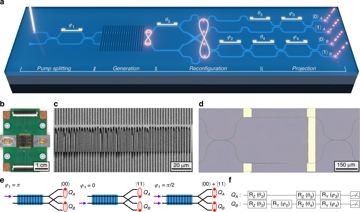
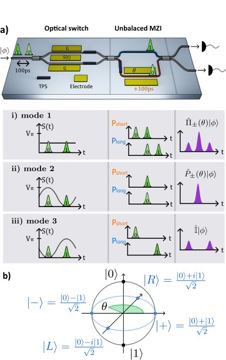
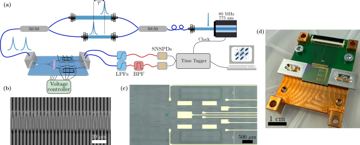
Time-bin / path photonic encoding
Photonic dual-rail qubit in arrival-time bins or waveguide path; loss is the dominant error, and it is heralded — an erasure at a known location — rather than a silent error.
Verdict. The two halves have diverged: path encoding won on chip (PsiQuantum Omega), time-bin survives in fibre, because an on-chip delay costs 0.27 dB per ns. No fusion logical qubit by 2028 leaves it a communication encoding.
Λ = error-suppression factor per code-distance step; QBI = DARPA Quantum Benchmarking Initiative (Stage A concept → B R&D plan → C government V&V); G1–G7 = the report's goal classes (see Actors & economics).
Identity & lineage
One photon, two orthogonal modes: two arrival-time bins, or two waveguides. Nothing continuous decoheres, so the dominant error is loss — and a lost photon fails to herald, detectable where it happens. Time-bin entanglement came from Brendel, Gisin, Tittel and Zbinden at Geneva in 1999, built for telecom fibre D[418]; path encoding is the on-chip descendant, and Omega says so plainly — "a path-encoded qubit using a heralded photon and two-mode interferometers" D[169]. Attributes: no mobility, no control modality, no fabrication of its own; pure-loss error.
Physics & limits
The floor is a loss budget, not an infidelity: every interferometer, coupler and switch removes amplitude, and the two halves of this node price it differently. A 1 ns time bin needs ~0.15 m of on-chip delay at group index 2, which at PsiQuantum's measured 1.8 ± 0.2 dB/m SiN loss D[169] costs ~0.27 dB — over half a ~0.5 dB per-photon budget, against ~0.04 mdB in fibre. That is why chips are path-encoded and fibres time-bin encoded — one node only in the abstract. The erasure advantage needs a trusted herald: Omega's median on-chip detector efficiency is 93.4% D[169], so about one heralded event in fifteen is an unflagged loss entering the code as ordinary error.
Engineering state of the art
table
| Date | Figure | Who | Tag |
|---|---|---|---|
| 2025-02 | Fusion Bell fidelity 99.22 ± 0.12%, chip-to-chip 99.72 ± 0.04% | PsiQuantum | D[169] |
| 2025-02 | Single-mode SiN loss 1.8 ± 0.2 dB/m; on-chip SNSPD 93.4% | PsiQuantum | D[169] |
| 2026-06-26 | Unencoded 6-ring loss threshold 0.38–0.82% | Löbl et al. | S[264] |
No logical qubit exists in this encoding, and the threshold it must meet is disputed: 2.7% per photon for a boosted 6-ring and 17.4% for a {7,4}-encoded state S[179] against 0.38–0.82% unencoded S[264] — an order of magnitude apart, unreconciled fact.
The main report's "waveguide loss 0.5 dB/m" is not the Omega single-mode silicon-nitride figure, 1.8 ± 0.2 dB/m fact. Loss thresholds for 6-ring fusion differ by an order of magnitude between sources, unreconciled fact. No platform has demonstrated syndrome extraction with heralded loss. The 0.27 dB per nanosecond of on-chip delay is derived from published loss figures, not measured. Not published: whether Toshiba's 2025–26 deployments use time-bin encoding; its public pages do not say so [420].
Manufacturing, materials & supply chain
No fabrication step of its own: the encoding rides its host — PsiQuantum's 300 mm silicon nitride, Quandela's III-V quantum dots, QuiX's SiN meshes. Control is inherited: no per-qubit drive line, but every interferometer needs a phase shifter and every output a detector — thousands of cryogenic channels and their fan-out at 10³–10⁴ qubits. Chokepoints are the detector vendors (Single Quantum, ID Quantique, Photon Spot) and the III-V and SiN foundries Pfact; ECCN 4A906 applies fact.
Role in the stack
The encoding under the fusion-based discrete-variable architecture (PsiQuantum, Quandela, QuiX); it needs only a single-photon source, and its one rival there is the dual-rail encoding, primary on PsiQuantum's Omega and QuiX's Carina. Swapping path for time-bin trades interferometer phase stability for delay-line loss, unaffordable on chip. It also caps fusion: passive linear-optical Bell measurement on a dual-rail qubit succeeds at 50%, at least 75% with unentangled ancillae S[419]. Verification: no group has run a syndrome cycle using heralded loss as an erasure flag, so the advantage is a design argument, not a measurement.
Actors & economics
Who.
| Organisation | Role | Country | What they do | Evidence |
|---|---|---|---|---|
| PsiQuantum | developer | US | Path-encoded qubits on Omega | D[169] |
| Quandela | developer | FR | Photonic QPUs on quantum-dot sources | Cfact |
| QuiX Quantum | developer | NL | Carina core delivered to DLR, dual-rail encoded | C[340] |
| Sparrow Quantum | supplier | DK | Only merchant single-photon source vendor | P[342] |
Money.
2025-04-10 · Sparrow Quantum · Series A · EUR 21.5 M · lead undisclosed · closed P[342]
2025-09-10 · PsiQuantum · Series E · USD 1 B at USD 7 B · BlackRock, Temasek · closed Cfact
2026-07-22 · PsiQuantum · DARPA QBI Stage C expansion · USD 125 M · DARPA · announced Pfact
Market & supply chain. Sparrow is the only merchant source vendor, shipping 20–35% system efficiency against a 71.2% laboratory record P[342], so every fusion architecture pays a multiplexing tax set by one supplier's yield. Pays for G1/G2, is PsiQuantum's G3–G4 substrate, and pays separately for G6 through QKD.
IP & standards. ORCA holds US 12,437,225 on linear-optical encoded GHZ measurements (granted 2025-10-07), the only photonic dual-rail family a dated search surfaced G[407]; no computing-side standard exists.
Roadmaps & track record. PsiQuantum has published no hardware result since Omega, so 2026 progress is legible only through DARPA V&V Pfact. QuiX promised a universal machine for 2026 and delivered the core, not the machine C[340]. Quandela missed its 2025 first-logical-qubit milestone, still targeting 50 by 2028 R.
Strategic reading. Whoever cuts system-level loss wins the fusion race — likely whoever controls detector efficiency and source multiplexing, not whoever designs the encoding, which is free where its host is not. QKD monetises the same physics, so a fusion failure strands PsiQuantum and Quandela but not QKD.
Outlook & open questions
Confirm by 2027: a hardware syndrome cycle consuming heralded loss as an erasure flag; absent that it stays theory. Best case 2029: a small fusion-based logical qubit; worst case, commercially real only in QKD. Open: does anyone reconcile the 0.38% and 2.7% thresholds; can detector efficiency reach herald-trust levels at scale.
References
- [169] K. Alexander et al., “A manufacturable platform for photonic quantum computing,” Nature, vol. 641, no. 8064, pp. 876–883, Feb. 2025, doi: 10.1038/s41586-025-08820-7. D
- [179] S. Bartolucci et al., “Fusion-based quantum computation,” Nat. Commun., vol. 14, Art. no. 912, Feb. 2023, doi: 10.1038/s41467-023-36493-1. arXiv:2101.09310. S
- [264] M. C. Löbl, L. A. M. Pettersson, J. Dragašević, S. X. Chen, and O. A. D. Sandberg, “The subthreshold issue of fusion-based quantum computing,” arXiv:2606.28490, Jun. 2026. S
- [340] QuiX Quantum, “QuiX Quantum Secures €15 Million to Deliver First-Generation Universal Photonic Quantum Computer,” Jul. 10, 2025. [Online]. Available: https://www.quixquantum.com/
news/ Cquix-quantum-series-a - [342] M. Abdel-Kareem, “Sparrow Quantum Secures €21.5M ($24M USD) in Series A Funding to Advance Photonic Quantum Chip Production,” Quantum Computing Report, Apr. 10, 2025. [Online]. Available: https://quantumcomputingreport.com/
sparrow-quantum-secures-e21-5m-24m-usd-in-series-a-funding-to-advance-photonic-quantum-chip-production/ P - [407] ORCA Computing Limited, “Linear-optical encoded GHZ measurements and fault-tolerant quantum computation and communication,” Justia Patents, Oct. 7, 2025. [Online]. Available: https://patents.justia.com/
patent/ G12437225 - [418] J. Brendel, N. Gisin, W. Tittel, and H. Zbinden, “Pulsed Energy-Time Entangled Twin-Photon Source for Quantum Communication,” Phys. Rev. Lett., vol. 82, no. 12, pp. 2594–2597, Mar. 1999, doi: 10.1103/PhysRevLett.82.2594. arXiv:quant-ph/9809034. D
- [419] F. Ewert and P. van Loock, “3/4-Efficient Bell Measurement with Passive Linear Optics and Unentangled Ancillae,” Phys. Rev. Lett., vol. 113, no. 14, Art. no. 140403, Sep. 2014, doi: 10.1103/PhysRevLett.113.140403. arXiv:1403.4841. S
- [420] Toshiba Europe, “News Hub - The Latest Quantum Security News from Toshiba,” Toshiba Quantum Technology. [Online]. Available: https://www.toshiba.eu/
quantum/ Cnews/