Bulk-optics and fibre assembly (photonic samplers) fab_bulk
Photonic processors assembled from discrete parts — free-space squeezers and interferometers, fibre delay loops, fibre-coupled modulators and cryogenic single-photon detectors — aligned and locked by hand and servo rather than patterned on a wafer.
Bulk-optics and fibre assembly (photonic samplers)
Table-top optics and fibre loops assembled by hand — Jiuzhang, Borealis, PT-2 — as opposed to a photonic-IC foundry; it is how every beyond-classical sampler was built and how none of the fault-tolerant photonic machines will be.
Brief →Key references
Design space — attributes
- (a) carrier affinity
- photon (natural particle, engineered modes)
- (b) time · entangling
- —
- (c) readout
- —
- (d) mobility
- —
- (e) control
- —
- (f) error structure
- loss (erasure)
- (g) manufacturing
- optical / mechanical assembly
Evaluation space — dated attributes
no dated attribute
Alignment drift and per-element loss set the run length; no volume manufacturing path.
Actors & goals — annotations
Edges
Used by 7 machines (7 primary · 0 alternate)
- photonics 7
- PT-1 ORCA Computing paper product page ▦ 'Rack-mounted, room temperature and built with optical fibre components' ✅
- PT-2 ORCA Computing product page press ◌ 🔎
- Jiuzhang (1.0) USTC (Pan Jianwei group) press ◌ 🔎
- Jiuzhang 2.0 USTC (Pan Jianwei group) paper press ◌ 🔎
- Jiuzhang 3.0 USTC (Pan Jianwei group) paper press ◌ 🔎
- Jiuzhang 4.0 USTC (Pan Jianwei group) paper press ▣ Extended Data Fig. 1 (free-space unbalanced MZI, PZT-mounted mirror); Extended Data Fig. 3 ✅
- Borealis Xanadu paper link ▤ Methods: Pulsed squeezed-light source; Optical circuit ✅
Pictures
Every picture carries the story of what it shows and its credit line.

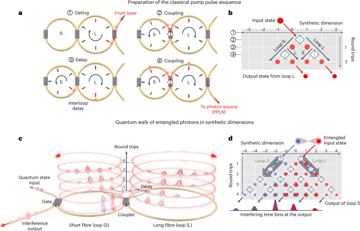
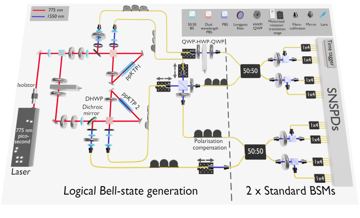
Bulk-optics and fibre assembly (photonic samplers)
Photonic processors assembled from discrete parts — free-space squeezers and interferometers, fibre delay loops, fibre-coupled modulators and cryogenic single-photon detectors — aligned and locked by hand and servo rather than patterned on a wafer.
Verdict. The lowest-loss way to buy delay and squeezing, and how every beyond-classical photonic sampler, Jiuzhang 1.0 (2020) to Jiuzhang 4.0 (2026), was built; as of 2026-09-26 no published fault-tolerant photonic design assembles its processor this way, and only fibre delays and links carry over to the chip machines.
OPO = optical parametric oscillator; (PP)KTP = (periodically poled) potassium titanyl phosphate; EOM = electro-optic modulator; MZI = Mach–Zehnder interferometer; SNSPD = superconducting nanowire single-photon detector; TES = transition-edge sensor; PIC = photonic integrated circuit; ECCN = US Export Control Classification Number; USTC = University of Science and Technology of China; G1–G7 = the report's goal classes (G1: analogue and NISQ simulation).
Identity & lineage
Crystals in free-space cavities squeeze light, beamsplitters or fibre couplers interfere it, fibre spools delay it, fibre-coupled cryogenic detectors count it. Jiuzhang 1.0 fed 50 squeezed states into a 100-mode "ultralow-loss" interferometer, the whole set-up phase-locked D[460]; Borealis moved interference into time, with fibre loops of 1, 6 and 36 bins at a 6 MHz clock D[270]; Jiuzhang 4.0 joins three 16-mode interferometers through two arrays of 16 fibre delays D[175]. ORCA sells racks of "telecoms-grade optical fibre components" at room temperature C[464]. Attributes: carrier affinity 0.25 (hosts modes, not qubits); no characteristic time, readout, mobility or control modality of its own; loss error; optics manufacturing.
Physics & limits
Fibre is nearly free per metre: ≤0.18 dB/km at 1550 nm, group index 1.4682 G[816]. Borealis's 36-bin loop (6.0 µs, ≈1.2 km) thus costs ≈0.22 dB in the glass, Jiuzhang 4.0's longest delay (12 µs, ≈2.4 km) ≈0.44 dB S[175], [270]; foundry silicon nitride at 0.5–1.8 dB/m would charge ~600–2,200 dB for 1.2 km S[169]. Delay stays in fibre; loss sits at transitions and active parts. Loss also caps squeezing: at transmission η the measured quadrature variance η·e^(−2r) + (1 − η) cannot fall below 1 − η — a 16.0 dB ceiling at η = 0.975, the efficiency behind the 15 dB record from a free-space PPKTP cavity D[344], but 1.7 dB at Borealis's ~33% S[270]. Phase is the second limit: Borealis's residual loop phase noise grows with length — 0.02, 0.03 and 0.15 rad for loops 0–2 D[270]. Assembly has no scaling term — each element is placed, coupled and locked singly — while Xanadu reckons fault tolerance would take a 20–30× cut, in decibels, in every component's insertion loss S[173].
Engineering state of the art
table
| Year | Figure | Who | Tag+key |
|---|---|---|---|
| 2016-09-06 | 15 dB squeezing observed; 9.3 mm PPKTP half-monolithic cavity; total detection efficiency 0.975 | Vahlbruch et al., AEI Hannover | D[344] |
| 2020-11-23 | Fibre-coupled SNSPD, system detection efficiency 98.0 ± 0.5% at 1550 nm | NIST | D[618] |
| 2020-12-18 | 50 squeezed states, 100 modes, 100 detectors, set-up phase-locked | USTC, Jiuzhang 1.0 | D[460] |
| 2022-06-01 | 216 modes from three fibre loops; 16 TES at 95%; net transmittance ~33%; 10 kHz | Xanadu, Borealis | D[270] |
| 2025-01-22 | Chip machine linked by stabilised fibre delay modules; ~14 dB loss | Xanadu, Aurora | D[173] |
| 2026-05-13 | 8,176 modes; source 92%, system 51%, 16 SNSPDs at 93%; phase held to ~λ/200 | USTC, Jiuzhang 4.0 | D[175] |
With Jiuzhang 4.0's source (92%) and detectors (93%) near unity, the ~40% (≈2.2 dB) lost between them sits in filters, meshes, delays and couplings S[175]; its filter stage of three unbalanced MZIs transmits 99.8% D[175]. Borealis loses ~20% in its filter stack and ~15% in its demultiplexer D[270]. Dominant term: transitions and switching, not propagation.
Manufacturing, materials & supply chain
Borealis's squeezer is a 10 mm KTP crystal in an OPO pumped at 775 nm; its loop beamsplitters are custom EOMs from QUBIG GmbH; its TES detectors reach 95%, with NIST Boulder's Lita, Gerrits and Nam among the authors D[270]. SNSPD supply is a handful of firms: Single Quantum (Netherlands) reported its 400th SNSPD system in July 2026 P[621]; Photon Spot (US) quotes ">90% quantum efficiency near 1550nm" C[630]; ID Quantique passed to IonQ, a computer maker, through a controlling stake C[633]. ORCA's PT-2 page names a Eurostars-funded collaboration with Pixel Photonics (detectors), Sparrow Quantum and the Niels Bohr Institute (sources) C[465]. The US rule of 2024-09-06 defines 4A906 quantum computers by ≥34 physical qubits and C-NOT error and names no single-photon detector, squeezer or photonic item G[301]; a sampler, with neither, is not obviously covered S[301].
Control, readout & I/O burden
The load is servo, not gates. Borealis locks each loop with a counter-propagating laser, piezos and lock-in detection, re-locking for 35 µs of every 100 µs — hence 10 kHz D[270]; Jiuzhang 4.0 sets delay phases with fast piezo stretchers and its meshes thermally D[175]. The electro-optic load (ct_eo) is small: three EOM-driven loop beamsplitters and a 1-to-16 demultiplexer of 15 EOMs, extinction above 200:1 D[270]. Time multiplexing is the one scaling lever: 16 detectors read 216 or 8,176 modes, and Jiuzhang 4.0's 43 ns SNSPD recovery sets its 50 ns bin D[175], [270]. Only detectors are cryogenic.
Role in the stack
Manufacturing slot of the Boson sampler architecture (ph_sampler, G1), shared with fab_pic. It requires ct_eo — fibre-coupled modulators and delay loops; it provides no edge; it replaces nothing, while fab_pic replaces it (photonic foundry vs bulk-optics assembly). The replacement is partial: Aurora moved squeezing and interference onto chips yet links them with fibre delay modules D[173]. This answers gap G-bulkoptics — the record samplers were built neither in a 300 mm PIC foundry nor with fab_optics's ion and atom optics; the Atlas added this technology rather than extend fab_optics to ph_cv and ph_fusion, whose processors are lithographed D[169], [173]. The register lists seven carriers, seven of them primary: Borealis (Xanadu, deployed 2022-06), Jiuzhang 1.0, 2.0 and 3.0 (USTC, demonstrated 2020–2023, now retired), Jiuzhang 4.0 (USTC, demonstrated 2026-05-13), PT-1 (ORCA, deployed 2023) and PT-2 (ORCA, deployed 2024–2026).
Evidence — how the numbers were measured
Three cells are ✅. Two rest on architecture papers: Borealis's Methods (fibre delay lines, EOM beamsplitters, fibre coupling above 97%) D[270] and Jiuzhang 4.0's Extended Data Fig. 1 (free-space unbalanced MZI on a PZT-mounted mirror), whose text confirms fibre delay loops but says only that the 16-mode interferometers "incorporate thermal tunability" D[175]; PT-1's rests on ORCA's product page, "rack-mounted, room temperature and built with optical fibre components" Cfact. PT-2 stays 🔎: its page gives no architecture C[465], and the fibre reading rests on ORCA's technology page C[464]. Jiuzhang 1.0–3.0 stay 🔎 too: their cells are inferred from the lineage, not read from a figure. As of 2026-09-26 no sampler has published an assembly yield, a per-element loss distribution or a realignment interval.
Jiuzhang 4.0's 99.8% may be per filter MZI or for the cascade; its arXiv v3 does not say which. No entry in the 2024-09-06 US rule names SNSPDs, TES or squeezers. Not published: Borealis's per-loop transmission — its Nature text gives only ~33% net, ~20% filter stack, ~15% demultiplexer and fibre coupling above 97% — so no dB-per-loop figure is given; the SNSPD maker for Jiuzhang 4.0; and the completion of ORCA's purchase of GXC, or any PT product using GXC technology.
Actors & economics
Who.
| Organisation | Role | Country | What exactly they do with this technology | Evidence |
|---|---|---|---|---|
| USTC | developer | CN | Jiuzhang: free-space filters, fibre delay arrays, SNSPD readout | D[175] |
| Xanadu | developer | CA | Borealis fibre loops; fibre delay modules kept in Aurora | D[173], [270] |
| ORCA Computing | developer | UK | PT racks of telecom fibre parts; bought GXC's integrated photonics division | C[464]P[817] |
| NIST Boulder | research | US | Borealis TES; 98% SNSPD | D[270], [618] |
| QUBIG GmbH | supplier | DE | Custom EOMs in Borealis's loops | D[270] |
| Single Quantum; Photon Spot; ID Quantique | suppliers | NL; US; CH | SNSPD systems | P[621]C[630]C[633] |
Money.
- 2024-01-30 · ORCA Computing · acquisition of GXC's integrated photonics division, Austin, Texas · undisclosed · announced P[817]
- 2025-05-06 · IonQ · controlling stake in ID Quantique · undisclosed in the release · closed C[633]
Market & supply chain. Of the seven carriers only ORCA's PT-1 and PT-2 are sold as systems; USTC is academic, though Jiuzhang 4.0 lists Jiuzhang Quantum Technology Co. Ltd. among its affiliations D[175]; Borealis was offered through the cloud rather than sold, and the register lists it as deployed, its roadmap field noting that Aurora superseded it. Scarce inputs: number-resolving detectors, low-loss squeezers. Pays into G1 only.
IP & standards. No assembly-specific patent count or standard found as of 2026-09-26.
Roadmaps & track record. USTC went from 100 to 8,176 modes in 2020–2026 by multiplexing, not by adding parts D[175], [460]; Xanadu left assembly within three years of Borealis, keeping the fibre D[173]; ORCA framed GXC as a step toward "scalable, fault-tolerant quantum computing" P[817], with no PT product on it published as of 2026-09-26.
Strategic reading. Assembly wins where the figure of merit is one machine's transmission on the day; fault tolerance needs that loss replicated with statistics, which only lithography offers — so the sampler architecture ends here while the CV and fusion architectures moved to PICs. Durable value sits with suppliers of fibre delays, squeezers and detectors, which chip machines still buy.
Outlook & open questions
Confirm if, by 2027-12-31, an assembled sampler beats Jiuzhang 4.0's 51% end-to-end efficiency at ≥8,000 modes, or ORCA publishes PT loop count and loss; demote if the next Jiuzhang or PT-3 puts its interferometers on a chip, leaving the technology only delays and detectors. Open questions. (1) What is each Borealis loop's round-trip transmission? (2) Are Jiuzhang 4.0's 16-mode interferometers bulk, fibre or integrated? (3) How often must a loop sampler be realigned, at what cost in uptime? (4) Can on-chip delay approach fibre's ~0.2 dB/km, or will every photonic computer keep fibre spools? (5) Does any export-control entry beyond the 2024 US quantum ECCNs capture SNSPD or TES systems?
References
- [169] K. Alexander et al., “A manufacturable platform for photonic quantum computing,” Nature, vol. 641, no. 8064, pp. 876–883, Feb. 2025, doi: 10.1038/s41586-025-08820-7. D
- [173] H. A. Rad et al., “Scaling and networking a modular photonic quantum computer,” Nature, vol. 638, no. 8052, pp. 912–919, Jan. 2025, doi: 10.1038/s41586-024-08406-9. D
- [175] H.-L. Liu et al., “Gaussian boson sampling with 1,024 squeezed states in 8,176 modes,” Nature, vol. 653, no. 8115, pp. 687–692, May 2026, doi: 10.1038/s41586-026-10523-6. arXiv:2508.09092. D
- [270] L. S. Madsen et al., “Quantum computational advantage with a programmable photonic processor,” Nature, vol. 606, no. 7912, pp. 75–81, Jun. 2022, doi: 10.1038/s41586-022-04725-x. D
- [301] US Department of Commerce, Bureau of Industry and Security, “Commerce Control List Additions and Revisions; Implementation of Controls on Advanced Technologies Consistent With Controls Implemented by International Partners,” Federal Register, vol. 89, p. 72926, Sep. 6, 2024. [Online]. Available: https://www.federalregister.gov/
documents/ G2024/ 09/ 06/ 2024-19633/ commerce-control-list-additions-and-revisions-implementation-of-controls-on-advanced-technologies - [344] H. Vahlbruch, M. Mehmet, K. Danzmann, and R. Schnabel, “Detection of 15 dB Squeezed States of Light and their Application for the Absolute Calibration of Photoelectric Quantum Efficiency,” Phys. Rev. Lett., vol. 117, no. 11, Art. no. 110801, Sep. 2016, doi: 10.1103/PhysRevLett.117.110801. D
- [460] H.-S. Zhong et al., “Quantum computational advantage using photons,” Science, vol. 370, no. 6523, pp. 1460–1463, Dec. 2020, doi: 10.1126/science.abe8770. arXiv:2012.01625. D
- [464] ORCA Computing, “Technology — ORCA Computing.” [Online]. Available: https://orcacomputing.com/
technology/ C - [465] ORCA Computing, “ORCA PT-2 — ORCA Computing.” [Online]. Available: https://orcacomputing.com/
orca-pt-2/ C - [618] D. V. Reddy, R. R. Nerem, S. W. Nam, R. P. Mirin, and V. B. Verma, “Superconducting nanowire single-photon detectors with 98% system detection efficiency at 1550 nm,” Optica, vol. 7, no. 12, p. 1649, Dec. 2020, doi: 10.1364/OPTICA.400751. D
- [621] TipRanks, “Single Quantum Hits 400-System Milestone as It Deepens European Quantum Partnerships,” Jul. 4, 2026. [Online]. Available: https://www.tipranks.com/
news/ Pprivate-companies/ single-quantum-hits-400-system-milestone-as-it-deepens-european-quantum-partnerships - [630] Photon Spot, “Photon Spot — Cryogenic & Quantum Detection Systems.” [Online]. Available: https://www.photonspot.com/ C
- [633] IonQ, “IonQ Completes Acquisition of ID Quantique, Cementing Leadership in Quantum Networking and Secure Communications,” May 6, 2025. [Online]. Available: https://investors.ionq.com/
news/ Cnews-details/ 2025/ IonQ-Completes-Acquisition-of-ID-Quantique-Cementing-Leadership-in-Quantum-Networking-and-Secure-Communications/ default.aspx - [816] Corning Incorporated, “Corning® SMF-28® Ultra Optical Fiber — Product Information (PI-1424-AEN),” Jul. 2025. [Online]. Available: https://www.corning.com/
media/ Gworldwide/ coc/ documents/ Fiber/ product-information-sheets/ PI-1424-AEN.pdf - [817] Tech.eu, “ORCA Computing acquires GXC's integrated photonics division,” Jan. 30, 2024. [Online]. Available: https://tech.eu/
2024/ P01/ 30/ orca-computing-acquires-gxcs-integrated-photonics-division/