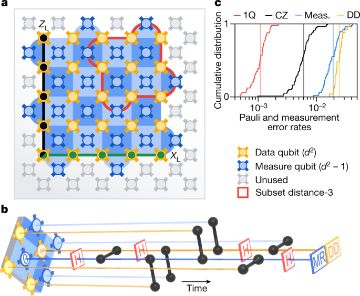
Three-panel paper figure: a drawing of the 72-qubit Sycamore superconducting chip as a square grid, with 25 gold data qubits and 24 blue measure qubits forming a distance-5 surface code and a red outline marking a smaller distance-3 patch; the repeating gate circuit along a time axis; and error-rate distributions for gates, measurement and idling. From Google Quantum AI, Nature 614, 676 (2023). Notice the measure qubits between data qubits: they repeatedly check neighbours for errors without reading the data directly.“Fig. 1 — Implementing surface code logical qubits (schematic of a 72-qubit Sycamore device with distance-5 surface code)” by Google Quantum AI (Rajeev Acharya, Igor Aleiner, Richard Allen, et al.), www.nature.com/articles/s41586-022-05434-1, CC BY 4.0 (creativecommons.org/licenses/by/4.0/)Still frame from a video showing a two-chip stack under blue light: a small dark die mounted face-down on a larger mirror-like die whose fine lines fan out to its edges, resting on a machined aluminium pedestal. The caption says it comes from a Google video (2019-10-23) showing the Sycamore quantum processor. It illustrates flip-chip assembly of a superconducting processor: two dies are bonded face to face so wiring can run on a separate layer; the radial lines are those signal traces.“Google Sycamore Chip 001” by Google (www.youtube.com/channel/UCK8sQmJBp8GCxrOtXWBpyEA), commons.wikimedia.org/wiki/File:Google_Sycamore_Chip_001.png, CC BY 3.0 (creativecommons.org/licenses/by/3.0/)