Fibre links between photonic modules ic_fibre
Telecom fibre carrying heralded entanglement between photonic chips and racks — priced per connector, not per metre, and with no published rate.
Fibre links between photonic modules
Chip-to-chip Bell 99.72% over 42 m (loss excluded); Aurora inter-rack fibre.
Brief →Key references
Design space — attributes
- (a) carrier affinity
- photon (natural particle, engineered modes)
- (b) time · entangling
- —
- (c) readout
- —
- (d) mobility
- flying qubits (photons)
- (e) control
- electro-optic @ room temperature
- (f) error structure
- loss (erasure)
- (g) manufacturing
- photonic IC foundry
Evaluation space — dated attributes
Facet coupling is quoted on two different bases: Xanadu 0.085 dB/facet [C] against PsiQuantum's published 52(12) mdB [D] for the same interface.
Actors & goals — annotations
Edges
Used by 4 machines (2 primary · 2 alternate)
- photonics 4
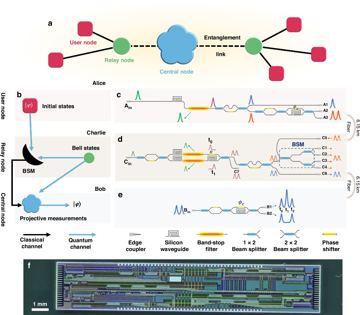
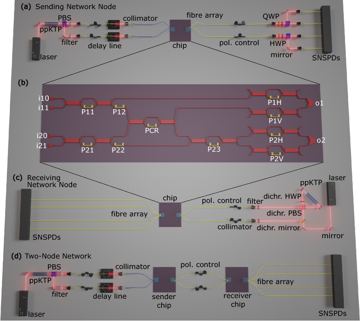
- Omega chipset (Moreton Bay / Chicago systems unnamed) PsiQuantum paper product page press ▣ Fig. 3b,g (chip-to-chip qubit interconnect); Fig. 5c (fibre-to-chip) ✅
- Aurora Xanadu paper press link ▣ Fig. 2 (fibre cabling and delay modules across racks) ✅
- Belenos Quandela product page press ◌ 🔎 (alternate)
- Lucy Quandela press ◌ 🔎 (alternate)
Pictures
Every picture carries the story of what it shows and its credit line.

Fibre links between photonic modules
Telecom fibre carrying heralded entanglement between photonic chips and racks — priced per connector, not per metre, and with no published rate.
Verdict. Real: 99.72% chip-to-chip Bell fidelity over 42 m (PsiQuantum, 2025), the fibre span itself costing ~8 mdB. Unproven: any inter-module entanglement rate. Demote if none is published by 2028.
Λ = error-suppression factor per code-distance step; QBI = DARPA Quantum Benchmarking Initiative (Stage A concept → B R&D plan → C government V&V); G1–G7 = the report's goal classes (see Actors & economics).
Identity & lineage
Commodity telecom single-mode fibre carrying single photons or heralded entangled pairs between photonic chips, racks or modules. PsiQuantum published chip-to-chip Bell fidelity 99.72 ± 0.04% over 42 m in Omega D[169]; Aurora networks 35 chips over fibre at ~14 dB total loss D[173]. The same physics underwrites metropolitan entanglement distribution, where rates are published. Attributes: flying photons, no deterministic timing, loss-dominated error; room-temperature electro-optic interfaces, photonic-IC fibre coupling.
Physics & limits
Attenuation is not the binding term at machine scale. Forty-two metres at 0.2 dB/km is ~8 mdB, while the two fibre-to-chip transitions bracketing it cost 52 ± 12 mdB each D[169] — ~104 mdB, a fifth of a ~0.5 dB per-photon budget, spent on connectors rather than span. Modularity here is priced per interface, unlike matter-qubit links. What distance costs is time: 42 m is ~206 ns one way at group index 1.47, longer than the best 2026 feed-forward electronics, so separation eats the decision budget before the loss budget. Rate is the term no computing vendor publishes, and its exchange against loss is brutal: 0.7 coincidences/s through 66 dB of metropolitan fibre versus 132/s on the 93 km leg P[791]. At rack-scale loss the ceiling reverts to source brightness and multiplexing depth.
Engineering state of the art
table
| Date | Figure | Who | Tag |
|---|---|---|---|
| 2025-01 | 35 chips networked over fibre, ~14 dB total loss | Xanadu | D[173] |
| 2025-02 | Chip-to-chip Bell fidelity 99.72 ± 0.04% over 42 m | PsiQuantum | D[169] |
| 2025-02 | Fibre-to-chip coupling 52 ± 12 mdB | PsiQuantum | D[169] |
| 2026-06-10 | Edge coupling 0.085 dB/facet, claimed a benchmark | Xanadu | C[172] |
The 2026 benchmark claim does not survive comparison: PsiQuantum's 52 mdB is ~39% lower at the same interface a year earlier D[169]C[172]. Fidelity is past 99.7%; the missing number is throughput.
PsiQuantum's 99.72% chip-to-chip Bell fidelity has no independent replication. The ~206 ns per 42 m latency and the ~104 mdB two-interface cost are derived from published figures, not measured.
Manufacturing, materials & supply chain
No new fabrication: fibre, connectors and edge-coupled arrays are commodity telecom, with Corning fibre arrays and DISCO singulation behind Xanadu's coupling figure C[172]. The scaling variable is attachment count: every module boundary is two attachments, each a yield event and a 52 mdB loss event, so at 10³ modules packaging throughput sets the build rate; at 10⁴ bundle volume and timing calibration bind; nothing addresses 10⁶. I/O burden sits upstream, in the source and the fusion measurement. The machine falls under BIS ECCN 4A906 only if its qubit count and C-NOT error land in one of the rule's bands, from 34–99 qubits at ≤ 10⁻⁴ to any error from 2,000 qubits fact.
Role in the stack
Two photonic architectures depend on it — fusion (PsiQuantum, Quandela, QuiX) and continuous-variable/GKP (Xanadu) — to scale past one chip's mode count, contributing ~0.21 µs per 42 m to the derived clock, comparable to the whole feed-forward term. Verification: the 99.72% is a conditional Bell fidelity on heralded events, channel loss excluded D[169], so it says nothing about link efficiency, and it is single-source as of 2026-09-04.
Actors & economics
Who.
| Organisation | Role | Country | What they do | Evidence |
|---|---|---|---|---|
| PsiQuantum | developer | US | Highest published chip-to-chip Bell fidelity over 42 m | D[169] |
| Xanadu | developer | CA | 35-chip fibre-networked system; coupling benchmark | D[173] |
| Quandela | developer | FR | Fielded 12-qubit Lucy coupled to Joliot-Curie HPC | C[792] |
| Corning | supplier | US | Fibre arrays for photonic chip packaging | C[172] |
Money.
2025-09-10 · PsiQuantum · Series E · USD 1 B at USD 7 B · BlackRock, Temasek, Baillie Gifford · closed Cfact
2026-03-26 · Xanadu · SPAC merger · ~USD 302 M gross, ~40% below plan · Crane Harbor · closed Cfact
2026-05-21 · PsiQuantum · CHIPS letter of intent · USD 100 M · US Commerce · LOI fact
Market & supply chain. Fibre and connectors are commodity; the concentrated input is precision fibre-array attachment, where Corning and a few packaging houses set loss and throughput alike. No cost per link is public. Pays for G3/G4, G6.
IP & standards. No dated patent family specific to inter-module photonic fibre linking surfaced as of 2026-09-04; ETSI QKD standards govern the physical layer, no computing-side interconnect standard exists.
Roadmaps & track record. PsiQuantum's 99.72% is unchanged since 2025-02, its 2026 progress visible only through DARPA V&V D[169]. Xanadu marketed a coupling benchmark it does not hold C[172]. No actor has published a dated inter-module rate target — a roadmap gap, not a slipped promise.
Strategic reading. While rate stays unpublished, every photonic logical-qubit roadmap rests on an unaudited number and buyers cannot compare vendors. Whoever publishes fidelity and rate together sets the benchmark; packaging houses, not chip designers, capture the margin, since loss and yield live at the connector.
Outlook & open questions
Confirm by 2028: a vendor publishing an inter-module rate with its fidelity; demote if the field still reports fidelity alone. Best case 2029: multiplexed links close a stated rate gap at rack scale. Worst case: rate stays unmeasured. Open: is 99.72% reproducible outside PsiQuantum; does multicore fibre help inside a machine.
References
- [169] K. Alexander et al., “A manufacturable platform for photonic quantum computing,” Nature, vol. 641, no. 8064, pp. 876–883, Feb. 2025, doi: 10.1038/s41586-025-08820-7. D
- [172] Xanadu, “Xanadu sets new industry benchmark in photonic chip packaging,” PR Newswire, Jun. 10, 2026. [Online]. Available: https://www.prnewswire.com/
news-releases/ Cxanadu-sets-new-industry-benchmark-in-photonic-chip-packaging-302796562.html - [173] H. A. Rad et al., “Scaling and networking a modular photonic quantum computer,” Nature, vol. 638, no. 8052, pp. 912–919, Jan. 2025, doi: 10.1038/s41586-024-08406-9. D
- [791] J. Du et al., “Entanglement distribution over 155 km metropolitan fiber using a CMOS-compatible silicon chip,” arXiv:2409.17558, Sep. 2024. P
- [792] M. U. Rehman, “Quandela Deploys Photonic Quantum Computer Integrated with HPC System,” The Quantum Insider, Apr. 14, 2026. [Online]. Available: https://thequantuminsider.com/
2026/ C04/ 14/ quandela-photonic-quantum-hpc/