Zuchongzhi 3.0
USTC / Hefei National Laboratory
Zuchongzhi 3.0
Профиль реестра — вариант архитектуры у этой машины (поля реестра — на английском)
тип кубита: tunable transmon, tantalum-aluminium on sapphire
механизм вентиля: tunable coupler CZ-family; 1Q 28 ns, 2Q 45 ns
связность: rectangular lattice, average connectivity 3.5
управление: room-temperature RF
размещение управления: room-temp
считывание: dispersive
свидетельство вентиля: число, названное производителем, без протокола
флаги: оценочная база
Технологии по слоям — ячейка машины на каждом слое
| 1 Носитель кубита | |
| 2 Кодирование | «Голый» физический кубит (без кодирования) · основная ◌ 🔎 Bare two-level subspace — Computational subspace of an anharmonic oscillator; leakage to |2⟩ is the price. |
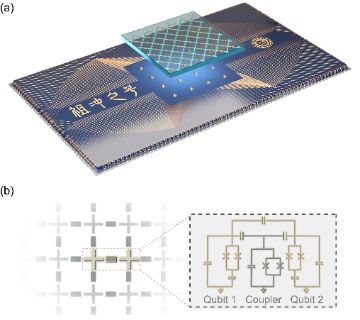
| 3 Механизм вентиля | CZ / iSWAP через перестраиваемый элемент связи · основная ▣ Fig. 1c (two qubits via coupler); §II ✅ tunable couplers (182), CZ-family; 1Q ≈28 ns, 2Q ≈45 ns; parallel 1Q 99.90%, 2Q 99.62% (Mar 2025) |
| 4 Связность / транспорт | Статическая решётка со связью ближайших соседей · основная ▣ Fig. 1b (qubit/coupler topology) ✅ 15×7 rectangular lattice with 182 tunable couplers; average connectivity ≈3.5 |
| 5 Управление | Электроника при комнатной температуре + коаксиальный / гибкий кабель на кубит · основная ▣ Fig. 1a (control lines on second chip); §II (wiring attenuators) ✅ room-temperature RF |
| 6 Считывание | Дисперсионное СВЧ-считывание (+TWPA, фильтр Парселла) · основная ▣ Fig. 1a (readout resonators on second chip); §II ✅ dispersive; readout 99.18% (arXiv) / 99.13% (USTC release), sources conflict |
| 7 Код | — none — в этом слое ничего нет ▤ §III (large-scale random circuit sampling) ✅ no QEC code run on 3.0 (NISQ); RCS 83 q × 32 cycles, 10⁶ samples in a few hundred seconds; surface-code d=7 work stated separately |
| 8 Декодер | |
| 9 Межсоединение | Многокристальная сборка в одном модуле (flip-chip, bump-bonding с управляющим кристаллом) · основная ▣ Fig. 1a (two sapphire chips, flip-chip) ✅ flip-chip: two chips bonded face-to-face, separating qubit layer from routing; one module, no inter-module interconnect |
| 10 Производство | Литография сверхпроводниковых кубитов (переходы Al/AlOx/Al, разводка из Nb, 300 mm) · основная ▤ §II (fabrication procedure) ✅ |
Стандартные рекорды
степень связности → 3.5 neighbours · typical (mean)
Mar 2025 · источник
ошибка двухкубитного вентиля при параллельной работе всей ширины → 3.80e-3 · typical (99.62% parallel 2Q)
Mar 2025 · источник
ошибка SPAM → 8.20e-3 · typical (readout error; sources give 8.2e-3 and 8.7e-3)
Mar 2025 · источник
T1-релаксация → 72 µs · типичное
Mar 2025 · источник
время однокубитного вентиля → 28 ns · лучшее
Mar 2025 · источник
когерентность T2 (эхо/DD) → 58 µs · типичное
Mar 2025 · источник
источники: ✅ 8 / 10
Иллюстрации
У каждой иллюстрации — рассказ о том, что на ней, и строка авторства.