Helios
Helios
Профиль реестра — вариант архитектуры у этой машины (поля реестра — на английском)
тип кубита: hyperfine clock states of Ba-137, chosen because its transitions are visible-wavelength
механизм вентиля: laser Molmer-Sorensen RZZ(pi/2); arbitrary-angle ZZ; 8 high-fidelity gate zones, up to 8 two-qubit gates in parallel
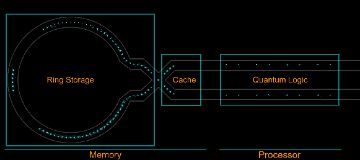
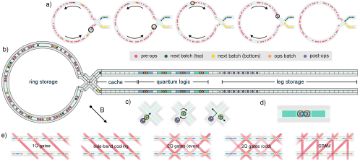
связность: QCCD on a ~15 mm surface-electrode chip with a four-way X-junction and a ring-shaped rotating storage loop; all-to-all by transport
управление: room-temperature electronics; 1,228 trap electrodes driven by 273 independent voltages (~2.8 control signals per qubit); shared time-multiplexed lasers, >=5 wavelengths (515 nm gates; 493, 614, 650, 1762 nm) delivered as focused free-space beams propagating parallel to the chip surface
размещение управления: room-temp + free-space optics
считывание: fluorescence, destructive per ion; mid-circuit measurement and reset with microsecond-latency conditional branching
свидетельство вентиля: число, названное производителем, без протокола
режим декодера: офлайн — синдромы декодируются после прогона
коды: iceberg, many_hypercube, stab_16_4_4, stab_4_2_2, steane, stellated_dodecahedron_css
флаги: нет идентификатора кода в реестре, противоречивые заявления, оценочная база
Технологии по слоям — ячейка машины на каждом слое
| 1 Носитель кубита | Ион в ловушке · основная ▣ Fig. 1 (98-ion image in 2-D trap); §Ion species: qubit and coolant ✅ 98 ¹³⁷Ba⁺ qubit ions (¹⁷¹Yb⁺ co-trapped as coolant); Ba chosen for visible-wavelength transitions (493/614/650/1762 nm), removing Yb's UV laser stack |
| 2 Кодирование | Сверхтонкий кубит / кубит на часовом переходе · основная ▤ §Ion species: qubit and coolant ✅ hyperfine clock states |F=1,m_F=0⟩ / |F=2,m_F=0⟩ of ¹³⁷Ba⁺ |
| 3 Механизм вентиля | Вентиль Мёльмера–Соренсена / на световом сдвиге (лазерный) · основная ▣ Fig. 2d,e (4-ion crystal alignment, 2Q gate beams); Methods: Quantum operations ✅ laser MS RZZ(π/2), arbitrary-angle ZZ; 2Q infidelity 7.9(2)×10⁻⁴ across all pairs, 1Q 2.5×10⁻⁵; t_2q ≈ 70 µs; 8 gate zones in parallel (Jun 2026) |
| 4 Связность / транспорт | Перемещение ионов (QCCD, перекрёстки, решётчатые ловушки) · основная ▣ Fig. 2a–c (ring storage, cache, junction transport); Fig. 3 (time per layer) ✅ QCCD on ~15 mm 2-D surface-electrode chip, four-way X-junction + rotating ring storage loop; all-to-all by transport, degree 97; ~55 ms per circuit layer |
| 5 Управление | Свободнопространственная лазерная адресация ионов (пучки АОМ/АОД) · основная ▤ § Optical delivery ✅ focused free-space laser beams propagating parallel to the chip surface; ≥7 wavelengths across 8 zones Лазерное управление с интегральной фотоникой (ионы) · альтернатива ▦ 🔎 integrated photonics: direction (Quantinuum roadmap), not used on Helios |
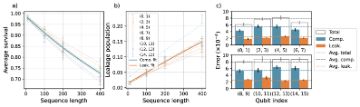
| 6 Считывание | Детектирование состояния по флуоресценции (ионы, дефекты) · основная ▣ Fig. 4a,b,i (SPAM and MCMR component errors) ✅ fluorescence, destructive per ion; SPAM infidelity 3.3(5)×10⁻⁴ (Nature; secondary 4.8×10⁻⁴); mid-circuit measure + reset with µs-latency branching |
| 7 Код | Высокоскоростные каскадные коды с трансверсальными вентилями · основная ▤ ✅ [[20,2,6]] C₄-Helix (Sep 2026); iceberg [[2m,2m−2,2]] concatenated to d=4: 94 error-detected / 48 error-corrected logical from 98 physical Цветовой код (трансверсальные клиффордовы вентили) · альтернатива ▤ 🔎 no colour-code result named for Helios in the note; codes run are iceberg/[[4,2,2]] concatenations and C₄-Helix Коды обнаружения ошибок ([[4,2,2]], поверхностный d = 2, iceberg, пространственно-временные) · альтернатива ▤ Abstract ✅ iceberg [[k+2,k,2]] detection codes and two-level concatenated iceberg [[(k2+2)(k1+2),k2k1,4]] on 98-qubit Helios: 48–94 logical qubits beyond break-even, with post-selection Фабрика магических состояний (культивация / дистилляция / переключение кодов) · альтернатива ▤ 🔎 no magic-state result named for Helios in the note; logical gates cycle-benchmarked at ~10⁻⁴ (Mar 2026) |
| 8 Декодер | GPU-декодирование через NVQLink · основная ▤ 🔎 GPU real-time QEC via CUDA-Q QEC over NVQLink: BP-OSD median 67 µs round trip, 5.4× LER gain; record results decoded offline with Frontier MWPM / Sparse Blossom (+коррелированное паросочетание) · альтернатива ▤ 🔎 alternate; record decoding uses Frontier (offline), real-time uses GPU BP-OSD; no matching result named in the note |
| 9 Межсоединение | — none — в этом слое ничего нет ◌ 🔎 single module — no ion–photon link on Helios; ic_ionphoton is Quantinuum's stated future path but nothing is built |
| 10 Производство | Изготовление ионных ловушек (планарные чипы; фрезерованные 3D ловушки-лезвия) · основная ▤ §QPU architecture and ion trap design 🔎 in-house surface-electrode microfabrication; ~15 mm 2-D chip with 1,228 electrodes; cryogenic surface trap Оптическая / механическая сборка (лазеры, вакуум, объективы) · альтернатива ◌ 🔎 room-temperature optical bench; 515 nm gate light and 493/614/650/1762 nm SPAM light delivered through the trap; 1762 nm cavity-locked |
Стандартные рекорды
степень связности → 97 neighbours · best (all-to-all by transport)
Nov 2025 · источник
ошибка двухкубитного вентиля при параллельной работе всей ширины → 7.90e-4 · typical across all pairs with 8 zones active
Jun 2026 · источник
линий управления на кубит → 2.79 lines/qubit · typical (273 voltages / 98 qubits)
1,228 trap electrodes · Nov 2025 · источник
ошибка SPAM → 3.30e-4 · лучшее
a secondary analysis gives 4.8e-4 · Jun 2026 · источник
задержка декодирования за раунд → 67 µs · typical (BP-OSD median on a GH200 over NVQLink)
5.4x LER gain · 2026 · источник
транспорт на слой вентилей → 55 ms · typical (average time per circuit layer)
~5e4x a superconducting 1.1 us cycle · Jun 2026 · источник
источники: ✅ 8 / 16
Иллюстрации
У каждой иллюстрации — рассказ о том, что на ней, и строка авторства.