40-ion Ba-133 qLDPC testbed (IonQ: a Tempo engineering test system)
40-ion Ba-133 qLDPC testbed (IonQ: a Tempo engineering test system)
архитектура: Ионы в ловушках — линейная ловушка Пауля с индивидуальной лазерной адресацией · Открыть на карте
Профиль реестра — вариант архитектуры у этой машины (поля реестра — на английском)
тип кубита: Ba-133 hyperfine
механизм вентиля: laser Molmer-Sorensen
связность: all-to-all through the chain's motional bus
управление: room-temperature electronics + free-space laser addressing
размещение управления: room-temp + free-space optics
считывание: fluorescence
свидетельство вентиля: опубликованной цифры нет
режим декодера: офлайн — синдромы декодируются после прогона
коды: generalized_bicycle, qcga, rotated_surface, stab_16_4_4, stab_4_2_2, toric
флаги: code params inferred, результат определяется постселекцией
Технологии по слоям — ячейка машины на каждом слое
| 1 Носитель кубита | Ион в ловушке · основная ▣ Fig. 1 (ion trap, Raman beams steered by AODs) ✅ 40 ¹³³Ba⁺ ions in one stationary chain; physical coherence 1.1±0.3 s; lab-only testbed (Jun 2026) |
| 2 Кодирование | Сверхтонкий кубит / кубит на часовом переходе · основная ▤ §II (Mid-circuit measurement) 🔎 ¹³³Ba⁺ ground-state hyperfine qubit; family-determined, no machine-specific encoding source |
| 3 Механизм вентиля | Вентиль Мёльмера–Соренсена / на световом сдвиге (лазерный) · основная ▣ Fig. 1 (counter-propagating Raman gates); Figs. 4–5 (MS gate DRB); App. C ✅ laser Mølmer–Sørensen entangling gates across the 40-ion chain |
| 4 Связность / транспорт | Шина на колебательных модах ионной цепочки (все со всеми в цепочке) · основная ▣ Fig. 1 (Tanner graphs of required 2Q connectivity); App. F Qubit mapping ✅ all-to-all through the chain's motional bus (degree 39); eight codes in three families run with no hardware reconfiguration (nine in the June version) |
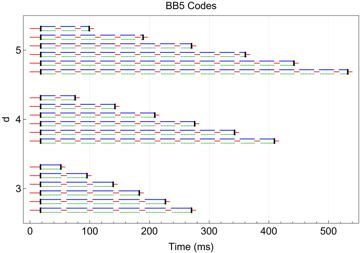
| 5 Управление | Свободнопространственная лазерная адресация ионов (пучки АОМ/АОД) · основная ▣ Fig. 1 (Raman beams steered with AODs); Fig. 10 (gate/MCM schedule) ✅ room-temperature electronics + free-space laser addressing |
| 6 Считывание | Детектирование состояния по флуоресценции (ионы, дефекты) · основная ▣ Fig. 1 (OMG-based MCM sequence); §II; Fig. 6 (leakage detection/rejection) ✅ fluorescence readout with leakage detection; ~75 % post-selection rejection for the larger codes |
| 7 Код | Нелокальные qLDPC-коды (bivariate bicycle, «gross») · основная ▣ Fig. 2 (BB5/GB4 survival vs syndrome cycles); §III; App. A Code definitions ✅ eight codes in three families on one device (nine in the June version); break-even within error bars (logical 3.95±0.68 s in one code vs physical 3.84±0.48 s = 3 T₂*, arXiv version of 14 Sep 2026; the June version gave 3.3±0.9 s); BB5 [[18,4,3]] 4× X / 9× Z below the prior superconducting BB run |
| 8 Декодер | — (пробел Атласа: ∅G-beam) · основная ▤ §III (Quantum memory experiments) 🔎 beam-search decoder (Delfosse) for the qLDPC codes, run offline; no Atlas node for search decoders |
| 9 Межсоединение | |
| 10 Производство | Изготовление ионных ловушек (планарные чипы; фрезерованные 3D ловушки-лезвия) · основная ◌ 🔎 surface-electrode ion-trap microfabrication; family-determined, no machine-specific fab source |
Стандартные рекорды
доля принятых → 0.25 · typical for the larger codes (~75% rejection)
Jun 2026 · источник
когерентность T2 (эхо/DD) → 4.0 s · best (logical lifetime, one code per the abstract)
physical baseline on the same device 3.84 ± 0.48 s (= 3 T₂*; arXiv version of 14 Sep 2026; 3.3 ± 0.9 s in June) · Sep 2026 · источник
источники: ✅ 6 / 10
Иллюстрации
У каждой иллюстрации — рассказ о том, что на ней, и строка авторства.